The Law Must Be Enforced, Or Chaos Will Engulf The Weak
In cities like Portland, Seattle, Philadelphia and Minneapolis, there seems to be an almost pathological aversion to the enforcement of laws that result in the arrests and convictions of certain property crimes less than a set dollar amount and a complete refusal to cooperate with federal immigration authorities to enforce immigration law.
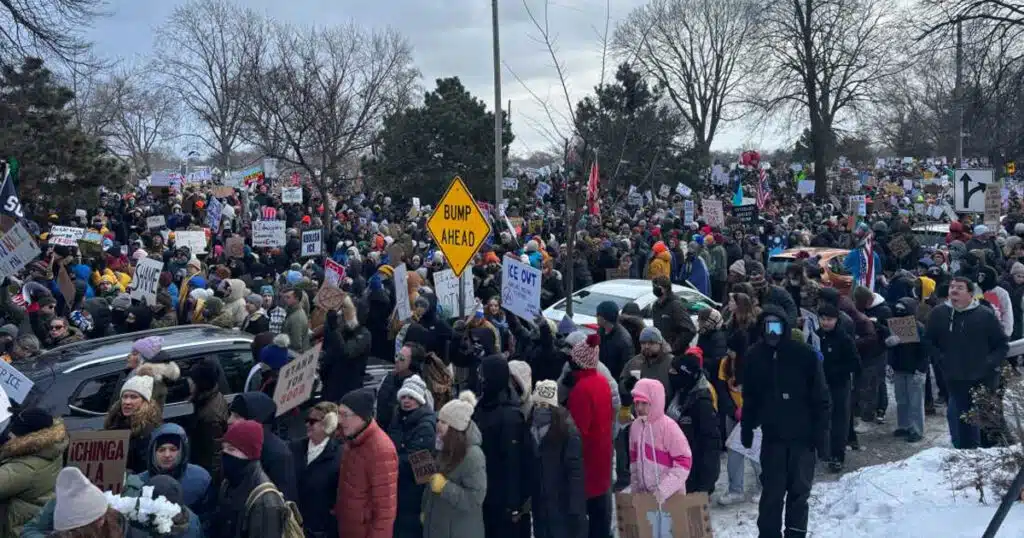
Jacob Frey, mayor of Minneapolis, stated yesterday that Minneapolis is a safe city because there have only been two fatal shooting this year, and one of them was an ICE agent shooting an alleged agitator when she drove her vehicle at him. His performative outrage was comedic, especially since “this year” was only 9 days old at the time of the statement.
That is not uncommon—in many of America’s largest Democrat-controlled cities, public officials insist that the breakdown of order is either exaggerated or misunderstood. Crime statistics are debated, definitions adjusted, and responsibility diffused across historical grievances and structural inequities. Yet for residents and small businesses living amid persistent disorder, the lived reality is unmistakable: laws still exist on paper, but enforcement has become conditional, selective, and often absent altogether.
This did not happen by accident. Nor is it merely the product of budget constraints, staffing shortages, or pandemic aftershocks. It reflects the quiet triumph of a governing philosophy that treats law itself with suspicion—an outlook rooted in radical traditions that view legal systems not as neutral frameworks for social cooperation, but as instruments of domination wielded by an oppressor class.
This idea has a long pedigree. Nineteenth-century anarchists argued that law primarily served property and power. Marxist theorists extended that critique, recasting criminal law as a mechanism for disciplining labor and preserving class hierarchy. In the twentieth century, critical legal theory refined the claim further, asserting that neutrality in law is a myth and that unequal outcomes are proof of systemic injustice rather than differences in behavior. While contemporary city officials rarely cite these sources, their assumptions now animate policy.
The result is not the abolition of law, but its selective disarmament. Rather than repeal statutes through democratic processes—which would require persuading voters—many cities have embraced non-enforcement as a substitute. Theft below a set dollar threshold is functionally decriminalized. “Quality-of-life” offenses are ignored. Drug possession and public disorder are redirected into diversion programs that impose little or no consequence. The law remains on the books, but its deterrent force is intentionally blunted.
This approach is often justified as compassion. Arrest, we are told, is itself a form of harm. Prosecution perpetuates inequality. Deterrence is dismissed as a relic of a punitive past. In this framework, enforcement is not a tool for maintaining order but a moral failing—an act that reproduces injustice rather than prevents it.
Immigration policy reveals the same logic. Sanctuary policies are not simply expressions of federalism or resource prioritization. They are grounded in the belief that immigration law is inherently illegitimate—an expression of exclusionary power rather than democratic consent. Cooperation with federal authorities is therefore framed not as lawfulness, but as complicity. Active resistance becomes a moral duty.
What makes this governing philosophy particularly destabilizing is that it replaces rule-of-law legitimacy with outcome-based legitimacy. Classical liberal systems presume that equal rules, applied universally, generate fairness even when results differ. Today’s progressive governance reverses that presumption. If enforcement produces unequal outcomes, enforcement itself is treated as unjust. The behavior being policed is rendered secondary.
This inversion has predictable consequences. When theft below a threshold carries no penalty, it increases. When disorder is tolerated in the name of equity, it concentrates in neighborhoods least able to absorb it. When police are instructed to disengage, informal power fills the vacuum—whether in the form of street-level intimidation, organized retail theft, or open-air drug markets. The victims are not abstract. They are bus riders, shop owners, service workers, and residents who lack the means to insulate themselves from disorder.
Ironically, the costs of this experiment fall hardest on the very communities its architects claim to protect. Affluent professionals can rationalize non-enforcement as enlightened governance while outsourcing its consequences to others. This creates a two-tier civic reality: moral posturing at the top, lived insecurity at the bottom.
A recurring theme in radical left traditions stemming from 19th-century anarchism and Marxism, refined through 20th-century critical theory, is that government creates hierarchies and laws to justify its existence, defining “crime” in ways that oppress the underclass.
It is a bit of an oversimplification, but it could be said this way: creation of law is not necessary due to crime, crime is exists due to the creation of laws.
Defenders of the status quo insist that critics simply want harsher punishment or mass incarceration. That is a straw man. The real question is whether law exists to restrain power impartially or to redistribute power selectively. Once enforcement becomes a discretionary moral judgment rather than a predictable civic function, trust erodes—first in institutions, then in neighbors, and finally in the city itself.
Cities are not failing because they enforce laws too strictly. They are failing because they no longer believe, at a philosophical level, that law deserves enforcement at all. Until that premise is confronted, no amount of rhetorical compassion will restore the order on which urban life depends.