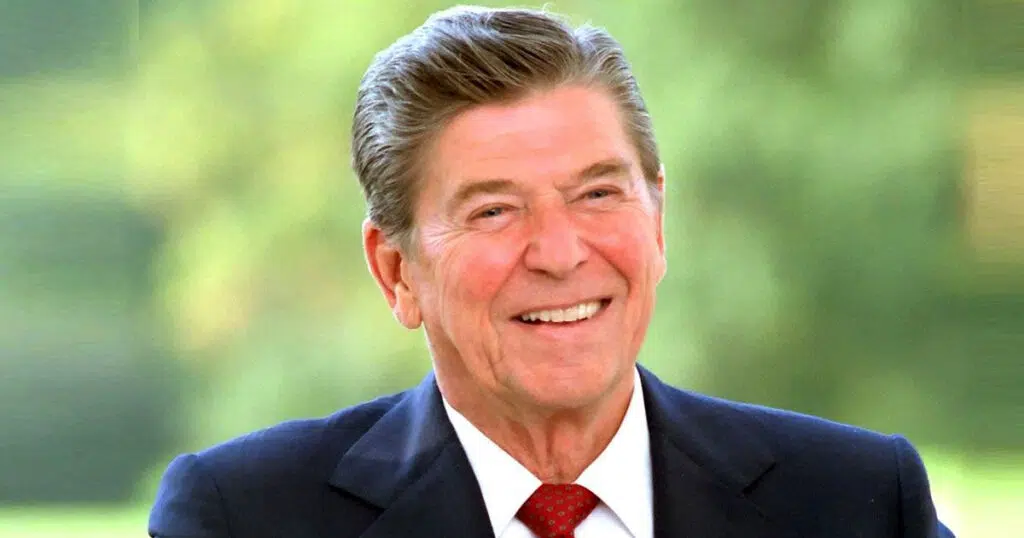
Faith Is Not Optional for Democracy—Ronald Reagan Knew Why
Ronald Reagan is remembered for many great speeches — from A Time for Choosing to his address at the Berlin Wall. In those moments, he spoke to the defining crisis of the generation: the struggle between American democracy and liberty and the Soviet Union’s “Evil Empire.”
Yet a lesser-known speech Reagan delivered at the centennial celebration of the Knights of Columbus (KofC) — the world’s largest Catholic fraternal organization — on Aug. 3, 1982, in Hartford, Conn., speaks powerfully to today’s moral conflict: that the preservation of American democracy rests not primarily on economic or military strength, but on a moral and religious people.
Reagan had familial ties to the KofC. His father Jack, who was Catholic, had been a Knight. The president, on the other hand, grew up in the Disciples of Christ and later attended Presbyterian services as a “born-again” Christian. As such, faith and prayer formed the pillars of his conservative values, which were woven throughout many of his addresses. The Aug. 3 speech was no exception; nevertheless, his remarks that day coalesced the intrinsic connection between freedom, limited government, and man’s inherent dignity.
In his remarks, Reagan lauded the KofC’s civic engagement as “unrivaled in its dedication to family, community, country, and church.” He clearly admired the organization’s charitable outreach and advocacy — particularly on social justice, pro-life issues, and opposition to communism.
Founded by Father Michael McGivney, a Connecticut-priest on the path to canonization, “much good has flowed” from the KofC, Reagan told the crowd, adding, “And your corporal and spiritual works of mercy for those in need are both a legend and an example to your countrymen” in the United States and abroad. In fact, in 1981, the Order — as it is known by Knights — contributed more than $41 million and 10 million hours of community service.
These works, inspired by a Christian sense of duty, exemplified the “vital part of our national political dialog,” the president asserted. Yet Reagan recognized faith as more than an impetus for civic engagement; but as the “rationale for our own daring notions about the inalienable rights of free men and women.”
“This faith in the dignity of the individual under God is the foundation for the whole political experiment,” Reagan continued. “It is central to our national politics.”
The Founding Fathers unequivocally forged a new nation based on this theological and philosophical truth, as evident in the Declaration of Independence that “all men are created equal, that they are endowed by their Creator with certain unalienable Rights.” Without this moral framework, borne from the Judeo-Christian tradition as Reagan suggested in his speech, democracy and the freedoms enshrined in the U.S. Constitution and Bill of Rights are merely words devoid of meaning on old parchment. As Reagan explained:
“These things that are publicly discussed still remain the foundation for our concepts of social justice, our political system, our very way of life. They are the values that ennoble man, making him something more than just the plaything of hedonism or the vassal of dictatorship; they entitle him to personal dignity and to the individual liberty and representative government that dignity enjoins.”
Communism, by contrast, devalued human life, imprisoning souls under the “darkness of godless” rule — a reality evident in the untold millions sacrificed by the “warmth of collectivism.”
Yet in 1982, Reagan spoke to a more religiously homogeneous audience of more than 10,000. At the time, generally, most Americans identified with a specific religious affiliation — which had been predominantly Christian — and regularly attended church services. Civic participation followed naturally from those commitments.
Since then, however, due to a confluence of contributing factors, such as a lack in catechesis, scandals, and the rise of secularization, the U.S. religious landscape has endured a precipitous decline. Moreover, more citizens are religious unaffiliates — otherwise known as “nones.” And while experts and pundits weigh the prospects of an emerging spiritual revival among Gen Zers, recent data suggests that there is “no clear evidence” of this phenomenon, at least at-large.
Some would argue the collapse in American religiosity is progressive, while criticizing religion’s import in society as reeking of moral arrogance (i.e., one need not be religious to be ‘good’).
However, this view neglects the historical reality and current sociological data.
In Dominion: How the Christian Revolution Remade the World, historian Tom Holland notes that the West has been, and continues to be, “utterly saturated by Christian concepts and assumptions,” adding, “So profound has been the impact of Christianity on the development of Western civilisation that it has come to be hidden from view.” Shaped within this ancestral lineage, the early colonists and Founding Fathers established a new nation inherently based on Christian principles — though not necessarily as a Christian nation, per se.
Still, religiosity and pursuing virtue are the bedrocks of social and political order. Freedom cannot exist without this “formulation,” as Reagan warned, even though this “simple truth” is often “overlooked in a society of high technology and mass communication and bewildering, everyday events.”
To those who insist on an absolute separation of church and state, Reagan offered a firm rebuttal: “We are supposed to have freedom of religion. Nothing in the Constitution says freedom from religion.” In other words, religion and democracy are not diametrically opposed, but dependent upon one another. Faith belongs in the public square.
Sociologically, the rise of secularization — and the closure of churches and civic associations — coincides with a persistent “happiness crisis” and other troubling mental health trends. People are more isolated and disconnected from community. Concurrently, not only has polarization intensified, but Americans’ confidence in the democratic system has been waning. Worse, younger demographics are alarmingly embracing illiberal ideologies like socialism and communism.
Coincidence, perhaps — but the parallel trends warrant serious reflection.
Ultimately, faith is not incidental to democratic self-government; it is essential. Reagan understood this truth — and based this conclusion on George Washington’s Farewell Address, in which the first president emphasized, “Of all the dispositions and habits which lead to political prosperity, religion and morality are indispensable supports.”
However, American religiosity — and thus, American democracy — is at a crossroads, ironically at the semiquincentennial. But ever the optimist, Reagan believed the country’s best days lay ahead even when confronted with an existential crisis. As he stated in his 1982 speech:
“Contrary to what followers of Marx and Lenin would have us believe, we’re not hopelessly buffeted by the tides and currents of history, for history is not the stuff of impersonal forces or unalterable laws. Free men and women, inspired by their deeply held beliefs and values, are capable of turning those tides of history and setting them running again in the cause of freedom.”
If Americans are to preserve democracy, the themes Reagan articulated in his 1982 speech must be renewed: faith, prayer, and civic engagement. The 250th anniversary of our country’s independence serves as an opportunity to inculcate history’s lessons and recommit to volunteerism. Whether through the charitable works Reagan praised or simple acts of faith and goodwill, the road to freedom runs through the human heart.
Although the heart can be fickle and fragile, much like freedom, therein also lies humanity’s immense zeal, strength, and wisdom when rooted in God.
May the faith of our fathers not fade from the New World, and may the hope Reagan prayed for — that all people might live in freedom — yet be fulfilled.
This article was originally published by RealClearReligion and made available via RealClearWire.