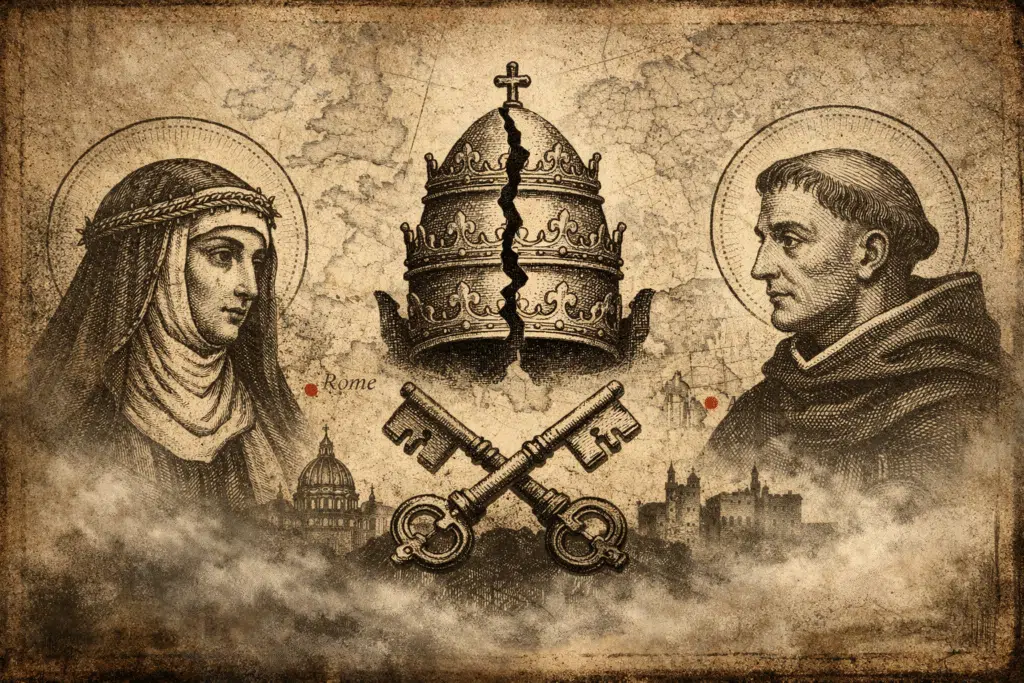
Saints Catherine of Siena and Vincent Ferrer—When ‘Obedience’ Turns Awkward
St Matthias the Apostle, the one who replaced Judas, whose feast day is today, pray for us.
The following isn’t even to get into the fact that the Church has never propped up “obedience” as the virtue to end all virtues. Faith, hope, and charity are, as we know from the Rosary. Thinking like this, as important as obedience is, is also how evil men like Saul Alinsky trick people. One of his thirteen rules for radicals is to make the people live up to their own set of rules.
For instance, one should never obey a contradiction, much less a litany of them, against established doctrine, dogma, and truth in Christ. Doing so breaks the Law of Non-Contradiction, a point on which the great St Thomas Aquinas among others opined.
The current Alinskian set of rules? For one, a great number of Catholics completely misunderstanding the Chair of Peter, and on the other, the connection between the keys of Peter and the keys of David in Old Testament times. This is the current of our time on which the great enemy of Genesis 3:15 seems to be capitalizing.
There are numerous examples we could present today that would make some of our current opinions on the matter inside the Catholic Church, let’s say, awkward. So do not assume the following is an outlier or even an exception to the pattern. This is what Christ taught would happen, going all the way back, by example, to the very choosing of his apostles.
St Catherine of Siena (1347–80), who is known for never hesitating to rebuke high-ranking clergymen and even the pope, threw her delicate but fiery weight behind Pope Urban VI. Seemingly contrary to her John the Baptist spirit, she once whispered: “Always obey the pastor of the Church, for he is the guide whom Christ has appointed to lead souls to Him.”
Such a quote from one of Catholicism’s greatest models—ignoring her numerous rebukes—undoubtedly provides the finishing touch for one tribe of Catholics in the current argument trending this week. See? the quote seems to say. Obey. Case closed. The problem is not a tiny one, however, and it goes well beyond how St Catherine’s actions often opposed the convenience of quotes ascribed to her. The real problem for such thinkers is that history has always refused to remain safe inside the sometimes-misleading package of cherry-picked lines.
Every Catholic should understand this, having experienced it with others throughout their lives.
St Catherine of Siena wasn’t wrong in this quote, but she could have been wrong about the claimant to the Chair of Peter–about Urban VI, that is.
The reason she could have been wrong? Another vaunted saint of the Church, St Vincent Ferrer–the Angel of the Apocalypse (what a saint!)–lived during St Catherine’s time. He was a fire-breathing preacher, a miracle-working Dominican, and a canonized saint who converted tens of thousands of antichrists to Christianity. And, lo and behold, as I understand it, he would have said essentially the same “obey the pastor” thing quoted above regarding Cardinals Sarah and Mueller.
…except for one, again, awkward detail.
He pledged allegiance to an antipope.
He even served as Benedict XIII’s confessor and theologian before later withdrawing his support, repenting, and doing grave mortification for any scandal he may have caused others because of his stance.
Here we are presented with a conundrum to the low-information Catholic: we’re stuck with a history where two sincere, great Catholics, one getting the papal legitimacy question right and one getting it wrong, have both been canonized as models to live by.
This means the fog of war is real, and it is a good idea to get serious about our faith lives this Lent.
It also drags “conscience” back onto the table, even if modern ears hear that word and immediately smell novelty and church choice like it’s a buffet line or a choice between Chevy and Ford. Yes, “conscience” gets abused by Modernists the way “freedom” and “liberty” get abused by politicians. But if the Revolt teaches anything, it’s that cherry-picked passages and Facebook memes don’t save the ark.
Precision and great care do.
Perhaps a third saint’s voice today, one who lived at the time of the Revolt, can provide fresh insight to the pleasure God likely feels with a soul sincerely, and doggedly, trying to do the right thing by both his Son and everything mapped out in relation to Apostolic Christianity in Acts. Cardinal Thomas Cajetan, writing in the sixteenth century, could cut a path to bring the tribes together:
If someone, for a reasonable motive, holds the person of the Pope in suspicion and refuses his presence, even his jurisdiction, he does not commit the delect of schism nor any other whatsoever, provided that he be ready to accept the Pope were he not held in suspicion. It goes without saying that one has the right to avoid what is harmful and to ward off dangers. In fact, it may happen that the Pope could govern tyrannically and that is all the easier as he is the more powerful and does not fear any punishment from anyone on earth.
In other words: suspicion is not schism, provided you’re not using it as a permanent hiding place for pride, provided you have spent at least a dedicated portion of your days sincerely seeking the truth about such things as the teachings of pre-conciliar popes, Modernism, Vatican II, the Alta Vendita, Leo XIII’s long version of the St Michael Prayer, Pius V’s Quo Primum, and so many other telling topics. There are folks that have opinions on this that spend exactly zero time studying their faith and its history; some of us may be wrong with where we stand in this story—which I have purposely not focused on out of charity and bridge-building—but at least we’ve devoted our lives to full repentance for our old wine and seeking first the kingdom of God and his justice, as the evangelist Matthew writes.
Consider which four souls stayed with Christ at the foot of the Cross.
Remember, this story is hardly a one-off. One only need consider St Paul’s rebuke of St Peter in the God-inspired Bible itself. Sometimes, especially because pride can get the best of even the most promising apostle, it is the laity–as deeply and regretfully sinful as we are–who must help right the ark.
Not by inventing doctrine, of course not.
But by knowing so much doctrine from your history, its documents, and its patterns that you know with full certainty, that wherever you be right and wherever you be wrong, this is a time in Church history where the sheep had better keep their eyes on the shepherd.
Or at least stay faithful to your Rosary every day—for the people on guard for everyone.
FURTHER READING
Gregory XVI and the Roots of Liberal Disorder
Catholicism: Clarity Amid the Camps