Watergate, Spygate, Deflategate, Pizzagate, And Now Penisgate
First, Happy Friday the 13th! Remember, it’s just a superstition; in fact, Friday the 13th has always been lucky for me. So, if you avoid ladders, black cats, and mirrors, it will be Valentine’s Day before you know it.
This year’s Olympics have fallen flat. When two skiers burst out of the starting gate, dissing America, and Lindsey Vonn’s comeback failed when she fell twice, the wind left my sails. We still have men’s and women’s hockey to look forward to, so hopefully some excitement and enthusiasm are still possible.
In the meantime, no Olympics are immune to controversy concerning some aspects of the competition, and this one is no exception. Being that it’s 2026, it’s not a surprise that the controversy is tinged with a touch of absurdity.
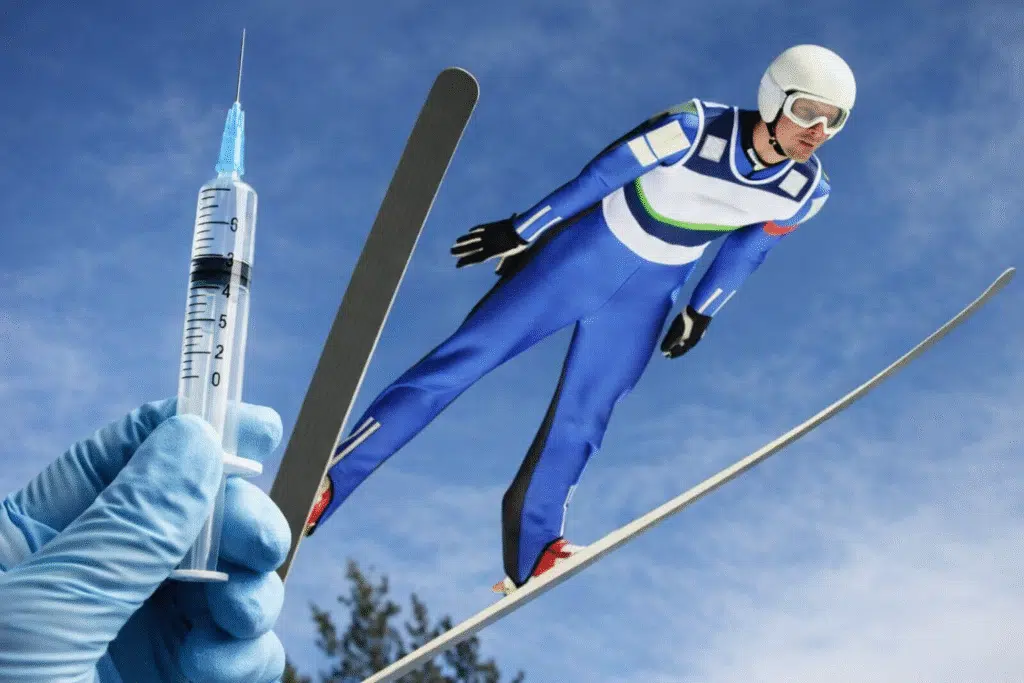
In this case, the controversy has been dubbed “Penisgate” because it involves ski jumpers gaining an advantage by adding extra material to the crotch area of their suits.
Allegedly, some competitive ski jumpers may have artificially enlarged their crotch area by injecting their genitals with an engorging chemical, hyaluronic acid, or stuffing their underwear to create bigger bulges. The German newspaper BILD was the first to report on this odd enhancement method, which is now under investigation by the World Anti-Doping Agency (WADA).
According to Prof Eric Chung, a urological surgeon, hyaluronic acid is a common filler used in cosmetic surgery, including injections being used for penile girth enlargement surgery.
Injecting a penis with hyaluronic acid would make it bigger girth-wise, “but you would need to inject a lot of hyaluronic acid,” says Chung, who was previously the leader of the andrology specialty advisory group for the Urological Society of Australia and New Zealand.
Hyaluronic acid is temporary in effect and requires a top-up every 6 to 12 months, depending on the particles’ absorption and migration.
Upon hearing this, my initial thought was probably the same as yours. Besides gaining locker room bragging rights, how would having an engorged penis enhance the ability to fly higher or further during a jump? Well, it turns out that the extra material in the crotch may improve aerodynamics, and in a sport where medals are often decided by centimeters, any advantage can be crucial.
According to the regulations set by the International Ski and Snowboard Federation (FIS), which oversees ski jumping, “crotch height” measurements for an athlete’s suit are taken using laser technology. This means that if an athlete’s crotch measurement is slightly larger at the time of measurement, they will receive a suit that is slightly roomier than it would be otherwise.
Suits must adhere strictly to body measurements within a tolerance of 2-4 cm. A 5 percent increase in surface area can provide extra lift, resulting in longer flights. In a sport where results are decided by centimeters or fractions of a point, minuscule differences in distance or suit measurements determine podium spots. A single centimeter of extra material on a suit can increase jump length by over 3 meters (9.8 ft), significantly impacting results.
Apparently, attempts to cheat are nothing new, but in the lead-up to the Olympics, they have become more blatant. Bruno Sassi, spokesman for the International Ski Federation, FIS, the sport’s regulatory body, said this about the situation.
“There have been disqualifications in the past, many. It’s part of the sport. But there had never been that kind of a brazen attempt to not only bend the rules, but like downright do something … to cheat the system in a way that it is very different from simply having a suit that is a tad too long or a tad too loose.”
“It has a huge impact,” says Lasse Ottesen, now race director for the Nordic Combined event at FIS and a former Olympic ski jumper. Athletes, coaches, and regulators are aware of the situation.
In January, prior to the “Penisgate” scandal gaining attention, several officials from Norway’s ski jumping team were temporarily banned from competition for altering athletes’ suits by adding extra stitching in the crotch area during last year’s Nordic World Ski Championships.
This incident went “way beyond what we have ever seen before,” according to Ottesen, who noted that the International Ski Federation (FIS) is working to refine ski jumping regulations. This includes ensuring that “everyone is measured in the correct way.”
The extra fabric has been compared to the patagium of a flying squirrel, the specialized, fur-covered membrane of skin that stretches between its front and hind limbs, from wrist to ankle. It functions similarly to a kite or parachute, turning a vertical jump into a horizontal glide.
Based on this information, it seems that women’s ski jumping has no such issues. On the bright side, we can also rest assured that there will be no transgenders crowding in on the women’s version of this sport.