Canada’s Trade Belligerence Should Cost Them Going Forward
Radical leftists are all delusional; it’s an integral part of their mental makeup. Which is why they are especially dangerous when they get any power at all. It’s bad enough having to deal with the Karens who tear up a McDonald’s because they didn’t get an extra packet of BBQ sauce, or getting dragged out of a Starbucks for knocking the hats off of customers wearing MAGA hats.
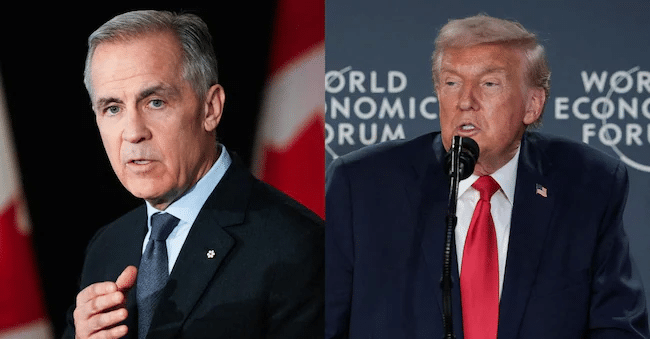
Mark Carney and his predecessor, Justin Trudeau, have both maintained an unjustified aura of arrogance and belligerence toward the United States. It’s as though these delusional lefties think that because they are north of America on the map, they have the right to look down their noses at the States.
That arrogance has led Carney and his minions to cling to the belief that President Trump wouldn’t dare dissolve the USMCA trilateral trade agreement between the U.S., Mexico, and Canada and negotiate separate bilateral pacts with each country. Canada knew this was going to happen for the last 16 months, but they have flat-out refused to accept it.
You can almost hear the Canadian knees knocking as they contemplate the prospect of negotiating a free trade agreement without the cover of a multilateral construct.
Their eyes are wide open now, though, because last week, Trump and Mexican President Claudia Sheinbaum held a phone call on the subject. After the call, Sheinbaum publicly shared the metrics behind it, which forced Canada to take their fingers out of their ears.
“There might be revisions that create bilateral deals instead of involving the three countries because some things are more important between Mexico and the United States or between Canada and the United States. Not everything has to be trilateral.”
The light bulb finally went on in Carney’s head as the idea began to register that President Trump was likely to overlook Canada and instead hold direct discussions with Sheinbaum. In response, Carney scurried off to Mexico to seek assurances from Sheinbaum that Mexico would consider Canadian interests before proceeding with any decisions.
Carney was trying to convince Sheinbaum to be on his team. During a phone call, President Sheinbaum diplomatically declined the Canadian partnership, as noted by President Trump.
The Canadians have also been engaging with U.S. media, trying to drum up sympathetic coverage related to trade agreements. However, in discussions between Canadian government officials and U.S. corporate allies, the sentiment from Team Trump is very clear.
Brian Clow is the former deputy chief of staff to former Prime Minister Justin Trudeau, who led Canada-U.S. affairs. He voiced his opinion, trying to portray Canada as the victim.
“The key thing that has struck me, and I think it has struck all Canadians, is so many of these guys in the Trump administration, frankly, they just hate Canada.”
Will someone please wave some smelling salts under Clow’s nose? Trump, nor his administration, hates Canada, although Canadian officials have done a magnificent job turning the general population of our neighbor up north against Trump and the U.S.
What Trump is tired of is the gaslighting that Canada has done concerning this border/trade issue. Before Trump initiated the new USMCA agreement with Mexico and Canada in his first term, Canada and its liberal leaders were exploiting the NAFTA agreement against the United States.
President Trump, Commerce Secretary Wilbur Ross, and U.S. Trade Representative Robert Lighthizer all agreed that the NAFTA agreement had significant problems. They believed it would be more effective to eliminate it and create two separate bilateral trade agreements: one between the United States and Mexico, and the other between the United States and Canada.
In the decades leading up to the 2017 efforts to renegotiate the trade pact, Canada had restructured its economy to achieve two main goals: (1) align with progressive climate change initiatives, and (2) take advantage of the loopholes in NAFTA. The Canadian government was not interested in engaging in a new trade agreement.
As part of this restructuring, Canada deindustrialized much of its manufacturing base to support the environmental aspirations of its progressive politicians. Consequently, Canada became an importer of component goods, which companies would then assemble into finished products for entry into the U.S. market without incurring tariffs. By collaborating with Chinese manufacturing companies, Canada successfully exploited the NAFTA loophole.
Not surprisingly, since all the benefits of this uneven field were leaning Canada’s way, Trudeau didn’t support renegotiating NAFTA, so he and Chrystia Freeland dug in their heels.
Trump was not impressed with Canada’s defiance and began bilateral negotiations with Mexico. Once the U.S. and Mexico agreed on the terms of the new trade deal and completed 80 percent of the agreement, representatives from the U.S. Chamber of Commerce informed Trudeau that his position was weak. They warned him that if the U.S. and Mexico finalized their deal, Canada would be left out.
The U.S. Chamber of Commerce was displeased because it was excluded from the agreement details between the U.S. and Mexico. In fact, the U.S. Chamber of Commerce was completely blocked from any participation.
When they approached the Canadians, the CoC warned them about the likely developments. They predicted that NAFTA would end, leading the U.S. and Mexico to establish a bilateral free trade agreement (FTA). Following this, Trump was expected to turn to Trudeau and declare that NAFTA was dead, prompting the need to negotiate a separate deal between the U.S. and Canada.
Trudeau was informed that a direct bilateral trade agreement between the U.S. and Canada would be the worst possible scenario for the Canadian government. Canada would lose access to the NAFTA loophole, and the country’s economy would no longer be in a strong position to negotiate against the size of the U.S. As a result, Trump would likely win every demand.
Following the warning, Trudeau ran to hide behind Nancy Pelosi’s skirt, looking for help. He wanted to determine whether Congress was likely to ratify a new bilateral trade agreement between the U.S. and Mexico. Pelosi warned Trudeau that there was considerable political support for eliminating NAFTA from both parties. Therefore, it seemed likely that the bilateral trade agreement would find support.
Realizing what was about to happen, Trudeau and Chrystia Freeland quickly changed their approach and began to request discussions and meetings with USTR Robert Lighthizer. It’s important to note that over 80 to 90 percent of the agreement had already been completed by the U.S. and Mexico teams. Both President Andrés Manuel López Obrador and President Trump were now openly discussing when the agreement would be finalized and signed.
Nancy Pelosi intervened to help Canada re-enter the agreement by leveraging support from her fellow Democrats. Trump agreed to allow Canada to engage, and Lighthizer consented to hold discussions with Chrystia Freeland on a trilateral trade agreement that ultimately became the USMCA.
When Trudeau was preparing to leave office, he admitted that Canada cannot function without all of the one-way benefits it receives from the USA. At that point, Trudeau didn’t care; he was on his way out the door, and being the liberal that he is, the problem was no longer his. That said, the Canadian arrogance didn’t leave with him, and the United States isn’t the only nation to see it.
Trump has a great relationship with Japanese Prime Minister Sanae Takaichi. That professional and personal relationship will become strategically important this year.
Japan’s economic and trade representatives have informed their Canadian counterparts that if the USMCA is dissolved and Canada loses its current trade access under the trilateral agreement, Japan will reconsider its entire investment portfolio in Canada, particularly in the auto sector.
Woops!
Japan is indicating that if the USMCA is eliminated, it may relocate all its cross-border manufacturing from Canada to the United States.
Prime Minister Mark Carney was recently questioned about statements from Japan, and he spoke nonsensically in circles about how Canada would use Chinese BYD electric vehicles to replace lost Toyota manufacturing. It’s a bad situation for Canada, and it’s not going to get any better.
It’s déjà vu again for Canada, as they are behaving the same way they did in 2017. On Friday:
“U.S Trade Representative Jamieson Greer and Mexican Secretary of Economy Marcelo Ebrard announced the first round of bilateral discussions in preparation for the Joint Review of the United States–Mexico–Canada Agreement (USMCA).”
“The ministers instructed negotiators to begin a scoping discussion on the necessary measures to ensure the benefits of the Agreement accrue primarily to the parties, including by reducing dependence on imports from outside the region, strengthening rules of origin, and enhancing the security of North American supply chains.”
“Ministers expect negotiators to hold the first meeting the week of March 16 and meet regularly thereafter as part of the Joint Review.”
President Trump is unlikely to renew a trilateral trade agreement that would allow Canada to continue exploiting its market access to the U.S. without reciprocating.
Canada’s last card to play is once again Congress. With Pelosi’s skirt unavailable, Carney is relying on the UniParty in Washington, D.C. to support him against President Donald Trump and prevent any attempts to end the USMCA.
Good luck with that. Dragging Canada to the negotiating table because they want to continue to screw the U.S. in trade is getting old. Carney, like Trudeau, is a liberal con man. He may be able to gaslight the Canadian citizens, but he can’t bullsh*t Trump.
The truth is that after the 2024 elections, Trudeau traveled to Mar-a-Lago and admitted that any trade agreement that would force reciprocity and/or balance economic relations on non-tariff issues would cause Canada to collapse economically and cease to exist. Trudeau was admitting that Canada could not survive as a free and independent North American nation without receiving all the one-way benefits from the U.S. economy.
President Trump then said that if Canada cannot survive in a balanced rules environment, including putting together its own military and defenses, then Canada should become the 51st U.S. state.
Trump knew what his statement would do. It hit Canada hard and shocked the government and its citizens. Trump’s stance on the outcome of the Canadian election was driven more by “America First” economic interests than by geopolitical alliances. When questioned about the election in Canada, President Trump stated:
“I don’t care. I think it’s actually easier to deal with a liberal, and maybe they’re going to win, but I don’t really care.”
The Canadian electorate, influenced by their liberal con man, voted emotionally and, by doing so, fell unknowingly into President Trump’s USMCA exit plan. Carney unwittingly will make the exit much easier. He now becomes the target of increased punitive coercion until the USMCA review begins, and Canada is forced into a position of renegotiation.
Trump doesn’t want the headache of Canada as a 51st state. He wants a U.S. Canada bilateral trade agreement, and he is going to get it.
It’s time for Canada’s leaders to stop talking tough without substance and for its citizens to take off their blindfolds.
The country’s days of playing tough guy and victim at the same time are over; it’s time to Grow Up.
Think of it as being progressive, that may help.