No, This Is Not “Israel’s War”
For days now, I have been watching a strange narrative spreading across Western media and social networks: the claim that the confrontation with the Iranian regime is somehow “Israel’s war” and that the United States was dragged into it.
As a Moroccan Muslim and an Arab who has spent years studying the politics of our region, I can say clearly: this argument is not only false—it is intellectually dishonest.
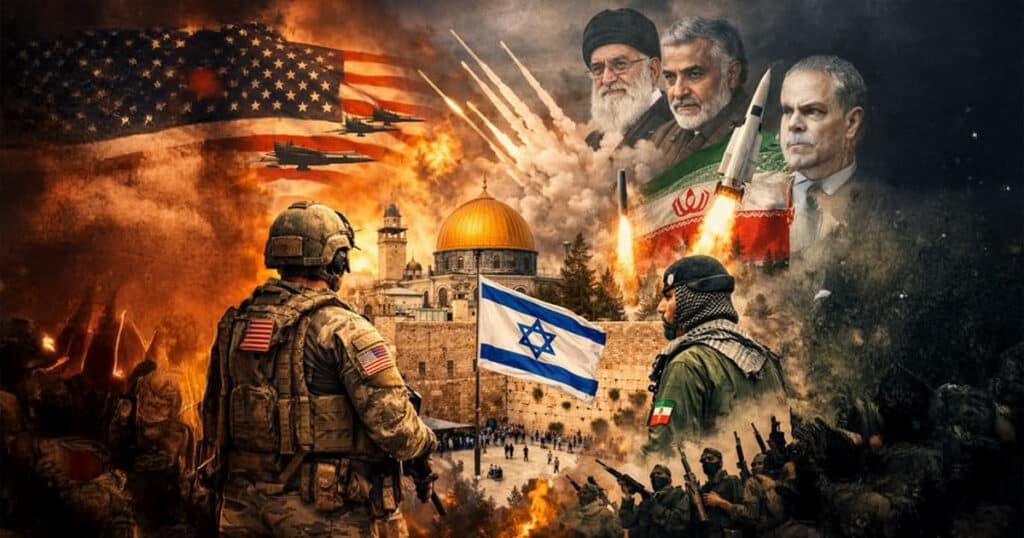
Let us start with a simple fact. The Islamic Republic of Iran has not spent the last four decades declaring war only on Israel. Its leaders openly speak of fighting the “Great Satan” — the United States — and the “Little Satan” — Israel. For 47 years, their ideology has been built around exporting revolution, destabilizing the Middle East, and spreading militant networks across the region.
This is not an Israeli fantasy. It is Iran’s own declared doctrine.
Iran finances militias, trains terrorist organizations, and builds missile and nuclear capabilities while threatening not only Israel but also Arab countries, American forces, and global stability. From Lebanon to Iraq, from Yemen to Syria, the fingerprints of Tehran are everywhere.
So when the United States acts against that regime, it is not acting on behalf of Israel. It is acting to defend its own strategic interests and the stability of the international system.
The idea that Washington needs to be “manipulated” by Jerusalem into recognizing this threat is absurd. Every American administration of the 21st century—Republican or Democrat—has stated clearly that preventing Iran from obtaining nuclear weapons is a fundamental national security priority.
The debate in Washington has never been about whether Iran is dangerous. The debate has only been about how to stop it.
Some believed diplomacy and concessions would change the behavior of the clerical regime. Others believe that a regime driven by revolutionary ideology and apocalyptic theology will never voluntarily abandon its ambitions.
But pretending that the Iranian threat exists only in Israel’s imagination is a dangerous illusion.
There is also another uncomfortable truth: Iran today is not an isolated regional actor. It is deeply connected to the broader geopolitical challenge facing the West. Tehran has become a strategic partner of Russia and an economic partner of China. Chinese purchases of Iranian oil have helped keep the regime alive despite international sanctions, while Iranian drones have played a central role in Russia’s war in Ukraine.
This is not a local Israeli issue. It is part of a global strategic confrontation.
Those who repeat the slogan “this is Israel’s war” are ignoring the obvious: a nuclear-armed Iran would not threaten only Tel Aviv. It would threaten the entire Middle East, including Arab countries, and it would destabilize global security for decades.
And yet, instead of confronting this reality, many prefer to blame Israel. They claim that the Jewish state somehow controls American policy, pushes Washington into wars, or manipulates global politics behind the scenes.
These accusations are not serious geopolitical analysis. They are recycled conspiracy theories that have circulated for generations.
Criticizing governments is legitimate. Debating military decisions is legitimate. But reducing complex strategic decisions to the idea that “Israel controls America” is not criticism—it is propaganda.
Israel does not need to invent the Iranian threat. Iranian leaders themselves have repeatedly called for the destruction of the Jewish state. They openly describe Israel as a country that could be erased with a single nuclear weapon.
No responsible nation would ignore such threats.
Standing against the Iranian regime is not about serving Israel. It is about preventing a radical theocracy from acquiring the most dangerous weapons on earth and using them to reshape the Middle East through intimidation, violence, and nuclear blackmail.
If that threat disappears, Israel will be safer. But so will Arab nations, Europe, and the United States.
Recognizing that reality does not require being Jewish or Israeli.
Sometimes it simply requires honesty.
And as an Arab Muslim who believes in stability, sovereignty, and the future of our region, I refuse to repeat narratives that protect the most dangerous regime in the Middle East while blaming the only democracy in the region for defending itself.