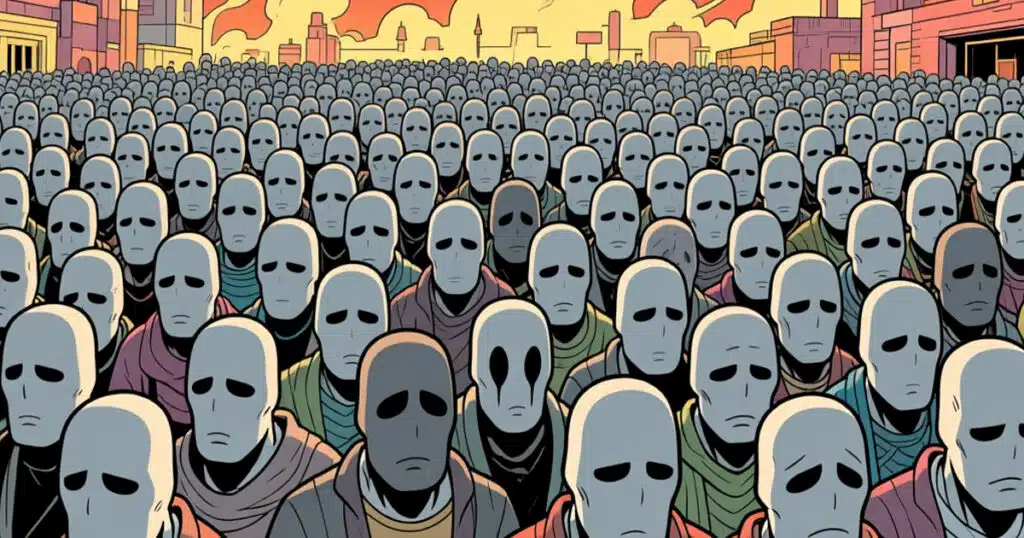
The Age Of Mediocrity
One of the quietest revolutions of the last half century has been the growing suspicion toward excellence. Increasingly, intelligence, discipline, mastery, and achievement are treated not as virtues to admire but as social problems to manage. In many institutions the goal is no longer to encourage people to rise as high as they can, but to make sure no one rises too far above the crowd.
That shift was predicted decades ago by the great C.S. Lewis. In one of his most prescient observations, Lewis warned that Western societies were beginning to experience a “vast overall movement towards the discrediting, and finally the elimination, of every kind of human excellence—moral, cultural, social or intellectual.” Lewis was not suggesting that talent itself would disappear. His concern was something subtler and far more dangerous: the possibility that excellence would gradually become socially unacceptable.
Civilizations rarely decline because excellence vanishes overnight. They decline when excellence begins to make people uncomfortable.
When I was growing up in rural Mississippi, there was very little confusion about what excellence meant. If a man could rebuild a tractor engine or tune a stubborn carburetor, people respected him for it. If someone could read difficult books and explain them clearly, others listened. If a farmer consistently produced the best crops in Union County, everyone knew it and said so. Nobody believed recognizing excellence was unfair. It was simply an acknowledgment of reality. People possessed different talents, different levels of discipline, and different ambitions. Some mastered skills others did not. That was not considered oppression. It was something to admire, and often something to aspire to.
Lewis saw the early stages of a different mindset emerging in education. Reformers increasingly argued that allowing bright students to advance faster than their peers might damage the self-esteem of slower students. The proposed solution was not to help struggling students improve, but to prevent capable students from moving ahead. Lewis described the result with biting clarity: a boy capable of reading Aeschylus or Dante forced to sit through lessons where classmates were still struggling with sentences like “A cat sat on a mat.” The capable student must be restrained, not because he lacks ability, but because allowing him to advance might reveal uncomfortable differences.
Anyone paying attention today will recognize the pattern. Academic tracking is criticized because it produces unequal outcomes. Gifted programs disappear in the name of “equity.” Grading standards soften because high expectations might damage someone’s self-esteem. Education slowly transforms from a system designed to cultivate excellence into one designed to protect feelings. The focus moves away from intellectual development and toward emotional management.
The consequences are predictable. When excellence becomes socially suspect, incentives to achieve inevitably decline. Why devote long hours to mastering difficult subjects if doing so invites resentment rather than admiration? Why strive for intellectual or moral excellence if such striving is interpreted as arrogance or elitism? The result is not genuine equality, because people do not suddenly acquire identical abilities. Instead, the system quietly levels downward. Standards soften, expectations shrink, and mediocrity spreads because it is the only outcome that avoids offending anyone.
Part of what makes this development difficult to challenge is that it is almost always framed in the language of compassion. Advocates speak about fairness, inclusion, and kindness. Yet beneath that rhetoric often lies something less noble: resentment toward those who excel. The disciplined student becomes arrogant. The talented artist becomes elitist. The successful entrepreneur becomes privileged rather than accomplished. Excellence must be explained away because its existence contradicts the comforting belief that everyone is equally capable in every domain.
Lewis warned that once the cultural norm becomes the phrase “I’m as good as you,” excellence itself becomes socially dangerous. Institutions that once cultivated talent begin subtly suppressing it. Standards decline not because anyone explicitly abolishes them, but because enforcing them would require acknowledging differences in ability and performance. Over time the very idea of excellence begins to feel undemocratic, even though democracy in its proper sense simply means equal rights under the law. It does not require pretending that all talents, efforts, and accomplishments are identical.
Lewis explored the danger of this mindset elsewhere when he wrote that a society determined to remove all distinctions between people ultimately produces what he called “men without chests”—individuals who possess intellect and appetite but lack the moral and cultural formation that once sustained civilization. A culture that refuses to recognize excellence eventually loses the ability to cultivate it.
And once that instinct disappears, the consequences spread far beyond the classroom.
Democratic societies depend heavily on excellence. They require citizens capable of reasoning clearly, leaders capable of exercising judgment, and institutions capable of cultivating knowledge and competence. A culture that systematically discourages excellence eventually undermines the very foundations that sustain democratic governance. Competence does not appear by accident. It must be cultivated, rewarded, and respected.
Lewis predicted the final stage of this process with remarkable clarity. Once excellence becomes stigmatized, society produces something worse than ignorance. It produces ignorance combined with absolute confidence. As he put it, we may eventually reach a point where we “no longer have to plan and toil to spread imperturbable conceit and incurable ignorance among men.” The system will accomplish that result on its own.
Look around today and it is difficult not to suspect that Lewis saw this trajectory with uncomfortable clarity. The discrediting of excellence is no longer subtle. In many places it has become institutional policy. Standards fall, achievement is downplayed, and the highest social virtue becomes avoiding offense rather than pursuing mastery.
Civilizations, however, are not sustained by comfort. They are sustained by standards. They survive because they recognize excellence, reward it, and encourage others to pursue it.
If that instinct disappears, something else inevitably takes its place.
A society that fears excellence eventually stops producing it.
A society that stops producing excellence eventually stops producing competence.
And a society that loses competence does not remain prosperous, free, or stable for very long.
At that point the leveling is complete but not because everyone rose together.
It is because everything worth rising toward was pulled down.