Biden’s NEVI Project Tells Obama’s Solyndra “Hold My Beer”
Does anyone remember Solyndra? In the endless pursuit of their “green energy” pipedream, Democrats continue to sink billions of dollars into wasteful projects that have no chance of producing anything worthwhile. Solyndra was one such project.
Solyndra was a manufacturer of cylindrical, thin-film solar panels based in Silicon Valley. Founded in 2005, the company gained significant attention in 2009 after receiving a $535 million federal loan guarantee from the Obama administration. However, by 2011, Solyndra filed for bankruptcy, resulting in the layoff of 1,100 employees and becoming the focus of a major political scandal.
Yes, Solyndra was just one of many Obama projects that were a total waste of time and money. It was later learned that the $535 million Energy Department loan was an example of cronyism, noting that a major venture capital firm backing Solyndra was a prominent fundraiser for President Obama’s campaign.
Federal investigators and a Congressional inquiry found that Solyndra executives misled the U.S. Department of Energy about their sales volume, revenue projections, and financial health while lobbying for the loan.
This was an obvious case of Obama trying to reciprocate by greasing the palm of one of his donors. He gave no thought to the fact that the project had no chance to succeed, and worse, he didn’t care as long as the hard-working Americans’ tax money was funneled to one of his supportive cronies.
The Republican Policy Committee reported that Obama’s Energy Department left taxpayers responsible for over $2.2 billion in losses incurred by companies such as Abound Solar, Beacon Power, and Fisker Automotive – all of which were politically connected and ultimately went bankrupt.
Biden expanded the operation.
In 2021, the law allocated $5 billion for the Electric Vehicle Infrastructure Formula (NEVI) program, an additional $2.5 billion for the Charging and Fueling Infrastructure grant program, and $5 billion for the Clean School Bus Program.
The Biden administration thought it would also be a great idea to install EV chargers across Tribal Native Americans’ land. Here’s the obvious problem: the vast majority of Native Americans can’t afford to buy an electric vehicle.
In Biden’s 2021 Infrastructure Investment and Jobs Act, which passed with some Republican support, hundreds of millions of taxpayer dollars were allocated for electric vehicle chargers on Native American reservations.
Once again, the hook was “climate justice” for communities that had supposedly been “left behind.”
So, with no forethought or reason, Biden’s merry band of misfits rushed off to install the machines. The project made no sense, but that once again was not something Biden cared about.
Biden installed $300,000 DC fast chargers in reservations where the people living nearby couldn’t afford the cars those chargers were intended for.
The average household income for Native Americans is $44,000. The average cost of an electric vehicle is between $55,000 and $58,000.
Still, it gets worse. Researchers at the EV analytics firm Paren determined that a charging station needs to hit 20 percent utilization just to cover its electricity, maintenance, and land lease costs. Yet they discovered that public chargers in rural and tribal areas are used less than five percent of the time.
That’s the equivalent of installing hundreds of speaker posts for a drive-in, but never installing a screen.
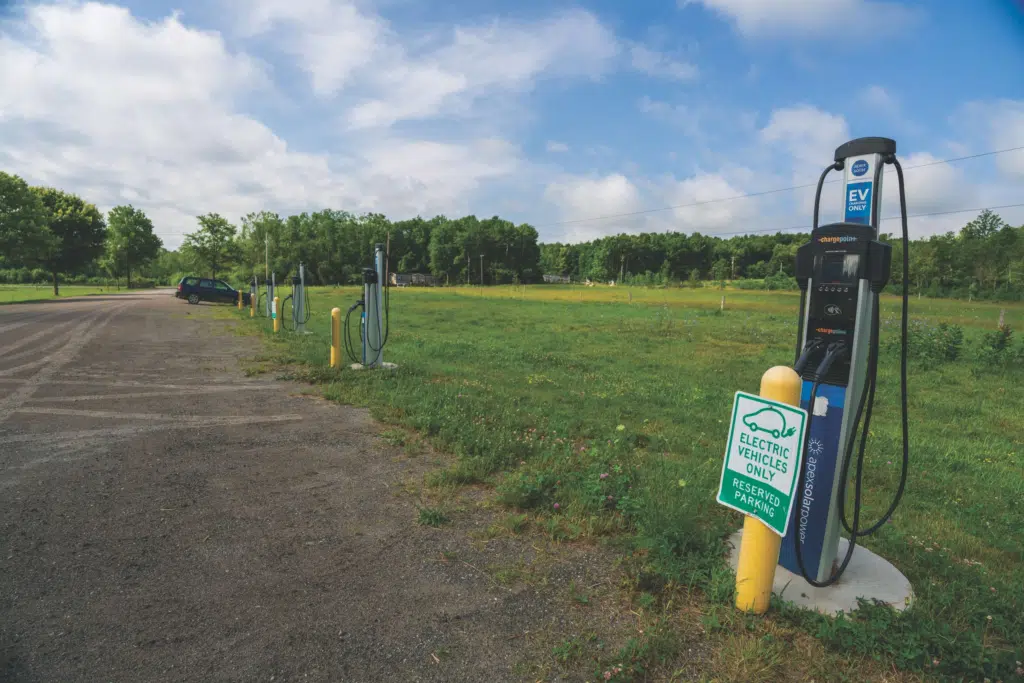
The Cherokee Nation in Oklahoma received $10.7 million to install 112 charging ports at around a dozen locations. The Fort Independence Indian Community in California was awarded $15.1 million to develop a solar-powered microgrid and charging station along US Route 395.
The Standing Rock Sioux Reservation, located in North Dakota and South Dakota, secured $3.9 million for electric vehicle chargers on land historically known for pipeline protests.
Still, it gets worse. When the chargers are installed, they often stop working. One in five EV drivers traveling through remote areas, including tribal regions, encountered charging issues due to malfunctions, payment failures, or outages, according to JD Power.
In July 2023, a widespread power outage across the Cherokee Nation rendered all EV chargers in the region inoperable for several days. A 2025 study by the US Department of Transportation found that faulty power supply frequently causes rural and tribal chargers to go offline, even when the equipment itself remains intact.
UCLA researcher Qiao Yu examined electric vehicle deployment on tribal lands and identified a problem that the Biden administration had never even considered before handing over taxpayer funds.
Yu told the Daily Mail, “If you don’t have electricity, how can you have EV charging?”
All of this while many of these communities still lack access to reliable electricity and clean water.
Still, it gets worse. Replacement parts for equipment are costly and can take a long time to arrive at remote reservations. Additionally, there is often a lack of trained personnel nearby to repair the hardware when it malfunctions.
A 2025 report from the Government Accountability Office revealed that many federally funded electric vehicle (EV) projects on tribal land lacked clearly defined performance targets. In some cases, metrics such as uptime and utilization were not monitored at all.
In February 2025, Trump halted the program, calling it an “incredible waste of taxpayer dollars.” The House then passed legislation to reallocate $879 million in unspent NEVI funds to infrastructure projects.
A Biden-appointed federal judge blocked the freeze.
The Democrats called it an historic investment
You be the judge.