John Paul II’s Conclave Law and the Leo XIV Problem Behind Hildebrand
We Catholics do not need to settle every disputed legal question in one afternoon, or in one text thread where one or both conversants fruitlessly imagine the whole crisis can be solved. Neither, however, are we permitted to pretend—particularly when we hang our hat so boldly on Tradition and the law of the Church—that law, heresy, and papal legitimacy are little side issues for bored internet bloggers with too much coffee and time on their hands.
The rot in Denmark will find us, even if we keep looking for softer beds where we don’t have to smell it.
If you are a newcomer to my most recent work or even the work going back especially to October 2025, please know there is a great deal of context I leave out here. I have been building this ecosystem with the scaffolding process of a teacher in mind, even as I, a soul working out my salvation “with fear and trembling” as St Paul puts it, continue to navigate the cognitive dissonance associated with all of this myself.
If all of this is true, we all need to start the preparatory process for our minds to accept it. Also remember, I am not writing this as anyone’s agent, recruit, or factional salesman. I am writing as a Catholic trying to obey Christ the King under the law of His Church. Nothing I am saying here will be popular.
John Paul II, Leo XIV, and the Hildebrand Question
For the sedevacantists out there saying the following section doesn’t solve anything because JPII was illegal himself, there are numerous other legal reasons to eliminate Prevost that we won’t get into here, even if the sede’s are correct. Admittedly, it is one of the questions I have, but to this moment I have not located a legal contradiction yet. One central reason I am investigating all of this in the first place, however, is that I see a way—a legitimate and legal one—to unite the clans in what has become an annoyingly combative Catholic world, one where the only people most of us listen to are the famous talking head podcasters who are likely controlled opposition in themselves, no matter how handsome or pro-life they are.
The Hildebrand claim we’ve been floating, at least in its foundational and most important form, begins with a legal problem. This is not something to gloss over as irrelevant; it is why I have been italicizing or underlining the words “legal” and “law” with purpose. It matters. It matters.
Assuming he was not embroiled in this dark chapter of Church history and was indeed a legitimate pope himself, John Paul II’s Universi Dominici Gregis (UDG)—published on February 22, 1996 on the Feast of the Chair of St Peter—governs the very conclaves we “witness” through electronic spectacle. UDG limited papal electors to 120 Cardinals, while the 2025 conclave that led to Leo is alleged to have included 133:
33. The right to elect the Roman Pontiff belongs exclusively to the Cardinals of Holy Roman Church, with the exception of those who have reached their eightieth birthday before the day of the Roman Pontiff’s death or the day when the Apostolic See becomes vacant. The maximum number of Cardinal electors must not exceed one hundred and twenty.
Regarding the very next sentence after the UDG pull here, which would seem to nullify any argument on a “Pope Hildebrand,” know that there are other legal issues with this that I don’t detail today but have mentioned at least once in a previous article. It involves forfeiture of right and the fallback to a law already in place. The canon, again assuming its 1983 publishing is legitimate, says that in such circumstances the general principle of ecclesiastical jurisprudence provides recourse to the previous law (cf. CIC 1983, Canon 19). This is a question I myself had as I began this investigative process, and I still have it, because I continue to seek out all the nuances of this story, such as exceptional clauses, sub-laws, etc.
Regarding the numbers, admittedly, this is from Wikipedia, but numbers indeed are all we need here:
A conclave was held on 7 and 8 May 2025 to elect a new pope to succeed Francis, who had died on 21 April 2025. Of the 135 eligible cardinal electors, all but two attended. On the fourth ballot, the conclave elected Cardinal Robert Francis Prevost, the prefect of the Dicastery for Bishops and president of the Pontifical Commission for Latin America. After accepting his election, he took the name Leo XIV.
An adjacent legal argument also raises the question of whether some of those 133 electors were even valid at all, depending on whether Francis himself was validly elected after Benedict XVI’s contested resignation (involving the difference in the words munus vs ministerium in the context of word of the law vs spirit of the law). The purpose of my work at this point, however, is to keep it somewhat simple because this is so new, not to mention because of my own soul-level navigations, so I only mention these latter two possibilities, without delving further.
Where Nicholas II and Paul IV Return
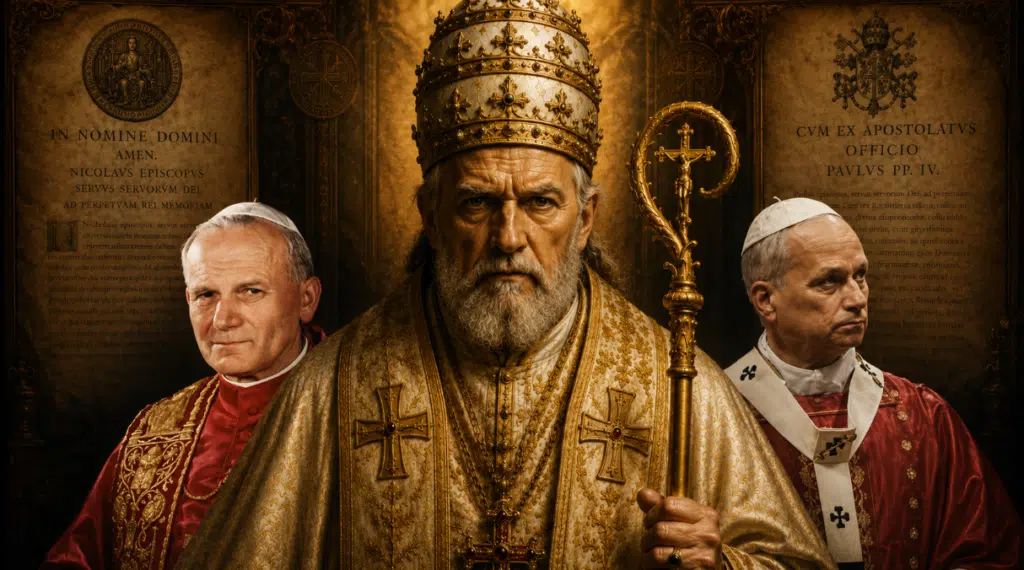
Beyond UDG, the Leo XIV problem invokes Paul IV’s Cum ex apostolatus Officio, which explicitly taught that heresy is an absolute disqualification from ecclesiastical office—yes, including the papacy—and points to Prevost’s prior statements and actions contrary to Church law and teaching. For a glimpse of how serious Popes once were in their teaching, read how this document ends:
10. No one at all, therefore, shall be permitted to infringe this document of Our approbation, restoration, sanction, statute, derogation, wishes, and decrees, or with temerarious daring to go against it. However, if any should presume to attempt this, let him know that he will incur the wrath of Almighty God and of the blessed Apostles Peter and Paul.
This, presumably, would include future antipopes.
CONTEXTUAL: Paul IV’s Teaching on When the Pope Is Not the Pope
A moment ago I mentioned the potential necessity to fall back to an already-established law, and I return to it here. One thing UDG does not appear to do is tell the Church how to handle a most sinister scenario in which the Cardinals themselves are all in communion with an antipope, or if they have forfeited their right to elect by the very disorder the law presumes them able—and willing under God—to resolve. What if, for example, the mission statement of the Alta Vendita actually came to pass? In that kind of void of law, indeed absence of all sanity, at least in a direct or modern sense, the argument must then turn to a basic principle of ecclesiastical jurisprudence.
That is where Nicholas II returns to the analysis. From an April 22 piece on the eleventh century pope’s bull In Nomine Domini (1059):
§ 1. Wherefore, if it please thy Brotherhood, We ought, with God assisting, take care prudently for future cases and this by Ecclesiastical statute, provide in the hereafter that (these) evils, revived, not prevail. On which account, having been instructed by Our predecessor and by the authority of the other Holy Fathers, We decree, and establish, that with the passing of the Pontiff of this universal Roman Church, first of all, the Cardinal Bishops, treating (the election) together with the most diligent consideration, summon immediately the Cardinal Clerics to themselves; and in this manner let the rest of the Clergy, and the People, approach to consent to the new election, so that, lest the deadly disease of venality insinuate itself by occasion, the most religious men be the chief leaders in the election of the Pontiff to be promoted, but the rest be their followers.
Understand that this is not some obscure thousand-year-old document that should be relegated to the dustbins of ancient history. Paul VI himself, he who is hailed by the Vatican II sect as being the shepherd to modernize it all, alluded directly to the bull:
This Bull of Pope Nicholas II is no obscure document, since it is the first Papal Bull which restricted the election of the Roman Pontiff to the Cardinals, two centuries before the first Conclave was ever held. It is even mentioned by name in the Apostolic Constitution of Pope Paul VI, Romano Pontifici eligendo, promulgated October 1, 1975, in its third paragraph, where it is called a “celebrated” constitution, that is, frequently used. Its importance for today is that it explains, what other Papal Laws currently in force today do not, namely, “What is to be done if all the Cardinals forfeit their right and competence to elect the Roman Pontiff by reason of grave malfeasance, in conducting an illegal election or one which is declared invalid by papal prescriptions?”
It is also referenced by almost every Catholic’s favorite pope, John Paul II:
It is implicitly referred to also in the current Papal Law of Pope John Paul II, Universi Dominici Gregis, promulgated Feb. 22, 1996, where it says in its preface, that “the institution of the Conclave is not necessary for the valid election of the Roman Pontiff”, and again, wherein in n. 76 it declares any election violating its norms null and void, without however expressing what is to be done if the Cardinals fail to return into conclave because they maliciously will to hold as pope a man who is illegally elected.
End April 22 pull. If you read that article, you will see why the hidden claimant today chose the name Hildebrand. The Hildebrand of the eleventh century was the pivot point among a series of figures and events that point directly to today’s crisis. He himself would one day become Pope Gregory VII, a man we honored just yesterday on his feast, but before that, was instrumental in lifting Nicholas II to legal legitimacy in the militant face of antipope Benedict X.
Nicholas II is of utmost importance because his bull addressed papal election disorder nearly a thousand years ago, including what should happen when a pure and free election cannot be held in Rome. Paul IV is important because he understood that sacred office could and would be infiltrated, and that in such a case it could not be treated with apathy and blind conformity. John Paul II is important because even the modern conclave law cannot simply be waved away. If we care about white and black smoke, we have to care about what legalities are behind it.
If nothing else, this should show not a vindictive attack on Leo, but a faithful response to a teaching of the most beloved Pope in a generation, assuming his legitimacy, in John Paul II.
CONTEXTUAL: Nicholas II & the Papal Election Crisis — When All Appearances Collide with Catholic Law
Where Hildebrand Fits
Hildebrand fast-forwards front and center now because, according to the legal argument, when the official Church machinery has failed, the faithful of Rome—the city itself—must, under older Catholic principles handed down by St Peter himself, elect a Catholic man of Rome.
That is one crucial way the “Bishop of Rome” title comes in, and where the actual real live people of Rome, or at least a number of them, have been beating the alarum for some time:
Here in Italy, our small editorial staff has dared to speak the truth regarding the most blatant acts of dishonesty afflicting our Church—right here in Rome. We have done this animated by the firm confidence that Christ Jesus is a just Judge and that He will reward those who live exclusively for Him, fully aware that He sees and hears our every word and every action—from the sanctuaries of our minds to the public squares of our city.
Just as God is Truth—and we, as Catholics, are called to live for the Truth—so too is God the Almighty, and we are called to place our trust in His Name and in His power.
For this reason, it constitutes a form of diabolical cowardice to pretend that Cardinals possess the authority to elect Popes at their own pleasure, in contravention of the norms of that very law—Universi Dominici Gregis—promulgated by the Successor of Saint Peter, John Paul II. And it is even more dishonest to pretend that these same individuals, acting like criminals, can determine the meaning of the law right under the gaze of the living God, compelling Him to accept as His Vicar a creature born of their own corrupt invention.
It is likely respectful, if nothing else, to hear what the boots on the ground are saying.
No, no serious Catholic should be bullied into instant assent if this is the first time you’re seeing this. I certainly wasn’t when I learned of this in January. I am still treading lightly, even now.
But neither should we be shamed out of asking the question—a very legitimate one when one applies even the most Modern meaning of the notion of “Apostolic Tradition” and “Apostolic Succession” to the Church.
If we believe what the Popes teach, we have to believe what all of the Popes teach, not just the ones coming through the screen.
And if the papacy is real, true, and binding—as even lukewarm Catholics generally claim to believe—then papal law is real too. If heresy matters when it comes to politicians and diocesan priests, then heresy matters even when it comes to shepherds-once-diocesan-priests-themselves now risen in the ranks. If Christ prayed that Peter would confirm his brethren, then Catholics have every right to ask whether the man claiming St Peter’s Chair is guarding, confirming, and working to hand down the old Faith—or simply continuing the revolution against individual souls, against culture, against the Kingdom of God itself.
That question is not rebellion, nor is it disobedient, particularly when you are obeying the decrees of Popes who came before.
What it may be, though—and wouldn’t it be of a most marvelous Providence—is the first sign that our memory is returning. What it may be is our billions of Rosaries are being answered as we speak—all while we’re still learning to recognize the answer.
—
FURTHER READING: Fr John C Murray, Vatican II, and the US Doctrinal Warfare Program