Our COVID-Induced Near-Progrom
I don’t make this comparison to diminish the Holocaust.
There are few moments in human history when the collective human soul was so thoroughly blackened as it was under Nazism, and nothing that happened during COVID approaches the industrialized extermination of millions of human beings. My comparison is about something different: the darker political impulse that precedes atrocities—the intoxicating belief that frightened people can be divided into the righteous and the unclean, and that government may do almost anything to the latter in the name of protecting the former.
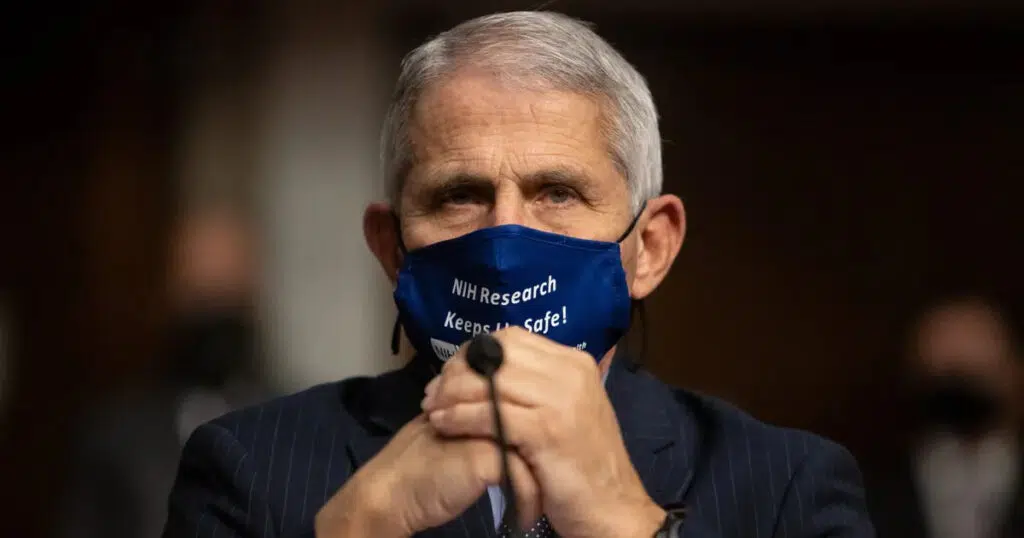
Watching Saint Anthony of Fauci’s dramatic reading of the Fifth Amendment before Congress reminded me how much of that spirit surfaced during COVID.
Covid authoritarians had the want, even if they lacked the will, authority, or opportunity to carry it to its ugliest conclusion.
Emails, internal discussions, subsequent testimony, and the changing public-health guidance showed something we should never forget: behind closed doors there was uncertainty, disagreement, evolving evidence, and debate. In public, however, uncertainty was too often converted into certainty. Scientific judgment became “The Science,” and questioning government policy became indistinguishable from questioning science itself.
What disturbed me most about the COVID era wasn’t simply that governments made mistakes during the pandemic, it was how quickly supposedly free societies rediscovered the pleasures of coercion. Businesses and churches were ordered closed or restricted. Children were kept from classrooms. Workers faced mandatory vaccination requirements. People were shamed, censored, ostracized, cancelled, and sometimes arrested for violating emergency rules whose effectiveness was itself legitimately debatable.
People were arrested for paddleboarding alone in the ocean or playing with their own kids in a deserted park.
The impulse behind this was not Nazism, but it was a pogrom nonetheless, one carried out by people who were seduced by power over others and with souls stained by evil. Never forget that there were forced on the left who wanted the “infected” in camps or dead for not complying – all for a virus with the mortality rate of a common flu outbreak.
Give frightened people a sufficiently frightening enemy and some will surrender astonishing amounts of liberty. Give ambitious officials an emergency and some will discover powers they never knew they possessed. Give ordinary citizens moral permission to police their neighbors and some will embrace the assignment enthusiastically.
That was the lesson of COVID.
Some Americans openly fantasized about punishing the unvaccinated, denying them employment, restricting their movement, refusing them medical care, or separating them from society. Such attitudes were not universal to any political faction, but they existed, and pretending otherwise prevents us from learning anything from the episode.
Thankfully, America’s residual hostility toward autocracy eventually asserted itself. Millions simply said no.
That resistance matters because emergency powers operate like a ratchet. Government acquires extraordinary authority during a crisis, retreats when the crisis passes, but rarely retreats completely to where it started. The precedent remains waiting for the next emergency.
An acquaintance asked me last night why “you right-wing people” remain intent on “relitigating” COVID because it was more than four years ago.
My answer was simple: you can’t “relitigate” something was never fully litigated in the first place.
The question isn’t whether Fauci was uniquely evil, whether every public-health official acted maliciously, or whether COVID itself was dangerous. Those are distractions from the larger issue. The question is what limits should exist on government power when officials invoke an emergency—and what consequences should follow when those limits are exceeded.
We never adequately answered that.
Instead, bureaucrats exercised extraordinary influence, elected officials discovered how easily emergency declarations could circumvent ordinary political restraints, corporations learned they could become enforcement arms of public policy, and citizens discovered how quickly their neighbors could become enthusiastic participants in coercion.
COVID therefore shouldn’t be remembered merely as a medical event. It was a stress test of republican government – and we didn’t perform nearly as well as we imagine.
My suspicion, admittedly anecdotal, is that the attraction to COVID-era mandates correlates with a broader willingness to use government power to compel desired social outcomes. Whether that correlation survives empirical scrutiny is worth investigating rather than assuming. My suspicion is that there is a very high correlation between Covid Plandemic Panicans and DSA voters.
COVID showed us how frighteningly thin that line can become during an emergency.
Four years isn’t nearly long enough to forget that.