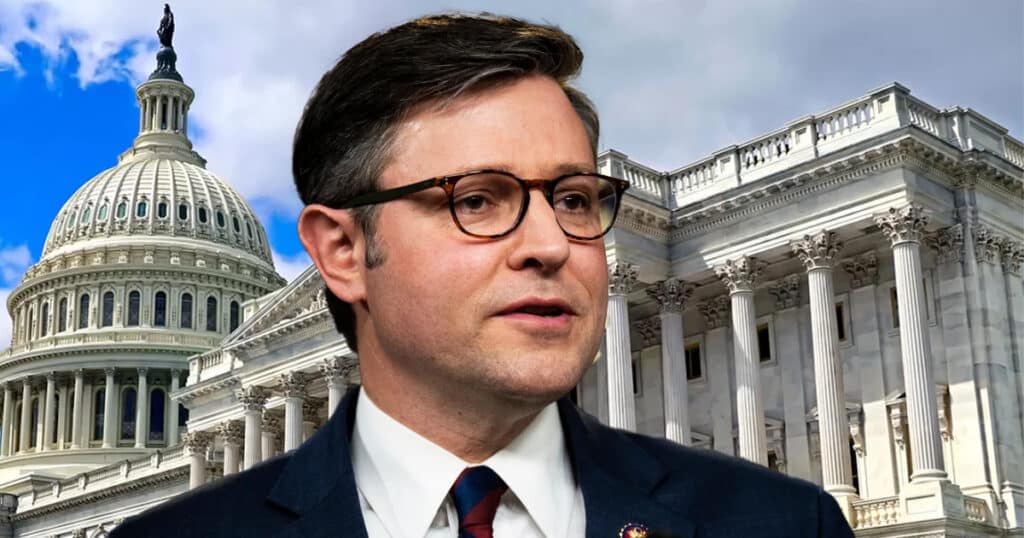
Speaker Johnson blames foreign bettors as prediction markets favor Democrats
U.S. House Speaker Mike Johnson says foreign bettors are helping push prediction markets into giving Democrats better odds of taking over the House.
Johnson made the claim while campaigning for Republican House candidates in Pennsylvania last week.
Punchbowl News reporter Jake Sherman reported that Johnson thinks Republicans will “substantially” grow their small House majority in November. Johnson also said prediction markets showing a likely Democratic win are being swayed by foreigners betting on the election.
Sherman’s X post about the interview didn’t say how much foreign money is in the markets.
The prediction markets disagree with Johnson’s forecast.
Kalshi gives Democrats an 86% chance of winning the U.S. House. Over $30 million has been traded on the market.
Polymarket gives Democrats an 88% chance of winning the chamber. That market has about $10 million in trading volume.
Prediction markets are different than polls. Users buy contracts based on whether an event will happen. A contract trading at 86 cents suggests traders collectively put the chance of that event at about 86%. A correct contract pays $1 once the market settles.
Foreign users can take part in some of those markets.
Kalshi accepts traders from many different countries. People must verify their identity and country of residence. Kalshi doesn’t show how much of its House market activity comes from each country.
Polymarket’s main exchange operates outside the United States. The platform says it blocks American users from that exchange, but the Congressional Research Service said questions remain about the efficacy of those restrictions.
The markets are also in line with national polling. The Silver Bulletin’s generic congressional ballot average had Democrats ahead by 6.6 percentage points as of Tuesday.
Republicans won a 220-215 House majority in 2024. Democrats only need a net gain of three seats to regain control.
Johnson’s comments come as prediction markets face pressure from Republicans and Democrats alike.
Last month, a bipartisan group of 44 state attorneys general told the Commodity Futures Trading Commission that the agency lacks the power to override state laws about sports betting.
That dispute is part of a bigger fight over whether platforms like Kalshi are financial exchanges, gambling businesses – or both.
Kalshi says its contracts are federally regulated financial products overseen by the CFTC. It lets users as young as 18 years old open accounts.
Meanwhile, states argue many of its sports contracts are the same as bets offered by sportsbooks like DraftKings and FanDuel. Those sportsbooks usually require users to be at least 21 years old to sign up. They must also obtain state licenses, follow state consumer protection rules, and pay state gaming taxes.
The American Gaming Association, which represents casinos and other legal gaming businesses, says states have missed out on over $1.3 billion in gaming tax revenue since prediction markets started offering sports contracts.
Kalshi disagrees. It says federal law gives the CFTC power over its exchange.
President Donald Trump agrees with Kalshi, but his oldest son, Donald Trump Jr., owns an equity stake in the company. The president said in May that it is “critically important” for the CFTC to keep exclusive authority over prediction markets.
Lawmakers in both parties disagree with Trump.
Sens. John Curtis, R-Utah, and Adam Schiff, D-California, introduced the Prediction Markets Are Gambling Act in March. The bill would stop CFTC-regulated exchanges from offering contracts that look like sports bets or casino games.
Johnson has not called for a public ban. However, in May he said that he would support banning House members and staff from trading on prediction markets because they often have inside information.