Seeding Our Own Destruction
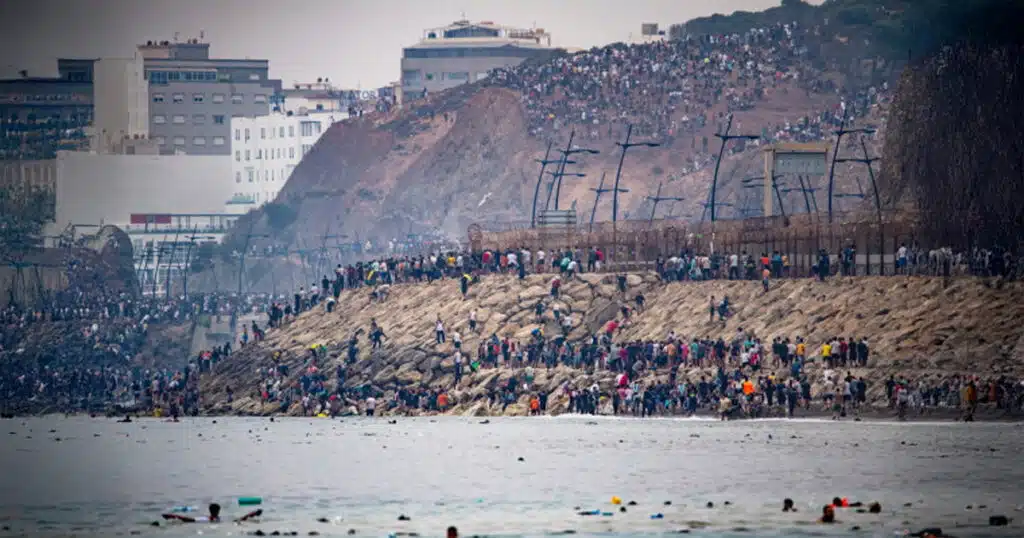
I was asked a while back why, if “migrants” have no allegiance to America and no affinity for the American way of life, do they continue to come?
I do think that economics play a part, largely because we are the most economically successful country of its size in the world and of course, we are increasingly expanding our welfare state to apply to “migrants”, but I think it is largely our levels of socially and legally enforced “tolerance” that allow the “migrants” to continue to live in enclaves where their home cultures continue while they reap the benefits of American “tolerance”.
There is difference in motivation, of course. There are forces that support this influx because they seek the disruptive and destabilizing effects it brings, something they want to use to their political benefit, something that has the potential to destroy 250 years of historical development and success.
The main conflict, as I see it, is between an agglomeration of people who have decided they want to live a certain way, with a certain set of principles and under a certain set of laws, under a certain government, the limits of which are specified by them, and in association with other people who believe and want the same things and those who want something different.
There is a fascinating tension here, because to my intellect, the seeds of creation of a nation under such premises are also the seeds of its eventual destruction.
How does a nation maintain individual liberty and institutional cohesion when those two ideals will inevitably come into conflict? What happens when a minority no longer agrees with the majority on basic foundational principles, cultural behaviors and social mores and forces change that the majority neither wants nor desires?
I’ve done quite a bit of digging and there seems to be no single philosophical consensus that every group has an unconditional right to create a sovereign state, draw borders, and preserve a particular culture. Different traditions derive such a right from different places.
The oldest Western answer is essentially that the right belongs to political community itself. Aristotle regarded human beings as political animals who naturally form communities aimed at a common good – building on that, later natural-law thinkers added the idea that people may legitimately organize political authority to secure peace, justice, and their way of life.
The liberal tradition that arose out of the Enlightenment shifts the foundation toward consent. Locke’s Second Treatise of Civil Government is especially important because it notes that individuals possess rights before government exists, and legitimate government arises when people consent to form a political society for the protection of those rights. Once formed, that society possesses jurisdiction over territory. Locke therefore provides much of the philosophical architecture behind the American argument: people do not belong to governments; governments are created by people.
The American Founders turned that principle into an explicit revolutionary claim. The Declaration of Independence says that governments derive “their just powers from the consent of the governed” and that when government becomes destructive of its purposes, “it is the Right of the People to alter or to abolish it.” The Declaration goes even further by asserting that one people may “dissolve the political bands” connecting them to another and assume a “separate and equal station” among nations.
But therein lies one of the seeds of destruction I mentioned earlier – if every culturally distinct population had an absolute right to sovereignty, virtually every existing country could fragment indefinitely. Does Quebec have a right to leave Canada? Scotland the United Kingdom? Catalonia Spain? The Kurds Turkey, Iraq, Syria, and Iran? If a region secedes, does a minority within that region then have the same right to secede from the new country?
How far does it go and to what lengths can an established nation go to prevent its own dissolution?
In the nineteenth century, nationalism added culture to the argument. Thinkers such as Johann Herder and Giuseppe Mazzini argued in different ways that people sharing language, history, customs, and cultural identity constitute meaningful communities and ought not simply be treated as administrative units belonging to empires. This eventually developed into the modern idea that a “people” may possess a legitimate claim to political self-government.
John Stuart Mill made the connection unusually explicit in Considerations on Representative Government (1861). He argued that representative government works best when the boundaries of government broadly correspond to nationality, writing that “it is in general a necessary condition of free institutions that the boundaries of governments should coincide in the main with those of nationalities.” Mill did not mean race in the modern biological sense; nationality could arise from language, religion, geography, history, and especially shared political sympathies.
The twentieth century transformed the philosophical principle into an international political principle. Woodrow Wilson famously promoted national self-determination after World War I, albeit in an inconsistent manner. After World War II, the concept entered international law with Article 1 of the UN Charter referring to “the principle of equal rights and self-determination of peoples,” and Article 1 of both major 1966 human-rights covenants declares: “All peoples have the right of self-determination.”
Of course, the difficulty arises with the word “peoples.”
Modern Western political thought simultaneously maintains that “peoples” (a word that has defied an accurate definition) have a right to self-determination and that individuals possess universal rights independent of their membership in a particular people.
Much of today’s argument over nationalism, immigration, borders, assimilation, multiculturalism, indigenous sovereignty, and secession is really an argument over where the legitimate claims of the political community, aka the “peoples”, end and those of the individual begin.
It is said that the American Constitution is not a suicide pact, but that is only true for a nation with a population that believes in the societal, religious, and economic systems that gave birth to the document upon ratification in 1788.
The erasure of immigration tests for legal immigrants and untrammeled illegal “migration” have diluted the people of the Constitution.
The problem looming in America’s very near future is that we no longer are the nation of 1788 and it seems that to hold America together means that unconstitutional steps are going to be made necessary.