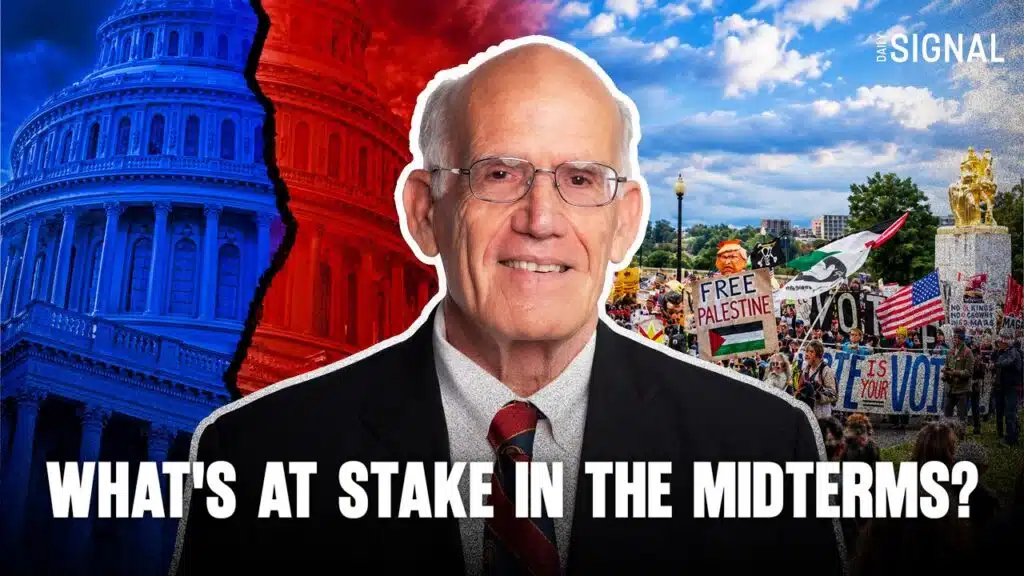
Victor Davis Hanson: The Deeper Stakes of the Midterms
Editor’s note: This is a lightly edited transcript of today’s video from Daily Signal senior contributor Victor Davis Hanson. Subscribe to the Daily Signal’s YouTube channel to see more of his videos.
This is Victor Davis Hanson for the Daily Signal.
We’re getting very close to the midterms. We’re less than three weeks away now. I would like to call them, though, the deep midterms because they’re about a deeper problem. Ostensibly, we are told that since 1900, only 12% of midterm elections have gone to the party in power in the White House.
Teddy Roosevelt, Franklin Delano Roosevelt, George Bush, and Bill Clinton, for different reasons, were able to retain a few seats and didn’t lose the House. But usually, 88% of the time, they will. So the odds say that [President Donald] Trump will not keep them. But the reason is that his personal approval is around 38% to 40%.
The price of gas right now, as I speak, is an average of $4.33 nationwide, and people are unsure what’s going to happen in the eight-month Iran war. But these are all fixable problems. The economic news is pretty good.
The Atlanta Federal Reserve says 5% growth in the fourth quarter. We have record oil and gas production. We have the highest family income in history per capita. We have the lowest poverty rate in history. Inflation is getting up near 3%, but that’s entirely governed by the price of gas and diesel fuel, and it’s two percentage points lower than the average inflation during the Biden administration.
[Gross domestic product] is 4.2%. We could go on. But the economy is pretty good, and with record foreign investment, deregulation and tax cuts, it’s going to get really good in the late fall and early winter.
But one way to look at this is that this election goes beyond the price of gas and the Iran war. We are seeing something we’ve never seen in a midterm before.
We have never seen a major political party deviate from the norms of American political traditions and protocols. And the democratic socialist-Islamist party is way off the spectrum, whether it’s defunding the police, an open border, mass amnesty, a war on fossil fuels, the Green New Deal again, or favoring the Middle Eastern Islamic countries over democratic, pro-American Israel.
So this is a very existential midterm, and we’re voting for more than just two or three issues.
We’re voting, really, on the future of the United States because these people in this socialist-Islamist party have a very different idea. We can get some idea of what it is, even though they’re not campaigning on issues. None of them are saying, “I disavow defund the police. I disavow open borders. I disavow wanting to tear down the wall. I disavow late-term abortion. I disavow my trans act.”
No, they’re not. So we have to ask what they’re talking about. It’s Trump, Trump, Trump, Trump, Trump, the bogeyman. But we can get some idea of what they’re doing for the following reasons.
Four to five million people are leaving the blue states—the blue states where Abdul El-Sayed is running, where [Peggy Flanagan] is running in Minnesota, where Mr. Troy Jackson is running on this platform in Maine, and, of course, in our governor’s race in California.
So what I’m getting at is that we’ve already seen what these people are for: a socialist-Islamist hard-left agenda. And the people are not talking about it. They’re just leaving.
They don’t want any part of it. And then, when you ask why they’re leaving and look at, say, 10 indicators or so—what’s the tax rate in blue states? What’s the deregulation or regulation status? What’s the crime rate? What’s the fertility rate? What’s the GDP? What’s the unemployment rate? What’s the affordability of housing—it’s a whole different world, and we’re almost bifurcating in the United States in a way we haven’t seen since the 1850s, when geography was a force multiplier of ideology.
Basically, we’re—if this trend continues, and this exodus is bigger than the Oklahoma diaspora of the 1930s into California. It is bigger than the black exodus from the South after World War I. It’s huge, and it’s unending, and we’re going to see two different countries separated not just by ideology—democratic socialism and Islamism versus traditional conservatism—but by locale and geography.
And so, it’s one way we could label this midterm election: It is a deep election. It’s deeper than the peripheral issues. It’s deeper than even the candidates. It’s about people who want to win Senate and House races, and they have a particular agenda. And that particular agenda is something we’ve never seen before. It transcends the price of gas. It transcends the Iran war.
Ask yourself, finally, one question: Which candidate is genuine and authentic in this sense—that they don’t say, “I didn’t mean what I said. I didn’t mean what I said. Why are you digging that up? That’s irrelevant. I’m erasing my social media account”?
So, Ilhan Omar—has anyone said that this is the worst country in the world? Has anybody on the conservative side said this is the worst country in the world? When there was a Jewish synagogue attacked by terrorists, Mr. El-Sayed said, “Hurt people hurt people.” I haven’t heard anybody excuse terrorism like that. Has anybody? I haven’t.
Mr. Hasan Piker, who seems to be the godhead of a lot of these people, has said that the United States—he said, “I hate the United States. We deserve 9/11.” I haven’t heard any Republicans say that, any conservatives say that.
I’ve heard Mr. Zohran Mamdani say that he wants to go after white neighborhoods for higher taxes. I’ve heard his housing czar say that homeownership is a sign of white supremacy. I haven’t heard a conservative black person say homeownership is a sign of black supremacy. I could go on with all of these candidates.
Ilhan Omar said this is the worst country in the world, as I said. So one side is telling you, “This is what I say. This is what I think about the United States as a socialist and an Islamist in this new coalition.” And to the degree that that might hurt my candidacy, I either say now, while I’m campaigning, “I didn’t really mean it,” or “Don’t dig that up,” or “That’s character assassination,” or “That’s Islamophobia,” or “That’s McCarthyism.”
But you know that they meant it when they said it, and they meant it and will mean it if they are elected.