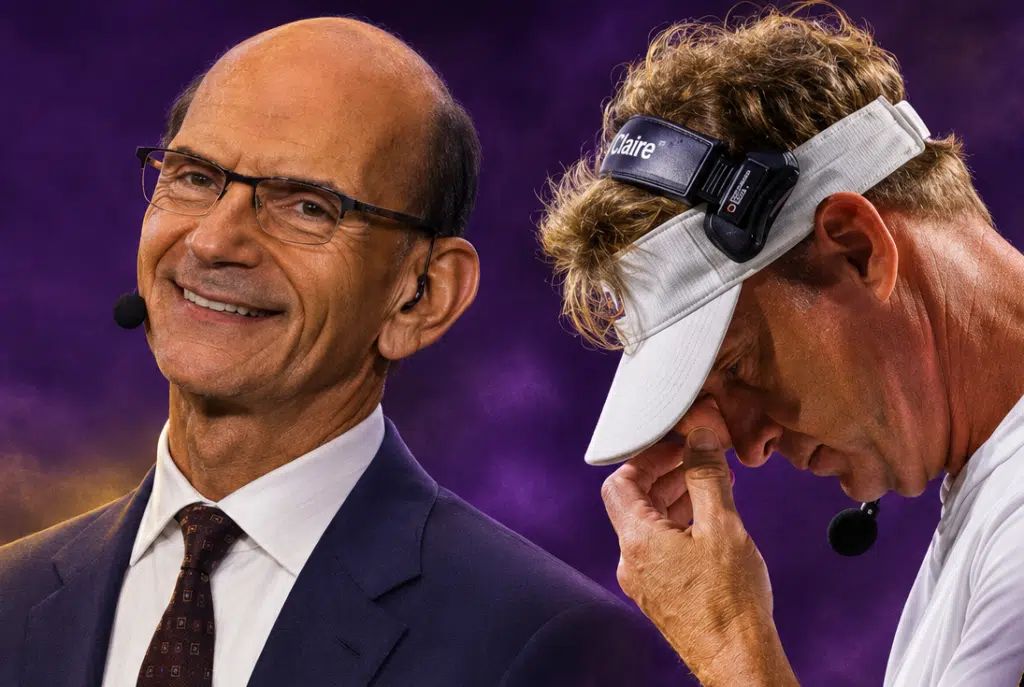
The Media’s Uncreative Case Against Lane Kiffin—and the Habit of Hate
When the same carbon-copy contempt comes at us through enough television shows, headlines, podcasts, and social media clips, if we’re not aware of what is going on, it all begins to feel like a conclusion everybody reached independently—and therefore must be true. It’s the rule of the mob, mentioned in a famous line spoken by Gracchus in the movie Gladiator, illustrated so poignantly when the mob chose Barabbas over Christ 2000 years ago. “Strength in numbers” is more than just a cliche; people feel safer inside a tribe than they do speaking out against it. There is comfort there, even if a part of them believes they are following something unfair or even untrue.
Before long in a mob-run society like our own, a football coach’s potential weaknesses and failures—those not created by said mob, mind you—have become an invitation to participate in his public humiliation, with each new voice making the temptation to pile on harder to resist.
The whole time, we could be wrong.
And even if we are right in most ways, what we don’t know is that we are not called to be the arbiters of justice in every single media-driven story in our lives.
That consolidation of hostility—aimed at LSU football coach Lane Kiffin—reveals a media habit that reaches well beyond sports. Over the years, Kiffin has given the media plenty to criticize, but the overall coverage of the man increasingly asks of fans something far beyond a simple evaluation of the football program he is running. It seems to me, in all its emotion and vitriol, to be encouraging the audience to enjoy the destruction of the man running it.
Lest we forget—or in case we’ve never been told:
- “When thy enemy shall fall, be not glad, and in his ruin let not thy heart rejoice: Lest the Lord see, and it displease him, and he turn away his wrath from him.” – Proverbs 24:17–18, Douay-Rheims.
- “He that despiseth the poor, reproacheth his Maker; and he that rejoiceth at another man’s ruin, shall not be unpunished.” – Proverbs 17:5, Douay-Rheims.
- “But thou shalt not look on in the day of thy brother, in the day of his leaving his country: and thou shalt not rejoice over the children of Juda, in the day of their destruction: and thou shalt not magnify thy mouth in the day of distress.”
— Abdias 1:12, Douay-Rheims - “Let them not say in their hearts: It is well, it is well, to our mind: neither let them say: We have swallowed him up. Let them blush: and be ashamed together, who rejoice at my evils.” – Psalm 34:25–26, Douay-Rheims; Divine Office, Roman Breviary (1939), Tuesday Matins, First Nocturn, third psalm section.
I pray the 1939 and/or 1962 versions of the Divine Office every day. This is a central theme in the prayers. Yes, punishment may come to someone through humiliation, but that doesn’t excuse the malice of those through whom it comes.
In his November 19 column, “How about lowering the heat on Lane Kiffin?,” Ron Higgins identifies one aspect behind this whole ongoing attack: ESPN’s numerous platforms allow Paul Finebaum to deliver his judgment repeatedly across different programs. Following LSU’s loss to Texas, that judgment included calling Kiffin “a broken man” who had “thrown up all over himself.”
Finebaum may have legitimate criticisms of Kiffin. But do you really want to go the way of Babylon in agreeing with him?
Finebaum’s made-for-sound-bite phrases tell us much more about Finebaum and the media than they tell us new about Lane Kiffin or the sport of college football. But true “news” doesn’t matter to these people. Once the spectacle of it all becomes a humiliation worth replaying over and over again, the network can keep selling the same emotional response through another show, another panel, another clip. Multiply that times millions and millions of user accounts, likes, and shares, and you have a mob assault we should wish on no one.
Whether particular voices are following corporate direction, copying one another, or securing the same promised incentives through their commentary, the resulting mimetic energy can sweep a nation toward a hostility far stronger than the underlying fallenness of a man warrants.
Although many will dismiss any connection between sports coverage and the broader media wickedness so many have come to recognize since 2020, I find the resemblance difficult to ignore. We all recognize the effect when celebrity voices coalesce for a cause or when the day’s talking points sound stunningly similar across supposedly independent sources. It’s called flooding the zone. So whether it makes any sense or not for Lane Kiffin and LSU football to be related to, let’s say, a Donald Trump-Elon Musk squabble from 2025, we should be quick to realize that the powers that be are about the business of relentlessly presenting to us the illusion of choice.
The point? Because they want to be able to sway the mob, and if they do it in seemingly trivial areas in the same way they do it in seemingly pivotal areas, it is more likely to become a habit-character-destiny reality. It already has become that, which returns me to the reason so many would dismiss my claim here. A relatively small subject like Lane Kiffin can still provide practice in a larger habit, which creates character, which creates destiny—a reality completely severed from God.
While we won’t be addressing the story specifically here, the same concern extends to the controversy surrounding LSU basketball player RJ Luis, regardless of where you fall on that issue.
The point isn’t the issue—that’s what people don’t understand. It’s drumming up a certain sentiment toward that issue that is important. Objecting to such excess leaves plenty of room for honest evaluation, whether he makes $13 million or $13 thousand. Kiffin’s coaching decisions, his team’s failures, and the money invested in the program are all legitimate subjects of scrutiny. But when that scrutiny becomes a recurring invitation to habitually enjoy someone’s humiliation, we should recognize what evils the media is leading us to—and what repeated participation in the ritual might make of us.
Kiffin is not a humble man, no. Kiffin owes LSU better redzone play and more victories, yes. But alongside that, and even more importantly for their own sake, media figures owe their audiences better than another uncreative invitation to hate him.