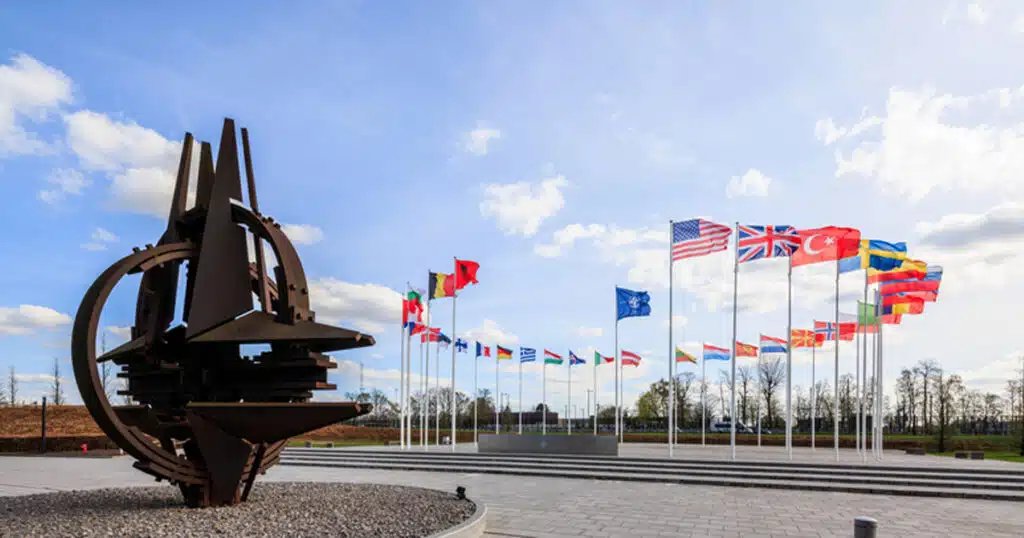
KENNEDY: Congress Must Hold NATO to Its 5 Percent Defense Spending Commitment
The main benefit of alliances, such as the North Atlantic Treaty Organization (NATO), is deterrence. Our enemies are less likely to harm one of us if they know they’ll have to face all of us.
At the end of the day, though, an alliance is just a promise—built on mutual trust—stating that we won’t leave each other to fight threats alone. An alliance will only deter threats if our adversaries sincerely believe that we will all stick together no matter what. If an alliance has loopholes, it’s not really an alliance at all.
That’s why some of the fine print in NATO’s latest defense spending commitment is so concerning. On the surface, it appeared as though every member of NATO agreed to increase its defense spending to 5 percent of its GDP by 2035—and I’m confident that many of our allies intend to do just that.
But some of our friends in NATO have already begun to weasel their way out of this commitment.
Spain, for example, has flat-out refused to spend 5 percent on defense. Spanish Prime Minister Pedro Sánchez told NATO officials that Spain would only spend 2.1 percent on defense, adding, “It is the legitimate right of every government to decide whether or not they are willing to make those sacrifices.”
To clarify: Sánchez expects the American people to make sacrifices to contribute to our shared defense, but he doesn’t want anyone in Spain to miss a single siesta for the cause. Does that sound like someone who would ride with you into battle?
Still, NATO exempted Spain and made the 5 percent defense spending requirement optional for each country, turning its commitment into a wish list.
The Spanish carveout isn’t the only crack in NATO’s commitment. Under the new agreement, only 3.5 percent of each country’s spending needs to contribute to core defense needs, such as military, ammunition, and other standard warfighting needs. The remaining 1.5 percent of spending can be applied to almost anything the country can claim is beneficial to its defense.
Italy, for example, is already planning to include a €13.5 billion bridge to Sicily as part of its 1.5 percent defense spending. The Italian government has long viewed the bridge, which would be the world’s largest suspension bridge, as a possible economic driver. Under NATO’s flimsy language, though, the bridge may count as defense infrastructure.
This wouldn’t be the first time our NATO friends skirted their defense responsibilities. In 2006, NATO agreed to have each member spend 2 percent of its GDP on defense. Only three members of the alliance had hit the spending goal by 2014, the same year that Russian President Vladimir Putin invaded Ukraine’s Crimean Peninsula. Putin’s aggression prompted NATO to reaffirm its 2 percent defense spending goal in 2014. By 2022, only seven members of NATO had reached 2 percent, and, once again, Putin invaded Ukraine in a war that continues today.
That should have been the final wake-up call our NATO friends needed to meet their 2 percent spending pledge. Still, NATO’s latest numbers show that eight members, including Canada, Italy, and Spain, have not met the 2 percent spending goal. Yet we are supposed to believe they’ll hit 5 percent defense spending by 2035.
Friends tell friends the truth. When they don’t, friendships fall apart—and our adversaries take note.
Today, I am introducing a resolution to commend our NATO allies who agreed to increase their defense spending to 5 percent and to strongly urge every member of NATO to follow through with this commitment sincerely. If we want to deter our adversaries, we need real investments in our defense, not bridges that have little, if anything, to do with national security.
NATO is one of the greatest defensive alliances in all of human history, but these loopholes make us weaker. The world needs to know we have each other’s backs, and that starts by putting your money where your mouth is.