Gratitude and the War for Words
“Once you remove a solid definition of a word and you make it mean multiple things, the word loses all its power.” -Chris Paul, Badlands Media
The Hayride‘s Quote of the Day encapsulates more about our cultural disorientation than perhaps most political analysis ever could. Once a word loses its definition, it no longer stands on truth–it bends to whoever has the authority to redefine it.
We see a fictional illustration of this in Ray Bradbury’s Fahrenheit 451 with the word “fireman.” We see countless real life examples of it when we simply press pause on life to think a little bit.
This dynamic shapes far more than arguments over vocabulary. It shapes identity, memory, and the stories we tell about who we are. Whoever shapes the words shapes the world. And perhaps the deeper question is this: Whom do we trust with that responsibility?
Consider yesterday’s reflection on Thanksgiving’s forgotten yet still documented origins–the quiet, almost hidden moments of gratitude that took place long before the version most Americans know. Why do some memories endure while others fade? And what does it say about us that certain accounts of gratitude survive while others never reach the classroom?
When words lose clarity, history loses coherence, and no longer can we recognize the patterns working against us. “Thanksgiving,” “mission,” “mercy,” “unity”–they all become drifting vessels that can be steered in any direction by whoever holds the pen. That’s not a condemnation–it’s simply an observable truth perhaps made more believable by the resistance we feel toward modern day media. It all raises a gentle but important question: Are we preserving the fullness of our story, or accepting only the parts that have been curated for us?
And if they’re curated, why are they curated?
What happens to a people when their words no longer point to stable realities? And how do we express gratitude for blessings we can’t even name clearly anymore, blessings from a God we long ago turned our back on?
This is why the “dead language” of Latin was so cherished inside the Church for nearly 2000 years, and is so fought for by Traditional Catholics–a “dead language” can’t move, can’t shift, can’t change to the whims of unwitting men.
Or worse, to the tactics of evil ones.
This is the essence of Modernism. Pius X warned that the Modernist does not reject the Faith outright; he dissolves it. He turns doctrine into “experience,” revelation into “consciousness,” and mission into “dialogue.” Even the recent language by Leo XIV of a “synodal Church… continually renewed” fits the same pattern: familiar vocabulary contorted into cognitively dissonant, destructive shapes. The words sound lovely, but the apostolic power behind them is lost. They don’t match what you thought you were taught.
Thus if a word can mean its opposite, can the truth it once carried still be received? And when the language of faith shifts with the faultlines under our feet, what exactly are we passing on to the next generation?
It is what the fight for Tradition means.
Because once you control the words, you control the story.
Or in Traditionalists’ case, you fight to return it to where it belongs.
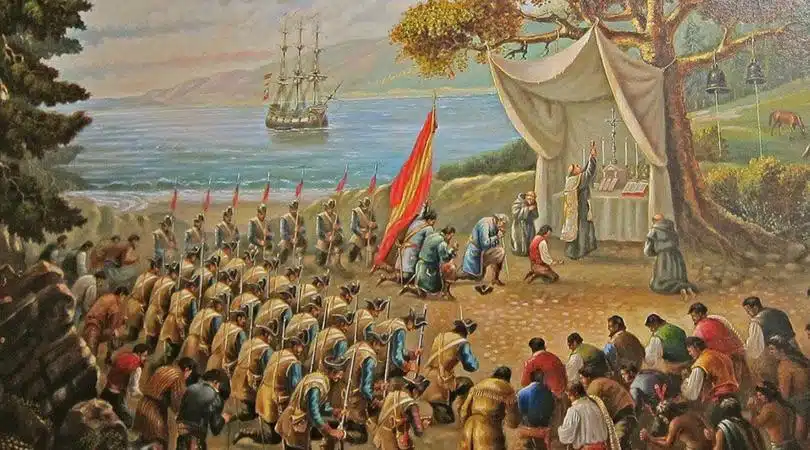
Let’s return to “Thanksgiving.” Most Americans imagine Puritans or Pilgrims somewhere on the east coast–because that’s the version handed down by publishers, curriculum committees, and textbook houses that framed the American story through a Protestant-English lens. To the victor goes the spoils, one might say. But the actual earliest Thanksgivings–the ones documented in Florida and Texas–were Catholic, sacramental, Eucharistic. They involved priests offering Mass, men giving thanks through the sacramental ritual that Catholics have always believed was instituted by Christ–the zenith of worship that definitely and not ironically means “thanksgiving.”
Do this in remembrance of me.
If these are our oldest thanksgivings, why weren’t we taught to be grateful for them? Why were they gently edited out?
The answer might whisper like a snake.
Consider that whisper. Resist turning a deaf ear.
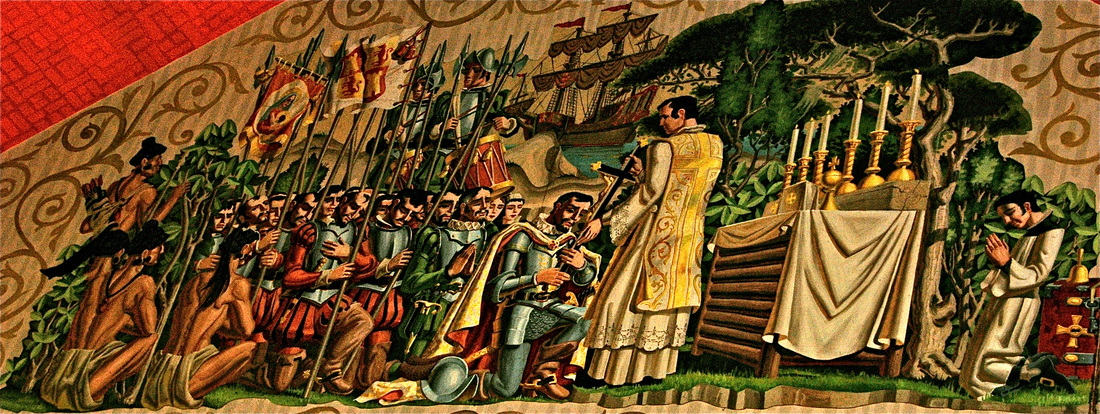
If you control the word “Thanksgiving,” you control what the nation remembers as its origin. You decide whether gratitude points upward, toward Providence–as the Traditional Latin Mass orients itself directionally and geographically–or inward, toward national brotherhood, liberty, and the best life here on earth. You decide whether the roots of the country are Catholic or Calvinist, sacramental or something else. Change the definition, and you change the memory. You control the identity.
But in the process, do you eliminate God as he commanded he be included?
Yes, to the victors go the spoils.
But exactly who are the victors?
This is how Modernism works in the Church, indeed, inside the State and society as well. Redefine “Thanksgiving,” remake “mercy,” reorient “unity,” and it all becomes goop and gobbledygook–with no shape, form, or order.
Redefine “mission,” and it becomes passive accompaniment. Ecumenism. Moral relativism. Speak your truth. You do you.
Redefine “Catholic,” and it becomes everything it was actually implemented to war against.
Definitions are anchors. Once you loosen them, everything drifts.
And both the Church and the culture are now drifting in a sea of words that no longer mean what they say–an indirect reminder, perhaps, to be grateful, at the very least, for the truths that have not yet been redefined. Maybe that’s where gratitude still has something to teach us. Gratitude requires honesty–an acknowledgment of what came before, of what we received, and of the shoulders we stand on. It’s difficult to be grateful for a past that has been edited beyond recognition.
Definitions steady us. They preserve meaning, memory, and the lessons of those who came before.
Once they slip, we drift–but once we remember what they meant and still should mean, we can find our bearings again.
This is why the Traditionalist–both the Catholic First and the American First for admittedly different reasons–fights. Let us thank God now for a prayer perhaps we can all pray in unison–that both Church and State be explicitly shown the real truth, the real way.