Fire, Lies, And A Coverup
The California wildfires have been a disaster since before they started, during their peak, and continue to be a disaster nearly a year later. Prior to igniting, the underbrush was not adequately cleared, creating fuel for the impending catastrophe.
During the fires, the response to extinguishing them was uncoordinated and chaotic. Since then, California’s bureaucracy has led to delays in permitting and rebuilding. To say that red tape has hindered the rebuilding process is a significant understatement. The hopes and dreams of nearly every resident and business owner remain trapped in the corridors of state and local authorities.
Inept Mayor Karen Bass, combined with bungling Governor Gavin Newsom and the DEI hiring of then fire chief Kristen Crowley, formed a perfect storm of incompetence that doomed areas like the Palisades and Eaton. Those fires burned tens of thousands of acres and destroyed thousands of structures.
As the smoke was still clearing, the blame game began immediately. In February of this year, Mayor Karen Bass fired Crowley from her position as LAFD Fire Chief. Officially, this was attributed to her perceived lack of preparedness for the Palisades Fire. However, many, including Crowley herself and various critics, believed the dismissal was retaliation for her outspoken criticism of budget cuts and for failing to alert the Mayor about the fire risk based on a prepared stance, which fueled the controversy surrounding her termination.
So, the battle lines were drawn. While Bass officially cited leadership and operational failures, Crowley and her supporters alleged the termination was political retaliation for her public honesty regarding budget cuts. In addition, Bass stated that Crowley inadequately staffed the operation by sending home approximately 1,000 firefighters on the morning the fires started, despite warnings of extreme weather conditions.
She went on to charge that Crowley refused to conduct an official after-action report requested by the Fire Commission, which Bass deemed necessary to investigate the fires.
Crowley testified that the department was significantly underfunded and lacked operational engines to deploy the 1,000 additional firefighters the Mayor mentioned. Also, the LAFD released records showing they had emailed media advisories and notified city officials about the predicted weather events days in advance.
Crowley also denied refusing to conduct a report, stating that she instead recommended collaborating with external investigators, such as the Fire Safety Research Institute (FSRI), to ensure an independent review.
In the aftermath of this back-and-forth, the residents still wanted to know what happened, but according to a Los Angeles Times report, the truth remains elusive.
According to records obtained by the Times, senior officials from the Los Angeles Fire Department revised and removed key findings from the department’s after-action report on the January 7 Palisades fire, which resulted in the deaths of 12 people and the destruction of thousands of homes. These changes consistently minimized failures related to leadership, preparation, and deployment decisions, especially during the crucial days and hours leading up to the fire, which intensified due to extreme Santa Ana winds.
The Times reviewed seven drafts of the report, including early versions completed by August. These drafts contained strong language, indicating that the decisions made by LAFD leadership were not in line with department policy during red flag conditions. One draft pointed out that the department’s decision not to fully staff and pre-deploy available engines in anticipation of severe wind warnings was inconsistent with established procedures. However, in the final public report, this language was changed to state that the department’s actions “went above and beyond” the standard pre-deployment guidelines.
Other edits softened or removed descriptions of operational failures. A section that was originally labeled “failures” was renamed “primary challenges.” References to violations of national firefighter safety guidelines were deleted. Notably, passages indicating that some crews waited more than an hour for assignments on the day of the fire were cut. Even aesthetic choices were debated; early drafts contained handwritten notes suggesting a change of the cover image from burning palm trees to something more “positive,” such as firefighters on the front line. Ultimately, the final report featured only the LAFD seal.
The most controversial revisions focused on events leading up to the ignition of the Palisades fire. Several drafts raised concerns about how a smaller fire that occurred on New Year’s Day, known as the Lachman fire, was handled. This fire burned in the same area and, according to some firefighters, reignited days later. One draft noted that an LAFD captain contacted Station 23 on January 7 to report that the Lachman fire had flared up again. While this reference was removed in one draft, it was partially restored in the final report, which still only briefly mentions the earlier fire.
Fire victims and former leaders of the Los Angeles Fire Department (LAFD) expressed serious concerns to the Times regarding the report’s incomplete examination of the Lachman fire. Weeks after the publication of the report, the Times uncovered that firefighters had been ordered to leave the Lachman burn site on January 2, despite warnings that the ground was still hot and smoldering. Complaints about this decision had been known within the department for months but were not addressed in the after-action report.
Former LAFD Assistant Chief Patrick Butler, who is now the fire chief in Redondo Beach, described the deletions as a deliberate attempt to conceal the truth. He expressed particular concern over the removal of references to violations of national safety standards, emphasizing that these guidelines were established following the deaths of firefighters in the line of duty.
Bass stated that her office did not direct any changes to the report. A spokesperson for the mayor told the Times that the report was written and edited by the Fire Department and that the mayor’s office sought only confirmation of factual matters, such as weather conditions and budget context. Following the Times’ report on the Lachman fire revelations, Bass requested that then-interim Fire Chief Ronnie Villanueva conduct a thorough investigation into how the department handled the earlier incident. Fire Chief Jaime Moore, who began his tenure last month, has been tasked with commissioning an independent review.
Despite the revisions, the final report still presents a concerning overview of the department’s response. It highlights issues such as disorganization, communication failures, and commanders lacking essential knowledge of wildland firefighting tactics. A paperwork error resulted in only one-third of the state-funded resources being prepositioned in high-risk areas. When the fire broke out, the initial dispatch sent only seven engine companies, even though conditions called for 27. The engines arrived and waited without assignments as confusion spread over the radio, and the staging area eventually became engulfed in flames.
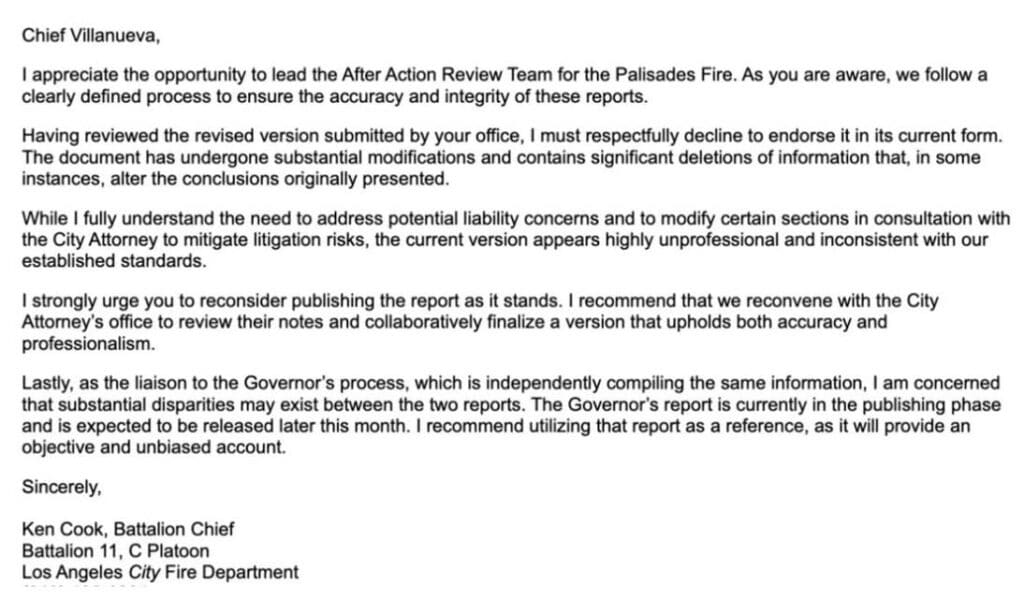
Recently, Palisades Fire Chief Ken Cook also blasted the report as ‘highly unprofessional,’ citing substantial alterations and deletions made to soften criticism of the department’s failures, including ignored wind warnings and inadequate pre-deployment of resources.
In an email obtained by the Times, Cook wrote to then-interim fire chief Ronnie Villanueva.
“Having reviewed the revised version submitted by your office, I must respectfully decline to endorse it in its current form. The document has undergone substantial modifications and contains significant deletions of information that, in some instances, alter the conclusions originally presented.”
Los Angeles is the perfect example of how not to run a city. It appears that a significant portion of the fire could have been prevented entirely; it most certainly could have been contained much more competently.
It sounds like there is plenty of blame to go around, and, unsurprisingly, no one is willing to accept any. Still, past errors are only being compounded by the incessant foot-dragging that prevents streamlining the permitting process so rebuilding can commence.