Acquiring Greenland Is a Potential Twofer for the U.S.
Donald Trump has always liked to troll his opponents, and it’s provided great amusement for his followers. Whether it’s making Canada the 51st state, putting his bust on Mount Rushmore or taking back the Panama Canal, watching his critics have a collective aneurysm every time he says something unexpectedly outrageous is hilarious.
That’s why the rapid escalation of the effort to acquire Greenland over the past week was unusual and surprising. Most everyone thought it was just another clever troll, but it quickly evolved from meme territory to stone-cold seriousness almost overnight, and it’s pretty clear that the Greenland issue is much closer to becoming an international crisis rather than a belly laugh. The parties involved are realizing Trump isn’t joking, and that he really does want Greenland to become part of the U.S.
The Basis for Trump’s Greenland Grab
Whether we realize it or not, world powers are becoming increasingly hegemonic. Whether it’s Russia’s efforts in Ukraine and the Baltics, or China’s absorption of Hong Kong and determination to conquer Taiwan and other Southeast Asian states, countries with military and economic might are flexing their muscles. Russia and China’s alliance is a serious effort to upend the traditional world order. It’s not a photo op. Both Xi Jinping and Vladimir Putin believe the United States is in decline and destined for collapse. If woke leftists get their way and can rig enough elections to gain permanent power, we will live in a world completely dominated by authoritarians.
Trump sees this and realizes that to secure a future for America that includes prosperity and self-sufficiency, the U.S. must expand its influence outside of current borders.
Thus, the effort in Venezuela, which may have been premised on stopping the flow of deadly drugs, but boy, controlling the country with the largest proven oil reserves in the world ain’t a bad side benefit. Venezuela has 303 billion barrels of oil in reserve. By contrast, the U.S. has 45 billion barrels.
Greenland is even more critical to U.S. security and prosperity than Venezuela. The geopolitical implications of control of Greenland are profound since its location above the Artic Circle makes it crucial for U.S. defense operations, particularly for missile defense and monitoring North Atlantic shipping routes.
Perhaps more importantly, Greenland would immeasurably enhance U.S. economic security moving forward because of receding ice sheets and milder temperatures. While it is true Greenland has abundant desirable natural resources, including rare earth minerals, oil and natural gas reserves, it’s the opportunities that are presenting themselves in creating shorter shipping routes from Southeast Asia and Russia to Western Europe and the U.S. that are most compelling. If the Northern Sea Route becomes practical, it is estimated that companies will save as much as 50% on shipping costs compared to using the traditional pathway through the Suez Canal.
Europe Loses It
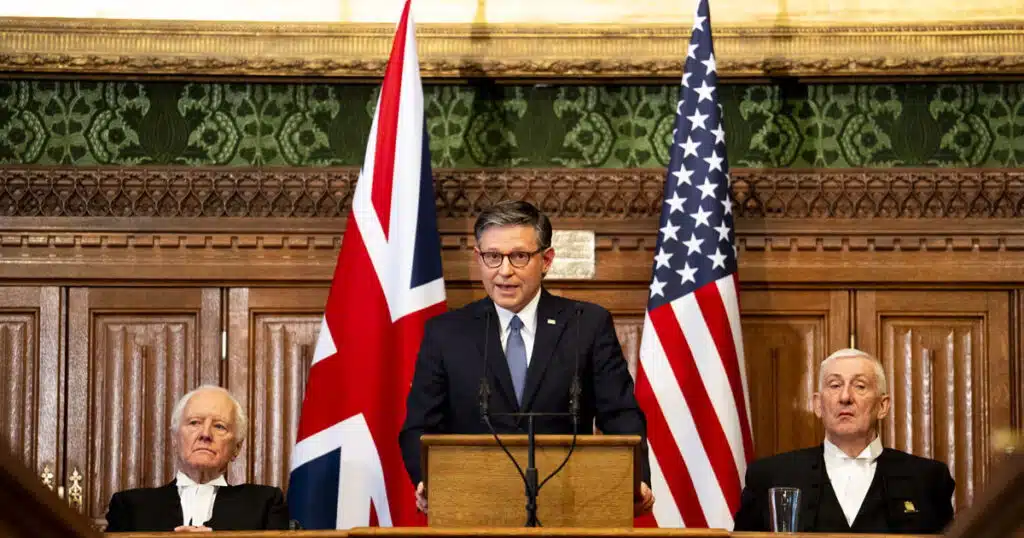
Naturally, Europeans were apoplectic as they began to realize how serious Trump is about Greenland. To that end, the president announced he is going to impose an additional 10% tariff on any European countries that oppose the Greenland acquisition.
The reaction was predictable.
The eight European countries targeted by Trump released a joint statement that warned the tariff threats “undermine transatlantic relations and risk a dangerous downward spiral.”
Danish Prime Minister Mette Frederiksen was equally outraged, saying, “The U.S. has no right to annex any of the three nations in the Danish kingdom. I would therefore strongly urge the U.S. stop the threats against a historically close ally and against another country and another people, who have very clearly said that they are not for sale.”
A Potential Twofer: Greenland and The Destruction of NATO
Frederiksen has said repeatedly that an attack and forcible takeover of Greenland would bring an end to NATO, which may be true, but not necessarily.
If the situation played out where the U.S. simply landed troops, Corps of Engineers and critical operations personnel on Greenland, who exactly is going to stop them? You really think French or British troops will fire on American soldiers? It’s bizarre, but likely, that the U.S. could functionally control Greenland without the rest of the world acknowledging it, unless Trump and Congress made the annexation official, which is unlikely.
So, while it might seem counterintuitive to think NATO would survive one member “attacking” another, it’s the most probable outcome
Which is a shame.
NATO has been nothing but a lead weight around the neck of the U.S. since the Cold War ended. The need to frame Russia as an authoritarian boogeyman actually turned the country into one. The cost to the world both in terms of lost economic opportunities and geopolitical consequences since the fall of the Berlin Wall has been incalculable.
And why? Because NATO’s total budget for common funding is $4.1 billion, and its combined expenditures exceed $1.4 trillion annually. That’s a lot of money left on the table if NATO no longer had a mission, which would be the case if Russia was a friend to the West. In fact, it’s too much money to walk away from, so prepare to see Russia portrayed as the big, bad enemy for a very long time.
Even Trump taking Greenland probably won’t fracture the alliance because there is too much money involved.
But we can hope, can’t we?