Purchasing Alaska Was Once Called “Seward’s Folly.” Doubters Are Making The Same Mistake With Greenland
About this same time last year, I wrote a column concerning Trump’s and the United States’ interest in Greenland. This is an updated version of that column.
In 1859, Russia proposed selling Alaska to the United States, believing that this move would counteract the ambitions of its primary rival in the Pacific at the time, Great Britain. The impending U.S. Civil War delayed the sale, but after the war concluded, Secretary of State William Seward quickly revisited the issue. On March 30, 1867, he accepted a renewed offer from the Russian Minister in Washington, Edouard de Stoeckl, to purchase Alaska for $7.2 million. The Senate approved the treaty of purchase on April 9, and President Andrew Johnson signed it on May 28. Alaska was officially transferred to the United States on October 18, 1867. This purchase marked the end of Russia’s presence in North America and secured U.S. access to the northern Pacific Rim.
For three decades after it was purchased, the United States paid little attention to Alaska, which was governed alternately by military, naval, or Treasury authorities—and at times, had no visible rule at all. In an effort to enforce U.S. mining laws, the United States established a civil government in 1884. Critics had referred to the acquisition of Alaska as “Seward’s Folly,” but former Secretary of State William H. Seward was vindicated when a significant gold deposit was discovered in the Yukon in 1896. This discovery made Alaska the gateway to the Klondike gold fields. The strategic importance of Alaska was finally recognized during World War II. Alaska became a state on January 3, 1959.
Alaska was called “Seward’s Folly” because many Americans thought the purchase was a waste of money. The press also mocked the purchase, calling it “Seward’s icebox” and “Andrew Johnson’s polar bear garden.”
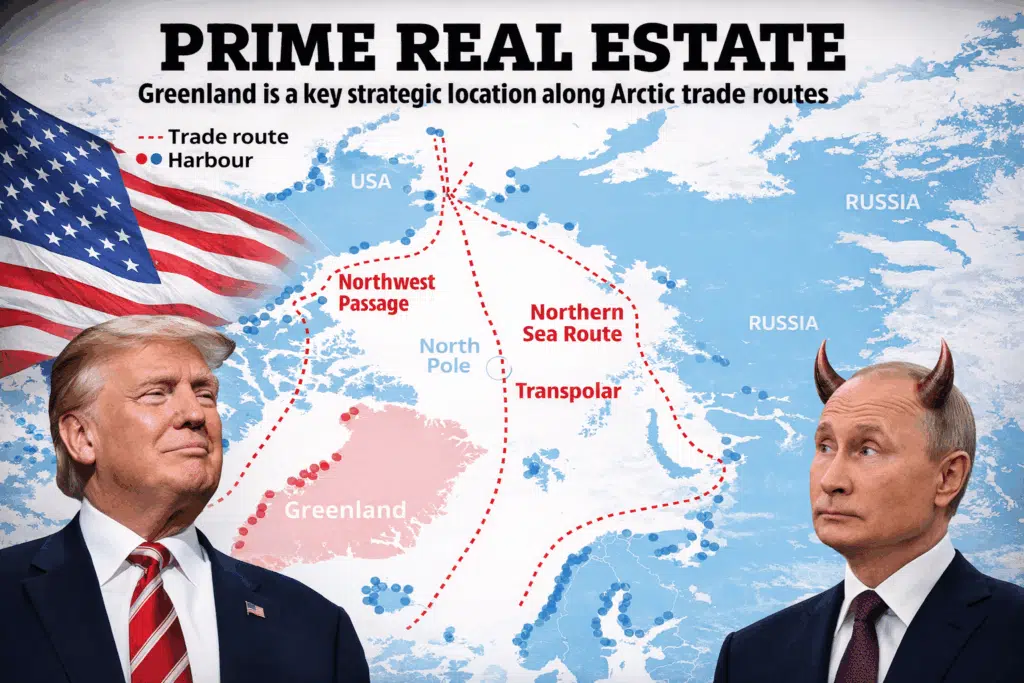
This story may be repeating itself with Trump’s discussions concerning Greenland. Around this same time last year, Megyn Kelly interviewed the then-recently confirmed Secretary of State, Marco Rubio. He then and now affirms that Trump’s intentions regarding Greenland are serious and clarified that the acquisition is not about expanding territory but rather about national security.
At that time, Rubio explained Trump’s approach to Megyn Kelly on her SiriusXM show.
“Well, I think President Trump, what he has said publicly, is that he wants to buy it. He wants to pay for it. How we worked on something like that, how something like that is approached, obviously, is probably done better in the appropriate forms. A lot of this stuff is done publicly, and it’s not helpful because it puts the other side in a tough spot domestically. So those conversations are going to happen. But this is not a joke. What he is saying is pretty accurate.”
“This is not about acquiring land for the purpose of acquiring land. This is in our national interest, and it needs to be solved. President Trump has put out there what he intends to do, which is to purchase it. I wasn’t privy to that phone call, but I imagine the phone call went the way a lot of these phone calls go, and that is, he just speaks bluntly and frankly with people. Ultimately, I think diplomacy in many cases works better when you’re straightforward as opposed to using platitudes and language that translates to nothing.”
The overreaction by Democrats, the MSM, and some RINOS to Trump’s idea is predictable, sadly, not because it’s a bad idea, but because Trump is suggesting it.
The United States has historically considered Greenland essential for the defense of its mainland, and former military strategies included Greenland among the territories that the US would occupy and strengthen in the event of a potential war.
President Harry Truman considered Greenland strategically important to U.S. defense against the Soviet Union. In 1946, he proposed to offer Denmark $100 million in gold to acquire the territory, viewing it as essential for detecting potential Soviet bomber attacks. However, Denmark rejected the sale. Later, the United States secured long-term military access to Greenland through a treaty.
The interest originated with the onset of the Cold War, as advisors highlighted its significance as a “geographic bulwark” against Soviet expansion. While the purchase failed, the U.S. eventually secured permanent military basing rights through a 1951 treaty with Denmark, establishing a lasting strategic presence.
Democrats got used to Biden doing nothing and never thinking outside the box. Hell, let’s be honest; all they care about is their own personal wealth and their agenda to destroy everything about Western civilization. Trump is laser-focused on preserving America’s values and its future.
Greenland is known as the “land of the midnight sun” because the sun doesn’t set in central Greenland from the end of May to the end of July. This sounds perfect for a man like Trump, who will never sleep until he’s done everything he can for our nation.