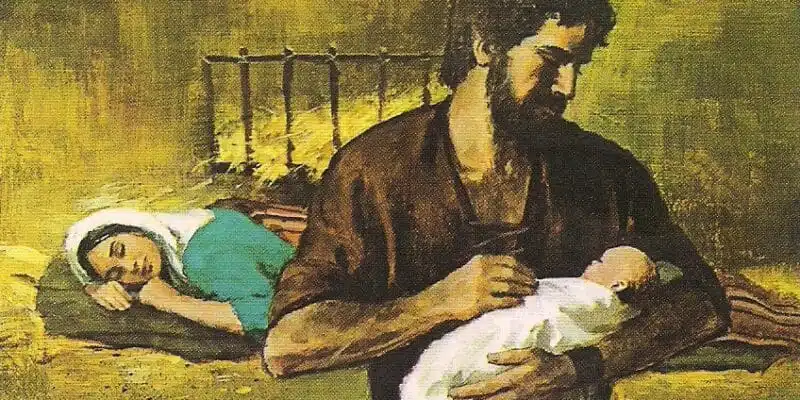
St Joseph at Fatima, Mary’s Submission, and the Collapsing Sun
“Both husband and wife, however, receiving these children with joy and gratitude from the hand of God, will regard them as a talent committed to their charge by God, not only to be employed for their own advantage or for that of an earthly commonwealth, but to be restored to God with interest on the day of reckoning.”
-Pope Pius XI, Casti Connubii (On Christian Marriage)
The apparitions at Fatima is often remembered for its warnings, its secrets, and above all the Miracle of the Sun.
But like many things in the life of the Church, what captures the imagination is not always what carries the deepest meaning.
There are details—quiet ones, almost hidden in plain sight—that, once seen, reshape the entire message. One such detail is so overlooked that even those familiar with Fatima often miss it entirely.
Today is the feast day of St Joseph, one of the ones left untouched in the new calendar. And we remember him today in a way and in a place not very often discussed. The notion of “memory-hole” has a most puzzling illustration in the great non-event of St Joseph’s very own appearance at Fatima.
It is one of the most maddening aspects of the entire Fatima story. For much of my life, I had completely forgotten about a little book titled St Joseph, Fatima and Fatherhood I’d obtained decades ago, about the significance of his appearance with the Child Jesus and Mary on October 13, 1917, the last of six dates Mary appeared to the three children in the small village in Portugal.
One might think that would be pretty significant. Especially since he appeared in direct conjunction with the infamous Miracle of the Sun event.
Then again, I don’t think I’d ever actually chosen to read the book as a child, so its contents were something I alone had the responsibility of not knowing. It is one of those little opportunities we miss in life that would, most fortunately, come back around for me.
There are two crucial aspects of this final Fatima apparition on which to reflect. First, there is the docile scene of Joseph holding the Child standing to the left of the sun and blessing the world, while the Virgin Mary is standing to the right of the sun; secondly, there is the unmistakable miracle Mary had promised the children months before—an erratic, spinning crash of the sun toward Earth witnessed by 70,000 spectators who, of course, thought the end of the world was upon them. In this second event, the members of the Holy Family are not visible anymore.
These two events may seem wholly disjointed at first glance. Indeed, before I became reacquainted with St Joseph’s presence at Fatima in 2020, the Miracle of the Sun seemed more a major sign than anything—a sign promised by Mary so that the multitudes would believe the children’s story going back to May 13. But the reality of Joseph, and him holding the Child no less, is so abundantly important that it defies understanding as to why his part of the story is left out entirely from modern Church teaching.
Sister Lucia described the appearance in her Memoirs:
After Our Lady had disappeared into the immense distance of the firmament, we beheld St Joseph with the Child Jesus and Our Lady robed in white with a blue mantle, beside the sun. St Joseph and the Child Jesus seemed to bless the world, for they traced the Sign of the Cross with their hands.
Over the years, particularly in my meditations on both the Rosary and the Seven Dolors chaplet, I have learned much concerning the deference of Our Blessed Mother to her husband. The truth that Fatima seems to point to is that this deference is not only an act of her will, but more importantly an act of God’s will. It is Joseph and the Child blessing the world in the first part of the apparition, not Mary. This would seem to put Joseph on a pedestal enough to imply his superior holiness, but the truth, as we know, does not draw us to this conclusion. It is this fact—that Our Lady and Our Lord both hold more rank in holiness than St Joseph—that makes this blessing, this clear fatherly authority in the family, evidence that Joseph’s power is willed by God the Father himself.
And he wills it in this way because the human race needs order, and a consistent one.
St Joseph’s Dreams
Consider Scripture. God sends the angel Gabriel at the Annunciation to announce the conception, by the Holy Ghost, of the Messiah in Mary’s womb. Yet, despite Mary’s immaculate conception and St Joseph’s natural conception, the angel would appear to Joseph in a dream four times when it came time to protect the family. The first time was to assure him that Mary, to whom he was already betrothed, was in fact still a virgin and that it was by the Holy Ghost that she was with child (Matt I.19-20). This is known in some circles I believe as the Annunciation of Joseph.
The second dream was to warn St Joseph to take the Child and his Mother to Egypt to avoid Herod’s murderous plot (Matt II.13). The third was to inform him that those who meant to kill the Child were now dead, and that he could return the family to the land of Israel (Matt II:19-21).
The fourth dream, in my humble observation, perhaps shows the agency and authority of St Joseph more than any other—even to the level handed over by God the Father himself. In the immediate verse following the above, where the angel directs Joseph to take the family back to Judea, a strange thing occurs. This verse states, after Joseph had indeed taken the family back to Israel, “But hearing that Archelaus reigned in Judea in the room of Herod his father, he was afraid to go thither; and being warned in sleep retired into the quarters of Galilee. And coming he dwelt in a city called Nazareth, that it might be fulfilled which was said by the prophets: That he shall be called a Nazarene” (Matt 2:22-23).1
Glossa Ordinaria (1480) has this to say on the two journeys:
Joseph was not disobedient to the angelic warning, but “he arose, and took the young Child and his mother, and came into the land of Israel. “The Angel had not fixed the particular place, so that while Joseph hesitates, the Angel returns, and by the often visiting him confirms his obedience. ord.: But then we might ask, why was he not afraid to go into Galilee, seeing Archelaus ruled there also? He could be better concealed in Nazareth than in Jerusalem, which was the capital of the kingdom, and where Archelaus was constantly resident. To this he adds the Prophet’s testimony, saying, “That is might be fulfilled which was spoken by the Prophets “Otherwise we may explain that it is found in Isaiah rendered to the strict letter of the Hebrew.
This commentary is somewhat obscure, but still, we see a bit of a puzzle in the passage from Matthew. Why the two dreams? When the coast finally cleared of Herod, but Herod’s son had assumed the throne, why wouldn’t God simply have his messenger instruct Joseph to go to Nazareth in the third dream? Why tell him to return home if home was so dangerous? And perhaps most convincingly, why tell him to return home if the Old Testament had prophesied that the Messiah would be called a Nazarene?
Humbly I present a possibility, all the while submitting to any previous commentary I have yet to discover.
There seems to me to be an inspiring answer—inspiring for the human race, particularly the men who so badly need it today—that keeps intact God the Father’s omnipotence and sovereignty, and that is the reality that God allowed Joseph, and no other, the chance to examine the landscape and make a new decision that would protect the Child and his mother. God clearly knew of the danger in Judea, despite Herod’s death, and could very well have skipped the third dream; instead, he makes abundantly plain for anyone reading this chapter the unfailing trust he has in Joseph. He willingly hands Joseph the authority to either stay or go, and of course Joseph’s concern with Archelaus is the precipitating prayer that invites the fourth and final dream—which is God’s response to that concern, the response to that prayer.
Such a prayer may have gone like this….
Yahweh, I am deeply troubled by the fact that you have led us back into possible danger. But you know you have my trust, and I know you know all things. Help me protect the Child and his Mother. Guide me in thy holy and never-failing will.
Yes, Joseph, your concern is warranted, and your faith has earned you favor. You have wrestled well. The Child and his Mother are indeed still in danger. Rise now, and take them to the land of Galilee. There, you will be blessed.
The Popes, St Joseph, and Fatima
It all is so fascinating, so inspiring, particularly whilst meditating on the mysteries of the Holy Rosary. The exchange between God and man is much like what Pope Benedict XV did back when his prayer seemed to precipitate the coming of Our Lady of Fatima. God Almighty had already decided on the response to the prayer he also inspired, which, like St Joseph’s story, also included an angel. It is the miracle of a humble God helping us believe in the power of simply going to him in faith.
This is why Mary’s soul “magnifies the Lord.” Because it is her humility more than her power than illuminates his heart.
God lowers himself when he doesn’t have to. All for the sake of helping us believe in ourselves, to know that his grace alone is sufficient for us in our human weakness.
He is saying to St Joseph, point blankly—I trust you, because I chose you.
I trust you with my very own Son and his Mother. You protect them.
You and no other.
When the enemy wanted to destroy the Savior of the world, at every turn it was St Joseph God sent the angel to. And Mary—the Holy Mother of God herself—submitted to him.
And she submitted because Joseph was the head of the household. Because she understood right order, despite her singular calling.
The true Catholic faith has always taught this. Once upon a time for over 1900 years, she was not ashamed of difficult passages in Scripture. She didn’t skip over them at Mass so as not to anger the congregation. As Pope Leo XIII taught in 1880 in Arcanum Divinae Sapientiae (On Christian Marriage), in what is simply an extension of St Paul’s Letter to the Ephesians, the structure of the family is not a social construct, but a divine one:
The husband is the head of the family and the head of the wife; and the woman, because she is flesh of his flesh and bone of his bone, must be subject to her husband and obey him… not, indeed, as a servant, but as a companion.
There is no modernist ambiguity in the matter. It is not a statement of domination or control, but of order—an order commanded by God himself, reflected even in the hidden life of Nazareth and in these latter times, unmistakably, in the final vision of Fatima.
Leo XIII precedes even this basic command with the deterioration of marriage in Old Testament times. Reading this may make one wonder how it sounds, to some degree, so much like the licentiousness and sin of today. Indeed, in our human frailty, so often false teachers will take historical developments like this as Biblical evidence of the acceptability of such madness in modern times—when in actuality it is simply a cautionary tale in God’s Divine Word as to what not to do, what culture not to fall into:
But the corruption and change which fell on marriage among the Gentiles seem almost incredible, inasmuch as it was exposed in every land to floods of error and of the most shameful lusts. All nations seem, more or less, to have forgotten the true notion and origin of marriage; and thus everywhere laws were enacted with reference to marriage, prompted to all appearance by State reasons, but not such as nature required. Solemn rites, invented at will of the law-givers, brought about that women should, as might be, bear either the honorable name of wife or the disgraceful name of concubine; and things came to such a pitch that permission to marry, or the refusal of the permission, depended on the will of the heads of the State, whose laws were greatly against equity or even to the highest degree unjust. Moreover, plurality of wives and husbands, as well as divorce, caused the nuptial bond to be relaxed exceedingly. Hence, too, sprang up the greatest confusion as to the mutual rights and duties of husbands and wives, inasmuch as a man assumed right of dominion over his wife, ordering her to go about her business, often without any just cause; while he was himself at liberty “to run headlong with impunity into lust, unbridled and unrestrained, in houses of ill-fame and amongst his female slaves, as if the dignity of the persons sinned with, and not the will of the sinner, made the guilt.” When the licentiousness of a husband thus showed itself, nothing could be more piteous than the wife, sunk so low as to be all but reckoned as a means for the gratification of passion, or for the production of offspring. Without any feeling of shame, marriageable girls were bought and sold, tike so much merchandise, and power was sometimes given to the father and to the husband to inflict capital punishment on the wife. Of necessity, the offspring of such marriages as these were either reckoned among the stock in trade of the common-wealth or held to be the property of the father of the family; and the law permitted him to make and unmake the marriages of his children at his mere will, and even to exercise against them the monstrous power of life and death.2
That is not permission to cast marriage to the trash bins in modern times. That is an illustration of what happens when the human race loses sight of the right order of God.
Order. It is what most everyone not dubbed “woke” wants. And yet the order of the family is one of those niggling little laws that get relegated to an ancient past, even by conservatives, not fit for how God expects us to live today.
That is Modernism. And we see it murdering everything around us—indeed we moan and grumble about it all—every single day.
But we don’t want the remedy.
This is why the final apparition is so critical to understanding the overall message of Fatima. Leaving St Joseph out of the story keeps it incomplete. It is only when he is included that we find that the ultimate miracle of Fatima does not have to do with Mary alone.
It has to do with the family.
The attack on the family has been raging in the free world for decades now. The movie A Wolf in Sheep’s Clothing, while modernist in some aspects, can shed light on the slow, sinister creep of evil into supposed first world cultures, targeting, specifically, the nuclear family. It is not always the destruction of Christendom by an outside enemy but an inscrutable crumbling from within, just as termites destroying a house go unseen while, for a time, the exterior appears untouched.
This is largely what was happening in the decades leading up to the 1960s revolution. It is what the 19th century popes and Pius X in the beginning of the 20th had been warning about. Vatican II wasn’t the beginning—it was the culmination.
Symbolically, in the apparition, when the Holy Family is intact, the sun remains still between them. Equally symbolically, when the Holy Family is no longer seen in its entirety, it is then that the sun begins to shake and plummet toward Earth—indicating a chilling omen of what is to come if we reject the sacredness of the family. In 2008, Carlo Cardinal Caffarra said that Sister Lucia herself, the only one of the three children to see the entirety of the final apparition, had written to him, saying:
Father, a time will come when the decisive battle between the kingdom of Christ and Satan will be over marriage and the family. And those who will work for the good of the family will experience persecution and tribulation. But do not be afraid, because Our Lady has already crushed his head.
It is the “fear and trembling” of St Paul, so that if love doesn’t move us, holy fear will. And yet even still, in that holy fear it is also a most promising hope, the morning sun’s beauty in St Joseph’s courage, in Our Lady’s submission, in Our Lord and his ultimate triumph.
Final Thoughts
Fatima is not merely a warning about punishment. It is a revelation of order.
Before the sun shakes, before the world is made to feel the weight of its own instability, heaven shows us something almost disarmingly simple: a father, a mother, and a Child—rightly ordered, rightly placed, rightly submitted to God and to one another.
And then it removes that image.
And the sun collapses.
We search endlessly for explanations of collapse—political, economic, technological—while the Catholic Church, through her saints, her Church Fathers, and her popes, has already told us where to look. The disorder of the world begins in the disorder of the home. And the disorder of the home begins when the dance between authority and submission willed by God is either forgotten, neglected, or outright rejected.
The vision at Fatima is not given to paralyze in fear, but to recall men to the gravity of fatherhood, not as domination, but as sacrificial guardianship. It is to recall women to the strength of ordered love, not as spineless inferiority, but as participation in divine harmony. It is to recall families to their true end—not comfort, not status, not survival, but sanctity.
It is yet another reason why “once saved always saved” is not sustainable inside the world in which God couched us. We stiff-necked humans, as Scripture so clearly illustrates, will do what we are allowed to do. And if we believe nothing we do matters, we will not place holy priority on getting ourselves, our spouses, and our children to heaven. There is nothing at stake in such a belief, and in such a belief anything goes.
Even the collapse of the sun.
God has not changed his design. He has not revised his expectations. He has not abandoned his people to confusion.
He still entrusts the Child to Joseph.
He still crowns humility with authority.
He still builds his kingdom inside the quiet, hidden, prayerful life of family.
The battle, as Sister Lucia warned, is here.
But so are the weapons to win.
And so the question is no longer whether the world is shaking.
It is whether we will rebuild what heaven has already revealed—quietly, faithfully, and without compromise—before the tremor of the Son arrives.