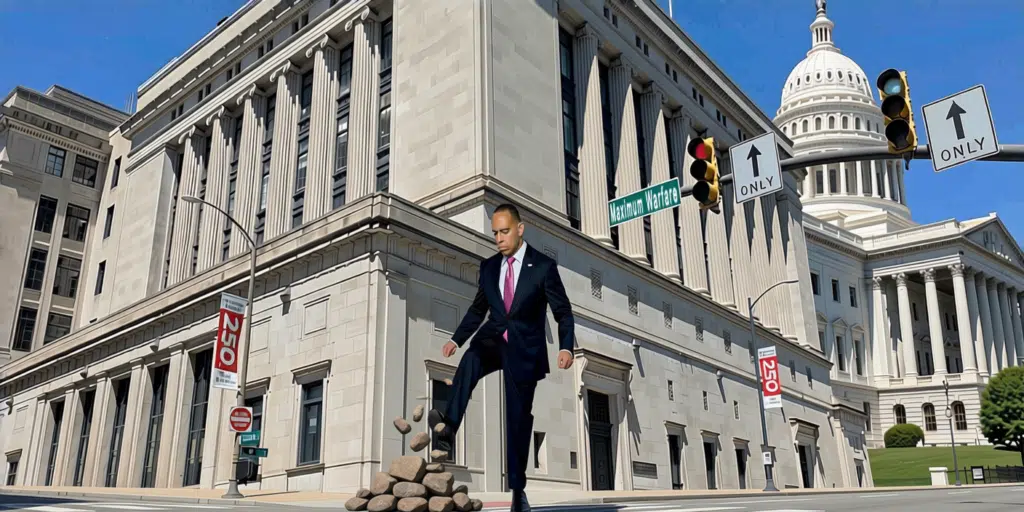
On The Dems’ No-Good, Very Terrible Week
Dems are having a less than optimal week. SCOTUS tanked racial gerrymandering, Tennessee redrew its boundaries to eliminate a Humanoid Hemorrhoid named Steve Cohen, and SCOVA aborted the 10-1 redistricting love child of Obama, Extreme Hakeem, and Abby Spanberger.
There is probably nothing less racist than the redistricting fight in Tennessee this week, despite the immediate cries of racism from the usual corners. What happened was not racial. It was political. There is a difference, and pretending otherwise is part of the reason Americans no longer trust the people framing these debates.
It is no secret that African Americans vote overwhelmingly Democrat. In Memphis, those voting patterns are among the most predictable in the country. Once the Supreme Court substantially narrowed the role race can play in redistricting decisions, Tennessee Republicans did what Democrats have been doing for decades in states like Illinois, New York and Maryland: they targeted an opposing party stronghold and tried to dilute its political influence. That is not some uniquely Southern tomfoolery.
It is just modern American politics practiced openly and aggressively by both parties. The move by Republicans in the Volunteer State was naked political aggression, but legal naked political aggression.
The key point is this: Memphis-area voters were not targeted because they were black. They were targeted because they reliably elect Democrats, specifically longtime Congressman Steve Cohen. If Memphis had been a heavily white urban district voting 80 percent Republican for forty years, Democrats would be trying to carve it apart with exactly the same enthusiasm Republicans are showing now.
What makes the outrage especially selective is the history of Tennessee’s 9th Congressional District itself. The modern majority-minority version of the district did not emerge naturally from geography or community cohesion. It was largely engineered during the redistricting cycle following the 1980 Census, when lawmakers centered the district around the heavily African American urban core of Memphis. That configuration emerged during the peak era of Voting Rights Act enforcement and under enormous federal pressure to create districts where minority voters could reliably elect candidates of their choice.
No federal judge sat down with a map and drew the district personally. Tennessee legislators drew the boundaries themselves, but they did so under the unmistakable understanding that failing to create or preserve majority-minority districts could bring lawsuits, Justice Department objections, or direct federal intervention. Throughout the South, heavily African American urban populations were consolidated into safe Democrat districts while surrounding suburban and rural districts became whiter and more Republican. Both parties quietly benefited from the arrangement.
In other words, the district itself was already the product of intentional political engineering. The only thing that changed this week is which party benefits from the engineering.
And that is where the whole performance becomes difficult to take seriously.
Is the most entertaining part that the congressman representing this “racially sacred” district is himself white? Steve Cohen has represented a majority-black district for years without Democrats objecting that the seat somehow “belongs” to an African American representative.
Or is the more revealing part that Democrats have spent staggering sums of money ($80-$100 million) over recent election cycles trying to prevent a black Republican woman from winning election to the House from Tennessee?
Apparently racial representation is vitally important and sacrosanct right up until the minority candidate stops voting the way progressive activists demand.
That contradiction exposes the real issue. Much of modern political rhetoric about race is not actually about race at all. It is about preserving political power while framing opposition as morally illegitimate. When Democrats draw districts to maximize partisan advantage in New York or Illinois, it is called protecting democracy. When Republicans do the same thing in Tennessee, it suddenly becomes an existential threat to civil rights.
Americans are expected to pretend these are fundamentally different activities when they are often nearly identical tactics wrapped in different moral packaging.
None of this means redistricting is noble, but it does mean melanin content should never have anything to do with it.
Gerrymandering is ugly no matter who does it, and I have never been a fan of it, but as long as Democrat states where Republicans get 40% of the vote but have zero Republican representatives, they can spare me their crocodile tears and threats. If Americans are going to have an honest discussion about representation, then honesty has to begin with admitting that both parties manipulate district boundaries for partisan gain whenever they possess the power to do so.
Tennessee did not invent that game. It simply stopped pretending not to play it.
Florida is doing the same.
Being a Ole Miss fan, I can’t stand that god-awful orange. It’s not in my color palette but I am not above a rousing rendition of Rocky Top to celebrate Republicans finally growing a set and playing some bare-knuckled politics.