A Warning From Across The Pond
Europe is warning us again. We’d better listen.
For years, Western leaders told their citizens that open borders were compassionate. Enlightened. Inevitable.
They told them national identity was outdated, that borders were relics, that assimilation wasn’t necessary, and that anyone who objected was simply afraid of the future.
Well, the future has arrived.
Across Europe, ordinary citizens are asking a question their leaders spent decades refusing to answer: what happens to a nation when it loses control of who enters, who stays, and what values govern public life?
The answer is no longer merely theoretical.
From Britain to France, from Germany to Sweden, from Ireland to Northern Ireland, the consequences of mass migration without meaningful assimilation are now visible. They’re showing up in overwhelmed public services, strained schools, rising social tension, parallel communities, public disorder, and a growing sense among native citizens that their governments care more about abstract global ideals than the peace, safety, and continuity of their own people.
Of course, that doesn’t mean every migrant is dangerous. It doesn’t mean every asylum claim is false. It doesn’t mean charity has no place in public policy.
Of course mercy matters. A civilized nation should show mercy.
But a civilized nation must also show prudence. Charity without order isn’t compassion. It’s surrender.
The great mistake Europe made wasn’t merely allowing too many people to enter too quickly. The deeper mistake was moral and civilizational. Europe forgot that a nation is more than an economy. It’s more than a labor market. It’s more than a tax base.
A nation is a people joined by memory, law, language, custom, sacrifice, and a common understanding of right and wrong.
When that common understanding is weakened, everything else begins to shake.
A country can’t import the world’s conflicts, customs, grievances, and tribal divisions at unlimited scale and expect social peace to survive untouched. A country can’t tell its own citizens that their history is shameful, their traditions are disposable, their borders are illegitimate, and their concerns are hateful, then act surprised when trust in government collapses.
That’s what the open-borders ideology has done. It has redefined the nation from a home into a hotel. It has reduced citizenship from an inheritance of duty into a paperwork status. It has treated national culture as an obstacle to be managed rather than a treasure to be preserved.
The result isn’t diversity in the healthy sense. It’s fragmentation.
When the host culture is told to apologize for itself, and newcomers aren’t expected to assimilate into it, the nation becomes a collection of competing enclaves
The law may still describe one country. But the streets begin to tell another story.
Europe’s leaders have often responded with condescension. When citizens complain, they’re lectured. When they worry about crime, they’re scolded. When they object to the rapid transformation of their towns, schools, neighborhoods, and public spaces, they’re branded extremists.
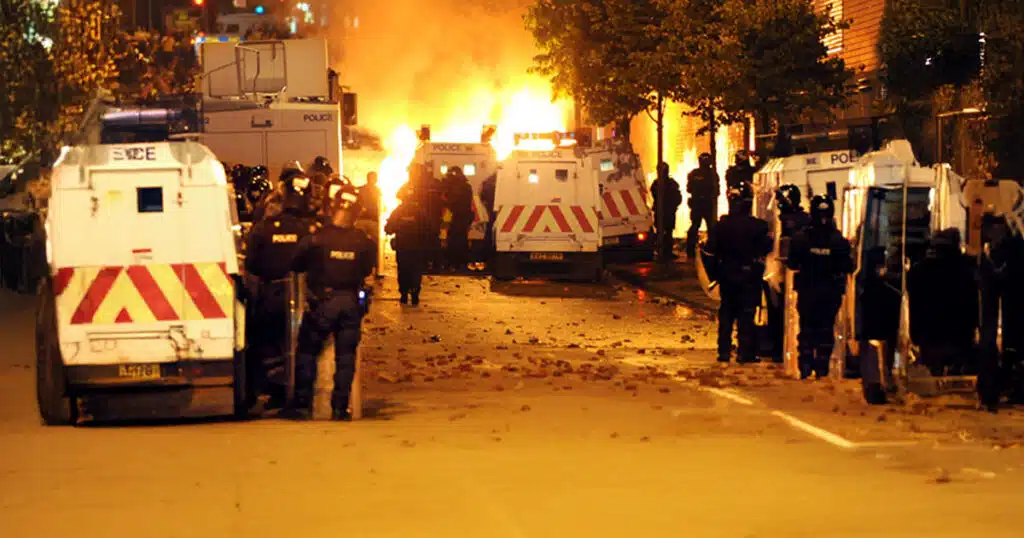
And when a violent incident ignites public anger, officials often seem more concerned with policing the reaction than confronting the policies that created the fear.
Just ask Ireland tonight.
But public order can’t be preserved by telling people not to notice what they can plainly see. Trust can’t be rebuilt by censoring debate. Social cohesion can’t be restored by pretending national identity is a prejudice. And safety can’t be guaranteed by a border system that depends more on hope than enforcement.
So the lesson for America is very clear.
We must not follow Europe’s lead.
America has always welcomed immigrants. But historically, we welcomed them into a nation with a defined identity, a constitutional order, a common language, and an expectation of assimilation. That was the difference.
Immigration worked when America insisted that newcomers become part of America, not that America dissolve itself to accommodate every foreign culture equally.
The modern open-borders movement doesn’t simply want immigration. bIt wants transformation. It wants to weaken the connection between citizenship and nationhood. It wants to turn borders into suggestions, sovereignty into bigotry, and assimilation into oppression. It treats the American people not as the rightful stewards of their country, but as an obstacle to be overcome.
Conservatives should reject that premise completely.
A nation has the right to decide who enters. It has the right to enforce its laws. It has the right to protect its citizens. It has the right to demand assimilation. It has the right to prefer social peace over ideological fashion. And it has the right to preserve its own civilization.
Western civilization wasn’t an accident. It’s the product of centuries of faith, law, philosophy, sacrifice, ordered liberty, property rights, representative government, and the moral claim that each person has dignity because he is made in the image of God.
Those principles didn’t emerge everywhere. They aren’t self-executing. They can be lost.
And they’re being weakened by leaders who no longer seem to believe they’re worth defending.
The crisis in Europe isn’t only about migration. It’s about confidence. A civilization that no longer believes in itself won’t require others to respect it. A nation that can’t name its own identity can’t preserve it. A government that fears offending outsiders more than failing its own people has forgotten its first duty.
America still has time to choose a different path.
We can secure the border. We can end asylum abuse. We can deport those who enter unlawfully or commit crimes. We can restore the meaning of citizenship. We can require assimilation into American law, language, and civic life. We can honor lawful immigration while rejecting mass migration as a tool of national transformation.
That isn’t hatred.
No serious person should celebrate disorder. No decent person should excuse mob violence. But neither should any honest person ignore the conditions that produce public fury. When governments refuse to enforce borders, ignore cultural breakdown, dismiss legitimate concerns, and punish citizens for speaking plainly, they create the very instability they claim to oppose.
A country belongs first to its own citizens. Its leaders aren’t elected to manage decline, dilute identity, or apologize for borders. They’re elected to preserve the nation entrusted to them.
The first duty of government isn’t to the world. It’s to its own people.
If Europe has forgotten that, then Europe isn’t a model.
It’s a warning.