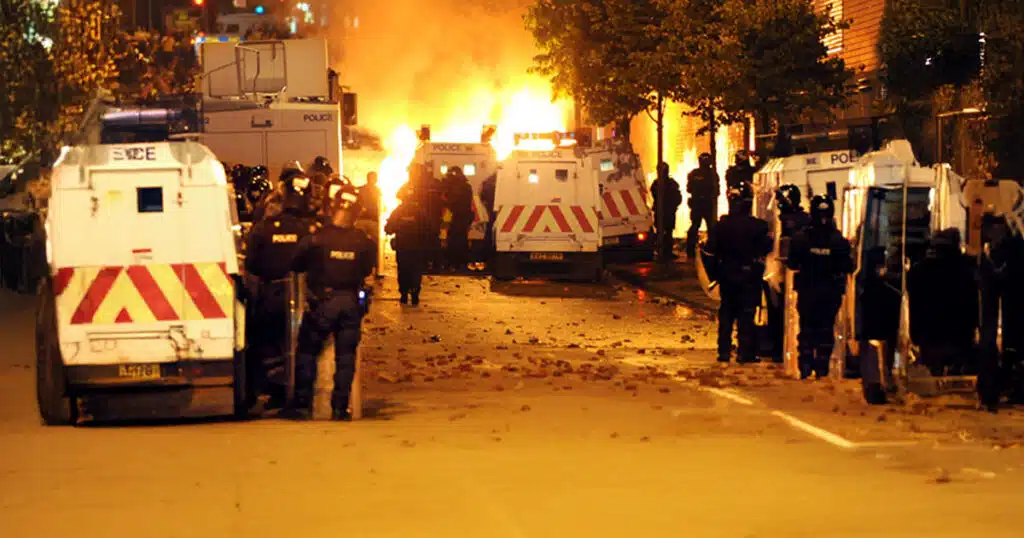
The True Message Of The Belfast Riots
The message of a protest is “we don’t like this”.
The message of a riot is “we don’t like this, and we’re able to do something about it”.
People who unconditionally call for peace and calm, regardless of the provocation, don’t fundamentally understand how politics works in the real world.
They do understand that the purpose of politics is to provide an alternative to violence, but that’s as far as their understanding goes. They don’t think through the implications, usually because they are quite comfortable with things as they are.
If politics is an alternative to violence, then politics is a proxy for violence.
And that means you have to dole out power in proportion to capacity for violence. Or someone’s going to figure out they can do better by flipping the table.
Monarchy wasn’t replaced by democracy because of fine-sounding philosophical ideals and eloquent documents declaring this or that.
Democracy happened because if you added rifling to the flintlock firearm, suddenly a individual farmer with a tube was the pinnacle of military technology, and now you had to keep all the farmers with tubes happy by giving them political power.
(Ancient Greek democracy had a similar relationship with the hoplite warrior.)
When political systems work well, for a while, the violence they represent becomes further and further from people’s minds, and those who can’t effectively commit or direct violence worm their way into power, and begin to take it away from those who can.
And they’ll defend their position by saying that violence is unthinkable, barbaric, always bad, must be disavowed at all costs, etc.
This isn’t some sort of high-minded principle on their part. It simply means one of two things. Either “the status quo works for me, so I don’t want you to upset it”, or “I suck at violence, and I don’t want to have to fight”.
They want young men demoralized, so that their artificial meritocracy of spreadsheets, or their non-meritocracy of patronage networks, can be protected from the natural meritocracy of conflict.
This means that riots aren’t actually for achieving any specific material aim. They are for reminding the comfortable that judges and bureaucrats and policemen have home addresses and families. And that violence is always on the table.
A protest would only send the message that the Irish don’t want to be ethnically cleansed. But the bureaucrats and judges and lawyers already know that. They just don’t care.
A riot reminds them that they have to care, because the Irish have a long tradition of doing something about it.