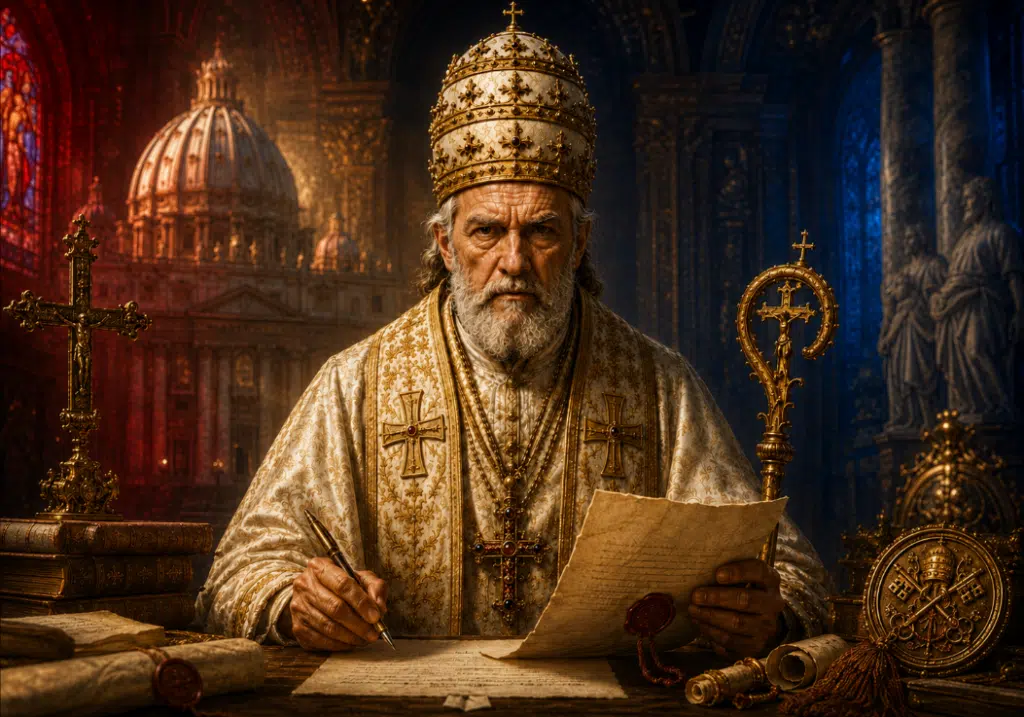
Hildebrand’s Letter to Catholic Clergy and Religious
What follows is a letter from one Pope Hildebrand, a claimant whom I have been investigating according to strictly legal principles. Yes, issues of heresy inside the Church would be enough, but if no legal rebuttal is submitted to the papal decrees of Nicholas II and Paul IV, it appears to me that we may have quite the unbelievable answer to a mountain of Catholic prayers, an answer I am still grappling with in terms of disclosure even to my own loved ones.
Today we publish, in full, “On the Reintegration of Catholic Clergy and Religious” from January 2026. Primarily, this is for readers who have been following our work on this strange, serious, and increasingly unavoidable line of inquiry.
Know that this information came to us in January. We sat on it until April. None of this is easy, and none of this will make me popular even with fellow Catholics, even with friends and family members. Understand, clearly, that I have not pledged allegiance to Hildebrand as Vicar of Christ yet. But here in this digital space, I do use my penchant for helping people navigate uncertainty while navigating it myself. We must. Else if this is true and it comes to pass, no one will be ready for it.
And if it isn’t true and all we’ve done is investigate, no harm done. Certainly no more harm than the Modernists have done already.
For newcomers, we realize the name “Hildebrand” itself may be jarring, even if you are frustrated with the Leos and Francises of the Faith. That is part of the problem. Many Catholics have been trained for decades to treat questions of papal law, conclave validity, public heresy, and actual Catholic restoration (instead of squabbling among tribes)—if they are exposed to such terminology at all—as either extremist or simply too “above their pay grade” to touch.
But if the papacy does in fact flow from a command of Christ as all Catholics believe, then Church law must both precede and follow who the true pope is. And if Christ founded one Church, then unity under Catholic truth cannot remain a slogan we admire from the safe distance of groups like sedevacantism or even the SSPX (just to name two for binary trap purposes), while refusing the hard question it demands.
The good thing is that hard question has real and numerous historical precedents. If you’re new to the term “antipope,” just know that there have been many in Church history. One saint, in fact, even supported a line of them at the same juncture in history that Saint Catherine of Siena supported the rightful claimant. We published this back in February as I was tussling with the idea of Hildebrand while not yet writing on him directly:
St Catherine of Siena vs St Vincent Ferrer—When ‘Obedience’ Produces a Pincer
In another historical precedent from the eleventh century, a parallel story exists, involving a Hildebrand, a Pope Nicholas II, and an antipope Benedict X. The latter two could be said, for simplicity’s sake, to parallel today’s Hildebrand and Leo XIV, respectively.
Benedict X was more popular and recognized according to visibility. Wildly so. Yet another is recognized as Pope in our history—based on the law of the Church.
The Hildebrand of the eleventh century, who would one day become Pope Gregory VII, is the namesake of today’s hidden claimant—the very reason he chose it.
Over the course of numerous articles after Lent, much more direct to the Hildebrand question, we have tried to introduce this subject gradually, moving through Nicholas II’s In Nomine Domini, Paul IV’s Cum ex apostolatus Officio, John Paul II’s Universi Dominici Gregis, the Leo XIV legal question, and the possibility that the Hildebrand claim deserves more serious Catholic examination than instant dismissal while we assume it’s not true simply because YouTube talking heads aren’t opining on it.
Speaking of that, we’ve written on the US Doctrinal Warfare program as well—specifically set out to use all media to capture our minds.
This letter should be read in the context of all of our previous work, as should all of our future work.
Readers who are new to the discussion may want to begin with the recent archives for the broader legal and theological background. For now, though, read the letter itself. Compare its claims with the older papal documents we’ve been examining in earnest since October of last year, and to a more cursory degree, back even to early 2025..
Ask whether the spirit of this letter sounds like the absurd novelty of Modernism or the haunting, beautiful memory of pure Catholicism—a Faith we most certainly know in our souls if not from the textbooks taken from us long ago.
Then ask why the memory of something so pure and impeccable should feel so threatening.
On the Reintegration of Catholic Clergy and Religious
Since, according to the Bull of Pope Boniface VIII, Unam Sanctam, it is impossible for any man to be saved unless he profess the Catholic Faith and show submission and reverence for Christ’s Vicar on Earth, the Roman Pontiff, His Holiness Hildebrand, the Pope Elect, wants to foster in every legitimate manner possible the reintegration of Catholic Clergy and Religious, who being deceived by the spirit of lawlessness, foretold by the Apostles (1 John 3:4; 2 Thessalonians 2:7; ), for so long, as to who is the true Vicar of Christ on Earth, have at last, by the grace of God, opened their eyes and recognized the truth, namely, that he alone is the legitimate Roman Pontiff who has been elected legitimately.
For these, their first duty is “to resist the wicked”, “who forsake the law” (cf. Proverbs 28:4). And for this reason, their first work must be to openly profess that the Conclave of May, 2025, was lawless and had no valid result, and that Robert Francis Prevost has no right to claim the pontifical dignity.
Second, they ought to examine the teaching of Pope Nicholas II, and recognize that His Holiness, Hildebrand, is the rightful claimant of the Apostolic Throne, for as Saint James the Apostle infallibly teaches: “If anyone, then, knows the good they ought to do and doesn’t do it, it is sin for them.” (James 4:17)
Hence, to provide for and facilitate the reintegration of such clergy and religious in communion with the Apostolic See, the staff of the Secretariate of State publishes here the norms by which such individuals and communities can petition to be accepted into ecclesiastic communion:
The prerequisites for Clergy who claim to have always intended to be in communion with this Apostolic See:
- A public profession of Faith according to the Creeds of the Sacrosanct and Ecumenical Councils of Trent and Vatican I;
- A public profession of the Oath against Modernism, published during the reign of Pope Saint Pius X;
- A public recognition of the legitimacy of the election of Hildebrand;
- A public oath of fealty, obedience and reverence to Hildebrand, the Pope elect, and to his canonically elected successors, and to the Roman Church, which alone has the right to elect them, according to the norm of Apostolic Right and Papal Law;
- A public profession of faith in the necessity of submitting and obeying the Roman Pontiff in the legitimate exercise of his Apostolic Authority to teach, govern and sanctify, and of appealing to no one against the judgements of this See.
- A public profession of obedience to the Magisterial Authority of the Roman Pontiff in matters of the validity and liceity of sacramental and juridical acts.
- A public recognition that the Roman Pontiff has the right to condemn the personal behavior of his predecessors who sinned like Simon bar Jonah, who denied Christ three times, or who, like Pope Marcellinus, are said to have participated in the worship of idols, or who, like Pope Honorius I, did not protect the Catholic Faith from heretical doctrine, or who, like Pope Stephen VI, mutilated the mortal remains of their predecessors, or who, like Pope Benedict IX, according to Bl. Pope Victor III, committed rape, murder and sodomy, or who, like Pope Gregory VI, obtained their offices by simony, or who, like Pope Clement V, absolved the murderers of their predecessors or ordered the unjust confiscation of the properties of a religious order, or who, like Pope John XXII, attacked Catholic doctrine in their public preaching, or who, like Pope Martin V, had previously supported antipopes, or who, like Pope Sixtus V, ordered the destruction of authentic copies of Sacred Scripture and the publication of an edition of the Vulgate rife with erroneous and false readings, or who like Pius XI, ordered the submission of Catholics to the civil authorities who persecuted them.
- A public profession that the Roman Pontiff has infallible authority to determine who was and was not an antipope, and when any of his predecessors, who renounced, renounced validly or not.
- A public profession that the Roman Pontiff has the authority to abolish, abrogate or overturn any decision of his predecessors which was provisional, invalidly promulgated, unjust or which has become unuseful, along with any decision of the Roman Curia which contains error, was unjust or based on a lie, or which was or has become a danger to right faith or morals.
The prerequisite for Christian Clergy of any Rite or Tradition who have not been in communion with the Apostolic See ever, or for any period of time:
- A public profession of faith in Jesus Christ, as the Head of the one true Church, and the source of all authority, doctrine and ritual in the Church;
- A public profession of faith in the inerrancy of Sacred Scripture;
- A public profession of reverence and obedience to the Fathers of the Church, mutually shared before the schism of their Church from Rome;
- A public profession of acceptance of the teaching of the Ecumenical Councils, accepted by their Church before their schism from Rome;
- A public rejection of polemical attacks heretofore launched by writers of their Church against this Apostolic See;
- A public profession in the authority of Saint Peter the Apostle and of those Apostles and Bishops who kept communion with him before their schism from Rome;
- A commitment to a sincere study in mutual friendship with the Apostolic See on disputed points of doctrine and morals and liturgical disciplines;
- A public profession to hold the same Faith that was delivered to the Church by the Apostles, in the same sense and signification as it was held by all who have been in communion with this Apostolic See, throughout all the ages.
All Clergy and Religious willing to request admission to ecclesiastical communion, according to the above mentioned prerequisites, respectively, are to contact the Secretariate of State according to the rules of that office. If the ones making the request have previously made application to this Apostolic See, they should be prepared to share with this Office all previous correspondence they conducted with the entities of the Roman Curia.
—
Thank you for reading. Saints Peter and Paul, pray for us!