Xi’s Twelve-Year Sentence
For twelve years, Xi Jinping has been sentencing American presidents to the same prison. They served their time. Trump refused his sentence.
Beijing, May 14, 2026.
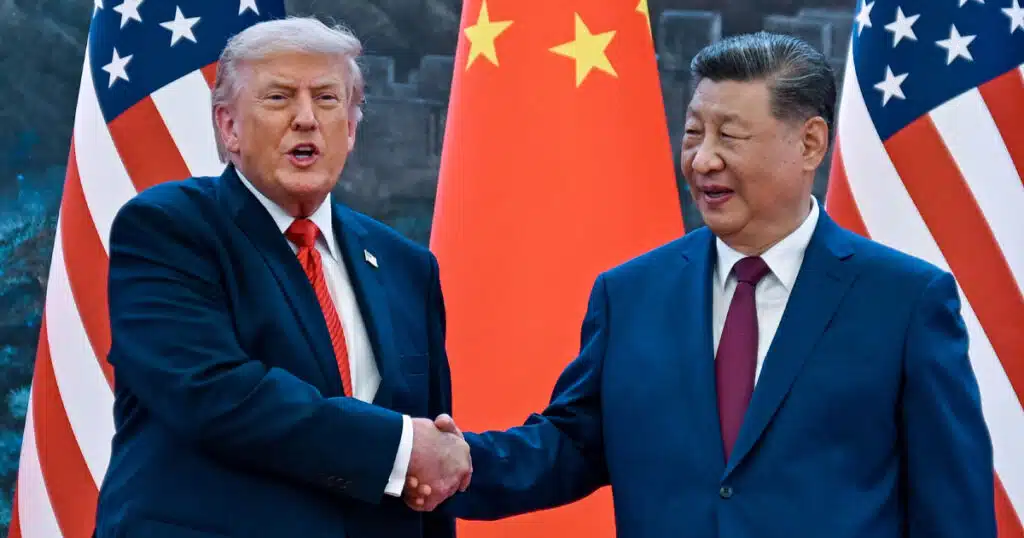
The Great Hall of the People. President Trump and General Secretary Xi Jinping sit down for the opening of the summit. The cameras frame them. The translators have their headsets on. Xi speaks first.
He asks one question. Can China and the United States, he wonders, overcome the so-called Thucydides Trap and create a new paradigm of major-country relations?
The phrase lands on the marble floor between them. The readouts will lead with it. The cable wraps will quote it. Within forty-eight hours, every China-watcher in Washington will be writing about it.
Xi spoke first. That was the point. He had been handing the same sentence down to American presidents for twelve years.
Twelve years. Three invocations.
This is not the first time he has done it.
January 22, 2014. Xi gives a written interview to The WorldPost, then a project of the Huffington Post. He tells American readers that the two countries should “work together to avoid the Thucydides Trap, destructive tensions between an emerging power and established powers.” Barack Obama is in his second term.
September 22, 2015. State visit to the United States. Xi addresses an audience in Seattle. “There is no such thing as the so-called Thucydides Trap in the world,” he says, “but should major countries time and again make the mistakes of strategic miscalculation, they may create such traps for themselves.” Obama again.
May 14, 2026. Beijing. The question to Trump.
The investment researcher Brent Johnson laid the documented cases side by side in a Santiago Capital research deck released this spring. The pattern is unmistakable. This is not improvisation. This is rehearsed. Xi has been preparing this room for twelve years.
Cambridge, 2012.
Where did the phrase come from?
In August 2012, Graham Allison published an essay in the Financial Times titled “Thucydides’s Trap Has Been Sprung in the Pacific.” Allison is the founding dean of the Harvard Kennedy School and a former assistant secretary of defense under Bill Clinton. In 2017 he expanded it into a book — Destined for War: Can America and China Escape Thucydides’s Trap? — published by Houghton Mifflin Harcourt. The argument is simple. Allison’s team looked at sixteen times over five hundred years when a rising country threatened a ruling one. Twelve ended in shooting wars. Four did not.
The book is serious. The idea has launched a thousand seminars. And yet.
Xi is not citing Allison the way an academic cites another academic. He is using the phrase as a tool.
A trial lawyer does not ask a witness “where were you?” to find out where the witness was. The lawyer already knows. The question is a trap that locks the witness into a story. Xi’s Thucydides line works the same way. It is not a thought he wants to share. It is an instrument he is using.
There is a term for what Xi is doing. It is called rhetorical statecraft — choosing your words so the listener will think and act the way you want. Posturing is what plays for the cameras. Rhetorical statecraft is what stays in the room after the cameras leave. Xi is doing both at once.
Twelve years of the same sentence is not philosophy. It is a prison sentence. And Xi has been handing it down.
The cell.
A prison is not just a building. A prison is also a way of thinking you cannot get out of.
Here is what the cell Xi has built for American presidents looks like.
Inside it, America is the worried older power. China is the rising younger one. War is the default outcome. Peace requires that the older power step aside. Chinese assertiveness is natural. American resistance is the variable that triggers catastrophe. The way to keep the peace is for the United States to be careful, quiet, and accommodating.
If you accept those rules, here is what follows in real American policy. Treat Taiwan as negotiable. Pull back from the Indo-Pacific. Slow your alliances. Stop building deterrence too visibly. Avoid sounding like you mean it.
Those are the bars. The phrase is the sentence. The cell is the policy you end up signing without realizing you signed it.
The presidents who served their time.
American presidents have heard the phrase. They accepted it.
The foreign policy class around them wrote thoughtful essays. They considered “managing the trap.” They proposed new paradigms for major-country relations. Some of the writing was excellent. None of it noticed that the prison being managed had been built by Xi.
This is the most dangerous response. Not because it is unsophisticated, but because it is sophisticated in someone else’s courtroom. Listening politely in another man’s language is not engagement. It is a guilty plea.
American Greatness, May 21.
In the days following the summit, the historian Victor Davis Hanson published an essay in American Greatness titled “America Is Not Caught in a ‘Thucydides Trap’!” It is the most thorough takedown of the theory available, and a sharper treatment than his shorter Daily Signal segment from a few days earlier.
Hanson knows the territory better than almost anyone alive. He is one of the most accomplished classicists of his generation, and the Greek world is his home ground. He notes that Athens was not just starting to rise in 431 BCE — the two cities had already fought a previous fifteen-year war from 460 to 446. He notes that Thucydides offered other explanations elsewhere in his unfinished history. He notes that Athens and Sparta were fundamentally different in nearly every way that mattered. The comparison, he argues, was strained from the start.
Then he turns to the present. On every important measure, Hanson observes, the United States is the one rising. American fertility is 1.7. China’s is 1.0 and falling. The United States is the largest oil and food producer in the history of civilization; China imports seventy percent of its oil and thirty percent of its food. Eleven American carrier strike groups; one Chinese. Eight of the world’s top ten companies by market value are American.
Hanson is right about every one of those points.
And his closing prescription is exactly right. The United States, he argues, can prevent any war “through deterrence, alliances, maintaining a balance of power, occasional respectful negotiations — and our far greater power and resilience.”
Read those words twice. Deterrence. Alliances. Balance of power. That is the same vocabulary the National Defense Strategy uses, almost verbatim. Hanson and the Trump administration’s defense doctrine are saying nearly the same thing about how to handle China. They are on the same side.
They differ on one thing only. Hanson refuses Xi’s verdict. But he does so in Xi’s courtroom. The strategy documents never enter the courtroom. They ignore the charges altogether.
Seoul, December 2025.
There is another way of seeing China that throws out Allison’s Athens-and-Sparta picture altogether.
On December 13, 2025, the political scientist Michael Beckley gave a talk at the World Knowledge Forum in Seoul called “The End of China’s Rise and the Future of World Order.” Beckley is a senior fellow at the American Enterprise Institute and a professor at the Fletcher School. His thesis is direct and grim. China is no longer rising. China is not yet falling. China is peaking. The four things that drove its three-decade climb — favorable geopolitics, capable government, a demographic windfall, and abundant resources — have each turned against it. Productivity growth has been negative for over a decade. Debt has passed American levels. Capital flight, youth unemployment, and the biggest peacetime military buildup since Nazi Germany are running at the same time.
Beckley is plain about what comes next. Peaking countries do not mellow. They tend to crack down at home and push outward. He sees Beijing already inching down that path.
China is a peaking power in a moment of maximum danger, and peaking powers do not mellow. The metaphor Xi keeps offering is the wrong one. The danger he is gesturing at is real.
Washington, October and December 2025.
The Trump administration released two documents in the months before the Beijing summit that had already answered the question Xi asked. The National Security Strategy came out in October. The National Defense Strategy came out in December.
What is striking about them is what they do not say.
They do not use the words “established power.” They do not use “rising power.” They do not use “Thucydides.” They do not use “trap.” They do not use “new paradigm.”
Other words appear instead. Pacing threat. Balance of power. Decent peace. Deterrence by denial.
The Defense Strategy is plain about the goal. “Our goal in doing so is not to dominate China; nor is it to strangle or humiliate them. Rather, our goal is simple: To prevent anyone, including China, from being able to dominate us or our allies — in essence, to set the military conditions required to achieve the NSS goal of a balance of power in the Indo-Pacific that allows all of us to enjoy a decent peace.”
That sentence is the answer to the phrase. It does not engage Xi’s theory. It does not argue with it. It does not dismiss it. It translates the question out of Xi’s language entirely.
Three camps exist in this argument. Two of them are crowded. The third one is almost empty. The strategy documents are the only ones in the third camp.
What doesn’t matter. What matters.
It does not matter whether the Thucydides Trap is a sound theory.
It does not matter whether Allison’s reading of ancient evidence holds up.
It does not matter whether China stands for Athens or Sparta.
It does not matter how much of the Western reading list Xi has personally finished.
What matters is the prison Xi has been building. He wants Americans to believe that war is the default, that China is too big to push, that the responsible side is the one trying to avoid the trap, and that the responsible thing for Washington to do is back off.
The strategy documents have said no to all four.
They have also said something else. America is a Pacific power. We have allies. We have a Navy that can deny aggression. We have an industrial base that can be rebuilt. We do not need to be Athens or Sparta. We do not need to stand in Xi’s courtroom at all.
Back to the Great Hall.
May 14, 2026. Xi spoke first. He set the frame. The cameras caught the phrase.
Trump did not repeat it. He did not engage it. He did not argue with it.
The silence in his response was not improvisation. The silence had been drafted in the months before the summit and signed in December. Somewhere between the National Security Council and the Department of War, the administration had decided it would not walk into the cell Xi had built for it.
The cell is real. It has been there for twelve years, furnished with Greek statuary, Harvard credentials, and the language of war as the default. American presidents walked into it. None of them noticed they had walked in. This one did not.
For twelve years, Xi Jinping has been sentencing American presidents to the same prison. They served their time. Trump refused his sentence.
The cell is still on the marble floor. America is not. Xi keeps building it anyway.
Christopher J. Little is a writer based in St. Louis, Missouri whose work appears at https://pocochris.substack.com/. His prior work for RealClearDefense has examined NATO burden-sharing, allied capability, and the MAGA defense doctrine.
Source Ledger
Beijing summit, May 14, 2026 — Xi’s opening question to Trump
Fox News opinion, “Chill is coming. Trump’s summit with Xi is proof of new Cold War with China”: https://www.foxnews.com/opinion/chill-coming-trumps-summit-xi-proof-new-cold-war-china
Washington Times, Clifford D. May, “Trump should distrust and verify Xi after Beijing summit,” May 19, 2026: https://www.washingtontimes.com/news/2026/may/19/trump-distrust-verify-xi-beijing-summit/
The Hill, Ryan Mancini, “What is ‘Thucydides trap,’ mentioned during Trump-Xi meeting?” May 14, 2026: https://thehill.com/policy/international/5877843-thucydides-trap-xi-jinping-china-trump-us-taiwan/
Xi’s prior invocations of the phrase
WorldPost (Huffington Post) interview, January 22, 2014. Archive with original Chinese text and English translation via Pekingnology Substack: https://www.pekingnology.com/p/xi-jinping-on-the-thucydides-trap
Seattle address, September 22, 2015. Verbatim quotation in East Asian Institute (National University of Singapore) Background Brief No. 1085: https://research.nus.edu.sg/eai/wp-content/uploads/2017/11/BB1085.pdf
Documentation of the pattern
Brent Johnson, “Destined for War? Chairman Xi’s & President Trump’s Thucydides Trap,” Brent Johnson Milkshakes Pod (Santiago Capital Research), YouTube: https://www.youtube.com/watch?v=A29mlEodQTg
Allison framework
Graham Allison, Destined for War: Can America and China Escape Thucydides’s Trap?, Houghton Mifflin Harcourt, May 30, 2017.
Allison’s framework with the full sixteen-case dataset, publicly accessible: Harvard Kennedy School Belfer Center for Science and International Affairs, “Thucydides’s Trap Case File”: https://www.belfercenter.org/programs/thucydidess-trap/thucydidess-trap-case-file
Original 2012 essay (paywalled at FT, archived at RealClearWorld): https://www.realclearworld.com/2012/08/22/thucydidess_trap_has_been_sprung_in_the_pacific_139363.html
Hanson’s challenge to the framework
Victor Davis Hanson, “America Is Not Caught in a ‘Thucydides Trap’!” American Greatness, May 21, 2026: https://amgreatness.com/2026/05/21/america-is-not-caught-in-a-thucydides-trap/
Companion: Victor Davis Hanson, “China’s ‘Thucydides Trap’ Theory Doesn’t Hold Up,” The Daily Signal, May 18, 2026: https://www.youtube.com/watch?v=6k-b8nECUXA
Beckley peaking-power frame
Michael Beckley, “The End of China’s Rise and the Future of World Order,” World Knowledge Forum, Seoul, December 13, 2025: https://www.youtube.com/watch?v=IL6OHMr21f8
Foundational strategy documents
2025 National Security Strategy, The White House, October 2025.
2026 National Defense Strategy, U.S. Department of War, December 2025.
2026 United States Counterterrorism Strategy, The White House, 2026.
This article was originally published by RealClearDefense and made available via RealClearWire.