The Utopian Horizon
Last night, I posted on Facebook that the feeling of resentment for the crazy and idiotic world in which I’m forced to live is growing within me and how there is not a single front that is being ignored. It is an all-out assault on the world I want to inhabit and my kids and grandkids to inherit.
I’m forced to constantly think about things I don’t want to think about.
It’s not all bad, there are some good things happening, but holy crap, you can’t take five minutes to enjoy anything because you know another bucket of excrement is headed your way soon. I noted that it sure seems peace of mind is a short-lived luxury these days, especially for us normies.
So, I spent last night and early this morning thinking about things I didn’t want to think about.
I had several people respond that I am just being nostalgic, pining for the fjords of a world that never existed, mostly because it didn’t exist and it was only childish perception of what that world was like.
Maybe.
I grew up poor in rural Mississippi, about as close to reality as you can get. But being poor didn’t mean I didn’t grow up absent of intellect or values. We might have been poor but proud – and for people who think those two are mutually exclusive the way they are thought of today, you are wrong. My family was proud of our reputation, our love of God and for each other, and that we never gave in to defeatism.
We lived in a time when the daily death and casualty count in the Vietnam War led every nightly newscast, when our local newspapers carried lists of the local dead, wounded and MIA. We survived desegregation, busing, communist radicals robbing banks, murdering police and bombing police stations, military installations, and public buildings. Race relations reached a negative crescendo. We watched as our foreign service workers were taken hostage, OPEC cut off our oil, and interest rates skyrocketed.
It was a time of massive change that echoes throughout American culture even today.
But it wasn’t like today.
Today, we argue about whether a man can be a woman if he clicks the heels of his ruby slippers together three times and wishes it so – and that, in Orwellian fashion, the rest of us non-gender confused must not only accept it, assert it, and believe it is true. We are supposed to believe that the only laws that apply are those we like, sovereignty is an antiquated quirk of history and capitalism is a failed economic construction and on top of all that, in Nietzschean fashion, we must believe God is dead, replaced by government.
Politics was once a sometime thing, we usually got interested and started paying attention around election time, but now politics is life. Nothing is not political or ideological now, even things that have nothing to do with politics are made political – and you will not be allowed to ignore it – and it is that way by design.
If you find arguing with the left is impossible, you are right, and it isn’t so much that they are idiots, it happens to be just another idea from the Frankfurt School that has become embedded in sociopolitical thought.
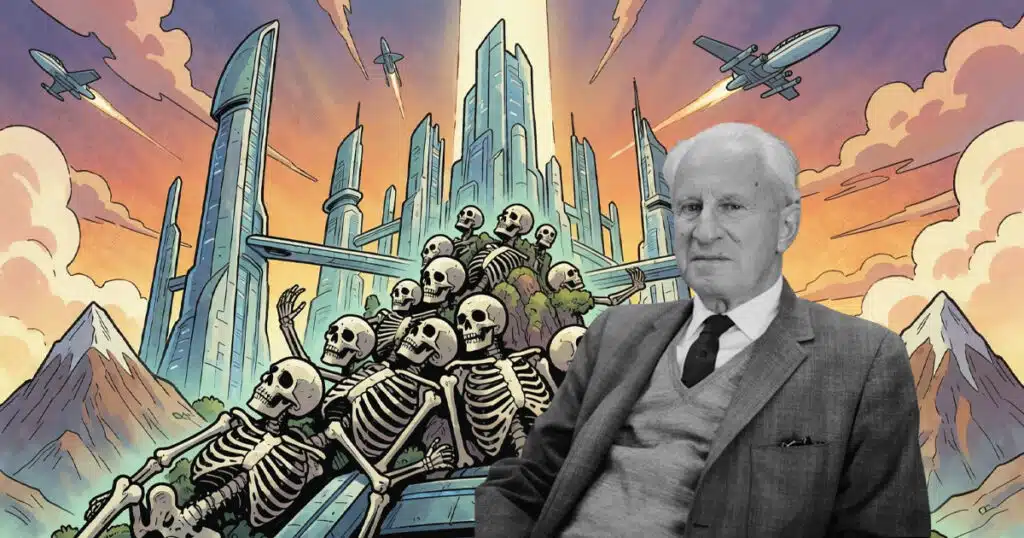
It is something called the “utopian horizon”.
The Frankfurt School’s “utopian horizon” was the idea that society should not be judged merely against other societies or its own past, but against the possibility of a radically freer world without domination, alienation, exploitation, unnecessary labor, and oppressive social constraints, a society where oppression is eradicated by breaking down every single hierarchy, including the family, because hierarchical structures inherently cause oppression.
In an example of how radical ideologies can never live up to their own rules, the devotees of such an idea of a perfect world avoided describing this ideal society in detail, fearing that a prescribed utopia could itself become oppressive. This concept gave Critical Theory its power by refusing to accept existing institutions as inevitable, but it also created a fundamental problem: the real world, with all its unavoidable tradeoffs and imperfections, could now be compared with an imaginary world that bears no costs, makes no compromises, and suffers no unintended consequences.
That’s where Reagan’s famous quote about the left knowing so much that isn’t so really hits hard.
Once people succumb to judging existing civilization, not against other actually existing civilizations, but against an imagined emancipated society, every area that fails to meet such utopian standards can only be defined in terms of failure and oppression and that leads to some ridiculous “logic” with more twists than a New York pretzel.
The perfect becomes the enemy not merely of the good, but of the evidence that the good is actually good.
The Smithsonian’s 2020 exhibit is a good example of the problem with the utopian horizon.
It associated things such as punctuality, objective and rational thinking, hard work, and rigid schedules with dominant “white culture.” Yet punctuality itself is racially neutral; it is simply a practical solution to the problem of coordinating human activity. Once society is viewed primarily through a framework of power, oppression, and domination, however, even useful and otherwise neutral institutions can be described negatively because they are part of the existing social order.
The question shifts from “Does this practice serve a useful purpose?” to “What system of power does this practice perpetuate?” The former opens a legitimate inquiry, the latter is simply an answer looking for a question that fits.
At that point, virtually anything that falls short of the imagined emancipated society can be reinterpreted as evidence that the existing society is oppressive.
Thomas Sowell suggests an appropriate challenge to such assertions is the simple question “As compared to what?” – as in “To which perfect society are you comparing this one?”
This question exposes the hidden counterfactual in a utopian argument: if the critic cannot identify an achievable alternative that performs better, pointing out that reality falls short of an idealized, theoretical version of reality proves nothing.