Who Was Really in Charge? The Intelligence the President Wasn’t Supposed to See
Sometimes the biggest stories aren’t hidden. They’re buried, in hundreds of pages of government records, waiting for someone stubborn enough to read them. Investigative journalist Catherine Herridge read them.
And what she found in newly declassified intelligence concerning China and the 2020 election raises a question far larger than another Washington scandal: Who decides what the President of the United States is allowed to know?
Herridge has been digging through declassified intelligence records, comparing internal communications and examining what happened to intelligence concerning China as it moved through America’s national-security apparatus. In her July investigation, “Prosecuting the ‘Shadow Government’”, she argued that the records reveal career intelligence and law-enforcement officials suppressing the magnitude of China’s 2020 influence operation.
But perhaps the most important thing Herridge has done is simpler: she read the documents.
That matters because the story racing across social media; that China was definitively “blackmailing the Biden family”, goes further than the evidence publicly establishes. Herridge herself was more careful.
Discussing the declassified records in a July interview, she said she found material “talking about blackmail by China” that was intended for President Biden’s Daily Brief. Then she added an enormously important qualification: “I can conclude, I think, that it was probably about targeting his family.”
“I think.”
“Probably.”
Those words matter.
Herridge did not claim she possessed definitive proof that China blackmailed Joe Biden or his family. She followed the documentary trail as far as she believed the available evidence allowed her to follow it.
That’s what journalism is supposed to look like.
But the blackmail question may not even be the most consequential part of what has emerged.
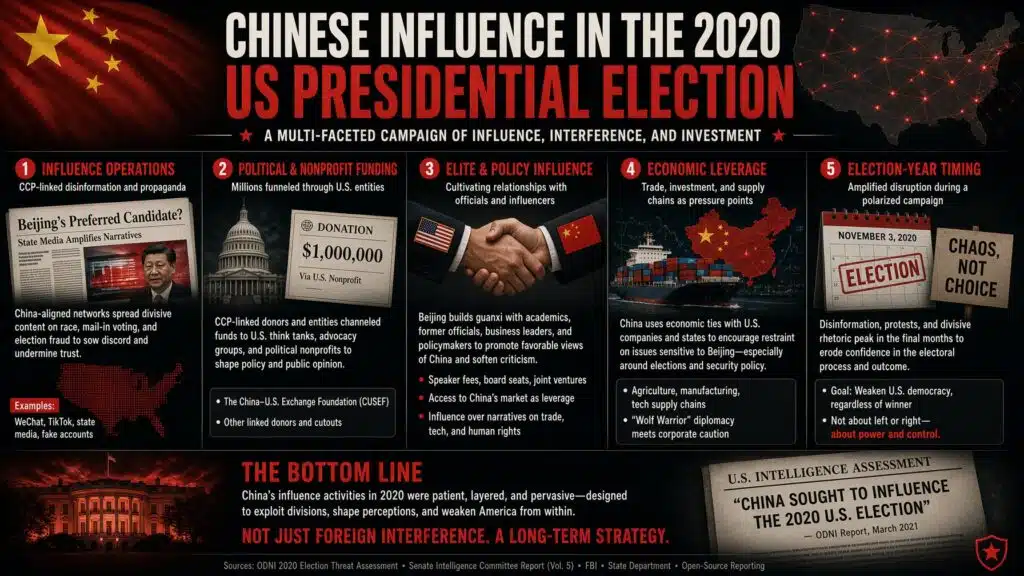
According to Herridge’s review of the declassified records, intelligence officials suppressed or minimized information concerning the scope of China’s activities surrounding the 2020 election. Her reporting describes a whistleblower-driven effort to declassify records involving China’s acquisition of enormous amounts of American voter information and what she characterizes as an intelligence bureaucracy deeply affected by politics.
That does not establish that China changed votes or altered the outcome of the 2020 election. Those are separate claims requiring separate evidence.
And precisely because those distinctions matter, the questions raised by the actual documents should not be drowned beneath claims they cannot yet prove.
Among the internal communications highlighted in the released material is a remarkable statement attributed to an intelligence analyst concerning a pending President’s Daily Brief: “We have deliberately massaged” the briefing to avoid direct election links.
Think about that phrase for a moment.
The President’s Daily Brief is not a newspaper editorial or cable-news segment. It is one of the most sensitive intelligence products prepared by the United States government for the president and senior national-security officials.
If intelligence was being “massaged” to avoid a politically explosive connection, Americans have every right to ask what was changed, why it was changed, who authorized the decision and whether legitimate intelligence standards, or political considerations, were responsible.
Another internal communication Herridge has highlighted contains an equally astonishing phrase from an FBI official: “I’m basically running a shadow government across the FBI at this point.” Her subsequent reporting has continued examining what she calls the “Shadow Government” and allegations of internal resistance within the intelligence bureaucracy.
Context matters. A provocative sentence does not by itself establish the existence of some secret government operating behind the constitutional one.
But neither should Americans shrug when officials entrusted with extraordinary governmental authority use language like that.
There is another institution that deserves scrutiny here: the press.
Herridge described what she saw from legacy media as a kind of “willful blindness.” The records were available, she said. Reporters simply needed to spend a few hours examining them.
That accusation deserves consideration precisely because journalism is supposed to be adversarial toward power, not selectively adversarial depending upon who occupies the White House.
A free press isn’t supposed to protect Republicans or Democrats. It isn’t supposed to protect the intelligence community, the FBI, Donald Trump or Joe Biden.
It is supposed to protect the public’s right to know.
Herridge herself is currently fighting an extraordinary battle over that principle. She faces an $800-per-day civil-contempt fine for refusing to reveal confidential sources from an unrelated investigation involving a Chinese-American scientist. The Supreme Court declined emergency intervention in July, and Herridge has continued refusing to identify her sources.
Whatever one thinks of her conclusions, that is a journalist putting something substantial on the line for the principle of independent reporting.
And that brings us back to the documents.
Americans should resist two equally dangerous instincts: believing every sensational claim because it confirms what we already suspect, and refusing to examine authentic government records because what they contain may be politically uncomfortable.
If intelligence professionals withheld information because it was unreliable, show us the analytical basis. If information was altered because new evidence changed the assessment, explain it.
But if intelligence was softened, redirected or withheld because unelected officials feared what an elected president might do with it, we have crossed into profoundly different territory.
The intelligence community serves the elected government.
It does not get to become the government.
Because in a constitutional republic, unelected officials may advise a president, warn a president and tell a president things he desperately does not want to hear.
But they should never become the people who decide what the president, and ultimately the American people, are allowed to know.
And if they did, there is only one question left worth asking: Who, exactly, was governing whom?
Maureen Steele is co-founder of the American Made Foundation