The 1619 Project Is Fiction; What Nikole Hannah-Jones Left Out
I am writing this from Warner Hall in Gloucester County, Virginia, the plantation named for my ancestor, Augustine Warner. My parents had us meet them here at this wonderful inn to learn more family history and see it first hand. Augustine came to Virginia in 1628 at seventeen as an indentured servant. According to Nikole Hannah-Jones’s standard, I woke this morning in the house of a slave.
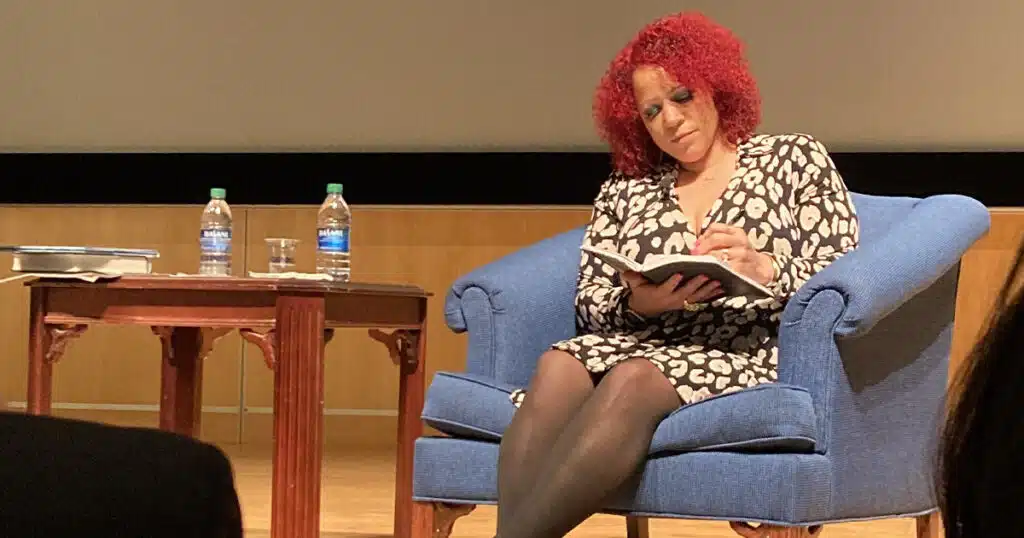
For some of you, the name Nikole Hannah-Jones means nothing. I think you should care about her enough that I am writing two essays about her work, and this is the first. If you don’t know who she is or why she matters, let me introduce you. She is a bestselling author and a brilliant woman who has had a profound cultural impact. She was back in the news recently for the educational journey she publicly put her daughter through, and I will write about that in essay two. This one is about what made her famous in the first place.
She began as a reporter. She became famous when she stopped reporting facts and started rewriting history.
In 2019, timed to the 400th anniversary of the first documented Africans arriving in Virginia, Hannah-Jones created the “1619 Project” for the New York Times Magazine. It argued that the true founding of America wasn’t 1776 but 1619, and that slavery and its legacy sat at the center of the American story, the thing that explained almost everything else about the country. Her lead essay won the 2020 Pulitzer Prize for Commentary. The project became a bestselling book, a Hulu documentary series, and a curriculum taught in school districts across the country. It’s hard to think of a single work of journalism in the last decade that reached more American classrooms.
It was also wrong about the specific claim the whole project centered on.
Most of the public fight over the 1619 Project focused on 1776, and Hannah-Jones’s claim that protecting slavery was a primary motivation for the American Revolution. Historian Leslie Harris, whom the Times consulted to fact-check the project, says she warned against that claim before publication and was overruled. In December 2019, five historians from Princeton, Brown, CUNY, and Texas State wrote the Times asking for corrections. The Times refused. Then in March 2020, days after Harris went public in Politico, the paper quietly softened the line to say slavery motivated “some of” the colonists. That editing was needed and it happened over the objection of Hannah-Jones.
The argument over 1776 obscures the deeper problem, about 1619 itself, the date she built the entire project around. A magazine package timed to a 400th anniversary needs an anniversary. Hannah-Jones needed 1619 to mark the birth of American racialized slavery, a clean, singular origin point, because that’s what makes a 400 year retrospective a coherent idea. She has since described the project as “journalism,” not history. She was writing the most ambitious, highest profile work of narrative nonfiction of 2019, and a narrative that needed an origin story with moral clarity. The actual record doesn’t offer one at 1619. So she ignored the truth and made one anyway.
I find it genuinely tragic how few Americans know enough colonial history to catch the massive lies that are central to her work. The story of how slavery in Virginia became what it became, race based, hereditary, codified into law over decades rather than present at the arrival of the White Lion to Virginia is more interesting and more instructive than the version taught in most classrooms today, including the version this Project replaced it with.
Start with Plymouth, not Jamestown. When the Pilgrims landed in 1620, the reason they could negotiate with the Wampanoag was Squanto, a man kidnapped by an English sea captain in 1614, sold into slavery in Spain, and eventually taken in in England, where he learned the language before returning home in 1619 to find his entire village dead of European disease. That’s the man history remembers as the friendly translator of the First Thanksgiving story, and the slavery in the middle of it is often excluded.
There were no racists at that first Thanksgiving. I can assert that with confidence because race, as a taxonomy sorting human beings into a handful of fixed, hereditary categories, with “white” as one of them, did not exist yet. It hadn’t been invented.
That doesn’t mean people were free of prejudice. Xenophobia and tribal contempt are as old as human contact itself. Chinese states looked down on the peoples beyond their borders centuries before Christ. Egyptians enslaved and despised the Israelites. Greeks called everyone who wasn’t Greek a barbarian. None of that required the concept of race. What the Pilgrims and the Wampanoag brought to their encounter was tribalism and religious difference, real and sometimes violent, but not race. None of the Pilgrims were “white” in 1620, because whiteness, as a category uniting English, Irish, Dutch, and other Europeans into a single race set above Black and Indian, hadn’t been constructed yet.
You can see how new the idea was in a marriage. In 1614, John Rolfe married Pocahontas in Virginia, and nobody thought the English colony had been disgraced. Her descendants, the Randolphs among them, were proud of the line. One of them ended up here in the family cemetery next to my ancestors (Elizabeth Randolph married Warner Lewis) because the planter elite freely intermarried. Nobody bans what cannot happen, and in 1691 Virginia banned marriage across that line and banished anyone who tried. Race was built in between. The wealth and family exception was so strong for the planter elite descended from Pocahontas that in 1924 the Racial Integrity Act still carried an exception for them recognizing them as “white”.
Racism would be constructed a few decades after that first Thanksgiving and a few hundred miles south, in Virginia, deliberately and for identifiable political reasons. That construction is the story the 1619 Project needed to tell and didn’t.
The Africans who arrived at Point Comfort in August 1619 did not arrive into a system of hereditary racial slavery, because no such system existed yet under Virginia law. What existed was indentured servitude, and the earliest record of how those Africans were treated reflects it: they worked out contracts and received land grants on completion, the same “headrights” any English servant earned. One of them, an Angolan named Anthony Johnson, arrived in 1621, worked off his indenture, and by 1651 owned 250 acres and had brought in five indentured servants of his own, becoming the first known African landowner in the colony.
My own ancestor followed the same path from servant to master. Augustine Warner came over in 1628, one of the settlers brought by a sponsor, Adam Thoroughgood. He served his term. In 1642 he patented 600 acres at the head of the Severn River, granted for transporting twelve people to the colony at fifty acres apiece. That grant became Warner Hall. No one in the 1600s thought it was controversial for an indentured servant to go on to employ indentured servants. It was how the colony worked. If Hannah-Jones calls the Africans of 1619 slaves, her standard makes my ancestor one too. The law of his day said neither.
The first documented racial double standard in servitude in Virginia appeared in 1640, when an African servant named John Punch escaped alongside a Dutch and a Scottish servant. All three were caught. The Dutchman and the Scot received four additional years of servitude. Punch was sentenced to serve for life.
The first civil case establishing the legal right to hold a person for life was not brought by an Englishman against an African. It was brought by Anthony Johnson, the freed African servant turned landowner, against Robert Parker, a white colonist, to reclaim a servant named John Casor. Casor had claimed his term was up, and under pressure from his family Johnson had briefly released him. Casor went to work for Parker. Johnson reversed course and sued, claiming he owned Casor for life, the way ownership worked back in Angola. In March 1655, the Northampton County court agreed.
John Casor became the first person in the colonies judicially declared a slave for life through a civil suit, without having committed a crime, and the man who won that case was Black.
This was in 1655 not 1619 and was not racialized slavery. The 1619 project is built on a lie much more widely known than the truth of history.
Seven years later, in 1662, Virginia passed the law that made slavery hereditary: a child would take the status of the mother, reversing English common law, which had always passed status through the father. Now bondage did not just persist for one lifetime. It replicated itself.
Even then, the boundary between servant and slave, between white and Black, was not yet fixed the way it would be by the end of the century. Poor whites and enslaved and indentured Blacks worked the same fields and lived in the same quarters.
In 1676 they took up arms together. Nathaniel Bacon led a rebellion of landless freemen, indentured servants, and enslaved people, Black and white together, against Virginia’s colonial government. They burned Jamestown. Then they crossed the York River and seized Warner Hall, the home of the family of a former indentured servant, and used it as a base. The original house has been replaced because of fire damage, but it is not lost on me that the true history of slavery and the invention of racism in America runs through the home I am staying in that my indentured servant ancestor built. His son Augustine Warner Junior sued the leader of the rebellion for damage to his plantation caused during the revolt.
The rebellion collapsed within months, but it terrified the planter elite more than any single crop failure or Indian raid ever had. They had just watched a multiracial coalition of the poor and the enslaved destroy their capital. Virginia’s lawmakers drew the obvious conclusion: a labor force that saw itself as one class, rather than two races, was a mortal threat to men who owned land and people. Over the following decades, the colony deliberately hardened the line between white and Black. In 1691 it banned marriage across racial lines, punishing any white person who married a Black, mulatto, or Indian spouse with permanent banishment, and ordered that no enslaved person be freed unless the owner paid to transport them out of the colony within six months. Virginia was not just building slavery. It was working to eliminate free Black people from the colony altogether.
Set the timeline next to the 1619 Project’s premise and the trouble becomes obvious. Racialized, hereditary, lifetime slavery was not the ideology English colonists brought with them in 1619. It was a system built over the following decades, refined case by case and law by law, accelerated by the fear of what poor whites and enslaved Blacks could accomplish when they stopped seeing each other as enemies. By 1700, Virginia had racist slavery. The first legal victory for lifetime bondage by civil suit was won by a Black man. The event that convinced Virginia’s elite to weaponize race as a permanent wall between servant classes was an uprising in which the two groups had fought side by side.
None of this diminishes the horror of what American slavery became. It complicates the story of how it began, and the truth is complicated. A start date of 1619 gives you colonizers and victims from page one. Anthony Johnson does not fit that narrative cleanly, and he is missing from the version of this story that gets taught in American classrooms. The Casor case is in the standard histories of Virginia slavery, and Jones had a team of historians. I cannot prove why Johnson is missing. I can tell you what his presence would have done to her story.
The 1619 project is fiction. The history of the creation of race and racialized servitude runs through Virginia in the 1600s in ways worth learning about. We should care about the truth enough to learn it. Thanks for reading and learning with me today!