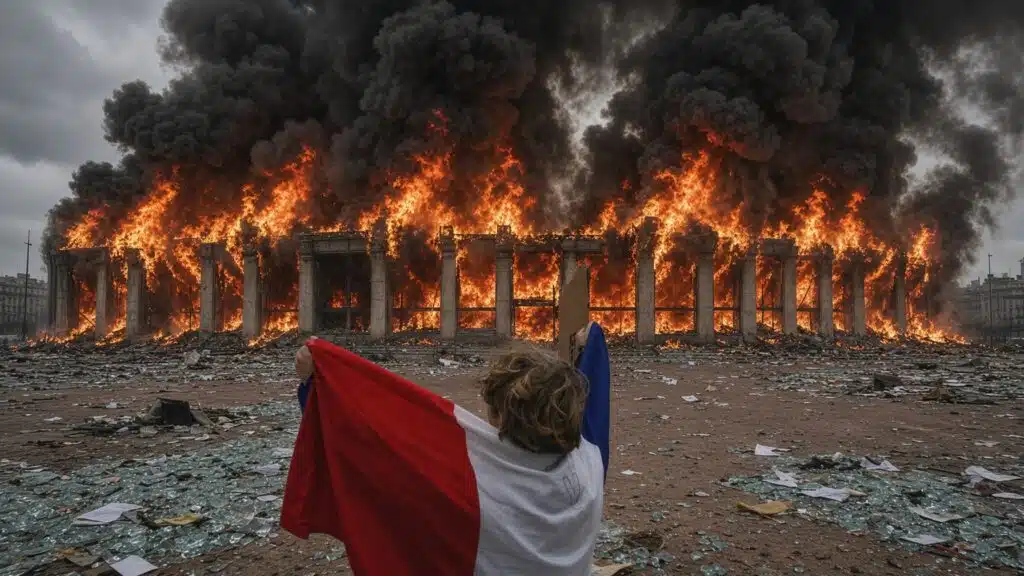
The Media Spin On French Riots Is Harder And Harder To Sustain
The mainstream media are fuming. Marine Le Pen, head of France’s most popular party, National Rally, is exploiting the French riots for her political advantage, the media grouse. Le Pen and her right-hand man, Jordan Bardella, portray the riots as the confirmation of everything they have been warning about for years, especially regarding Third World immigration. This is a ruse, complains the press and its establishment sources, a mere rhetorical trick.
A front-page article in the New York Times quotes a political scientist at Paris’s Sciences Po: “The picture of France emerging this morning, in light of all the destruction, plays well into their hands.”
The Wall Street Journal sounds the same note today: “The social instability over the weekend absolutely plays into Le Pen’s campaign that the establishment has delivered chaos,” said Mujtaba Rahman, from the risk analysis firm Eurasia Group.
Even the papers’ headlines echo each other: “France’s Far Right Seizes the Moment as Rioting Stuns the Country” (New York Times); “Marine Le Pen Seizes on French Chaos to Present Herself as Leader in Waiting” (Wall Street Journal).
It is necessary to deconstruct these far-right narratives; thankfully, the press is there to help us. The violence “perfectly aligned with the image the National Rally has long painted of a France divided into two and battling for survival,” a political science professor at the University of Nice, Côte d’Azur told the New York Times.
The Wall Street Journal writes that the “far-right” Le Pen has “cast” France as a nation adrift, “buffeted by waves of immigration and lawlessness that have torn at the country’s social fabric.”
It is mere coincidence that that image of a divided, degraded France constructed by the National Rally and the violence on the streets seem to align. That alignment does not mean that the National Rally was right, just that its demagogy was opportune.
But the waves of hate-filled destruction crashing over France’s once great cities validate Le Pen and Bardella’s diagnosis of France’s demographic catastrophe, not as narrative but as empirical fact. The Wall Street Journal again tries to dismiss Le Pen’s prognostications as a rhetorical maneuver: “Le Pen’s anti-immigration stance…gives her another way to frame the unrest. Le Pen has cast the unrest as the work of far-left radicals allied with youths from France’s banlieues, the poor urban outskirts where much of the country’s minority Muslim population resides.” How else would the Journal “cast” the “unrest?” As the work of lavender harvesters from Provence?
The elite effort at euphemism is by now desperate: “The looting drew attention to a segment of the population—specifically young people from certain neighborhoods, some of whom are from immigrant backgrounds,” pollster Adélaïde Zulfikarpasic told the Journal. “And that hits the themes at the heart of National Rally’s rhetoric.”
A conversation on German public media station ZDF yesterday between the ever-pinched and purse-lipped anchor Marietta Slomka and a French academic in Bonn referred delicately to the “decades-long problem” of poverty, concentration, and “integration” in the Plattenbauten (the concrete slab housing projects) around Paris. The problem is not “integration,” which suggests a failing in the host country, however, it is large-scale Third World immigration, which has turned many of these projects into no-go zones. And now that local anarchy is spreading.
If naming a deliberate attack on Western civilization by those who feel only resentment and envy earns one the title of far-right extremist or racist, so be it. The mayhem in France is not rhetoric, it is reality. And the National Rally’s law enforcement and deportation proposals are precisely what France and the rest of Europe need today.