Jeffries demands national defense bill bar sale of restricted AI chips to China
With the reinstatement of Jensen Huang as CEO of AI chip designer Nvidia, influential House Democrats are demanding that a major defense authorization bill include safeguards against U.S. companies selling or giving AI technology to America’s foreign adversaries.
The roughly $1.14 trillion fiscal year 2027 National Defense Authorization Act authorizes annual defense spending toplines and programs.
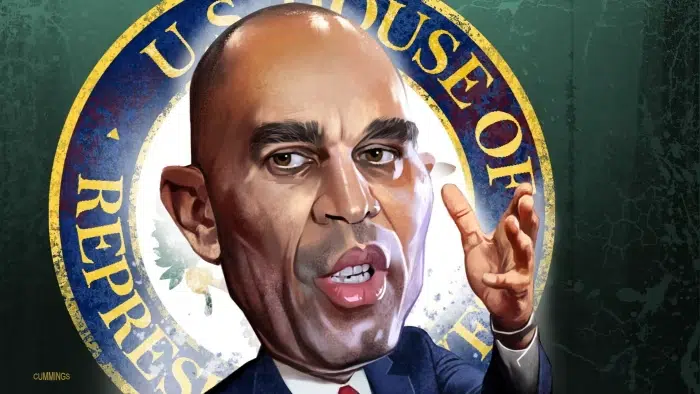
House Minority Leader Hakeem Jeffries, D-N.Y., who is set to become majority leader in January, called the Nvidia board’s decision “indefensible, irresponsible and incomprehensible” in a statement Monday.
He called on Republican lawmakers to support the insertion of “ironclad export control legislation” into the fiscal year 2027 National Defense Authorization Act “to prevent powerful AI technology from being exploited by the Chinese Communist Party and other adversaries.”
“Congress will not be deterred from conducting a swift, thorough and wide-ranging investigation into business malfeasance by NVIDIA and corrupt abuse of power by [U.S. Department of Commerce Secretary] Howard Lutnick,” Jeffries added. “We will not allow America’s national security to be sold out by the Trump Administration for personal financial gain.”
Lutnick is receiving criticism for reportedly delaying the implementation of stronger export control measures prior to the news of the Nvidia scandal.
Huang, who initially resigned as the company’s CEO after the news broke, was having a years-long extramarital affair with Alice Huang – no relation – who is an executive at Singapore-based AI infrastructure company Megaspeed and a suspected spy for the Chinese government.
During the duration of the affair, Megaspeed and other entities were accused of funneling billions of dollars’ worth of restricted Nvidia AI chips into China. Nvidia’s board, however, concluded after its investigation that it had no reason to believe national security or Nvidia secrets were compromised.
Both Democrats and Republicans in Congress appear unconvinced. Democrats have universally vowed to investigate the matter, as well as any potential Trump administration involvement, when they take power in the 120th Congress.
U.S. Sen. Kevin Cramer, R-N.D., posted Monday on social media that Congress “should immediately pass the strictest export controls possible,” while Sen. Pete Ricketts, R-Neb., said Hunag’s reinstatement “doesn’t excuse Jensen Huang from testifying before Congress” in December.
But it is uncertain if enough Republicans will be on board with Jeffries’ demand that strict export controls be included in the final NDAA.
Normally a widely bipartisan piece of legislation, the NDAA has stalled in Congress since late summer. Both the Senate and House versions of the NDAA, which lawmakers must meld at some point, have roughly the same topline, about $1.15 trillion.
Due to the lack of funding restrictions on the Trump administration’s unauthorized military attacks on Iran, the House’s version barely squeezed through and the Senate version failed to even make it to the chamber floor for debate.
Congress has less than eight weeks left in the lame duck session to send the bill to the president’s desk before the shift in party power.