Why Do Countries Cut Off Their Nose To Spite Their Face?
The climate change myth, if fully perpetuated, will turn out to be the greatest global hoax ever constructed. Climate change is not more than cyclical weather patterns that have been occurring for centuries.
Climate change has everything to do with lies, false fear, and the transfer of wealth. By using bogus legislation, shell companies set up for the elites and their compadres, and strict, unnecessary regulations and mandates, the money will be moved and wasted on a hysteria-induced crisis that has never existed.
Europe responded with a complete lack of foresight by deciding to impose fines on auto companies if they fail to meet sales targets for electric vehicles. These fines took effect this year. To avoid paying these penalties, automakers are forming partnerships with Chinese electric vehicle manufacturers to purchase carbon credit offsets.
Carbon offset credits are purchased to compensate for greenhouse gas emissions. This is achieved by funding projects that either reduce or remove carbon from the atmosphere. People and organizations buy these credits to attain carbon neutrality, support climate-related initiatives, comply with regulations, or as a temporary measure while transitioning to more sustainable practices.
Offsets enable companies and individuals to achieve carbon neutrality by balancing their emissions with verified reductions occurring elsewhere.
The irony and stupidity here is a foot thick. EVs are not that popular. So, how can any car dealership be held responsible for the number of vehicles sold? The vehicles are expensive, unreliable, and the batteries require huge lithium mining operations that don’t spare the environment; in fact, the mining ravages it. Child labor is also used in these operations.
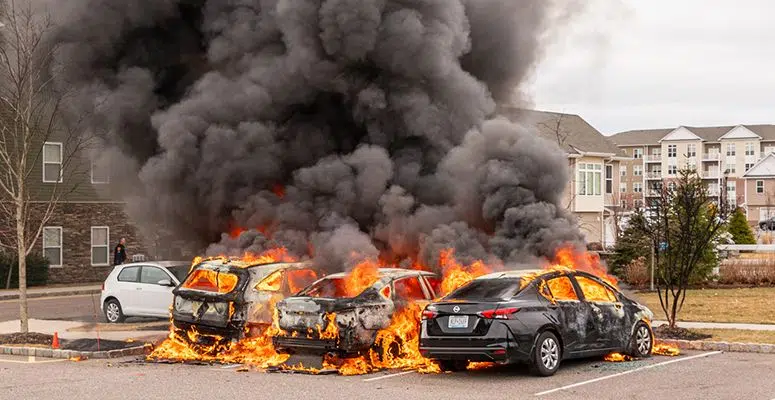
Once constructed and installed, the batteries are extremely heavy, causing, among other things, increased tire wear and also additional wear on roadways. The batteries are also volatile and have been known to catch on fire, fires that cannot be easily extinguished. Lithium battery fires are fueled by a chemical reaction called thermal runaway, which can’t be stopped by simply cutting off oxygen, and the batteries generate their own oxygen. They also release extreme heat and toxic gases that can reignite even after being extinguished and have a tendency to reignite hours or days later, as long as energy remains in undamaged cells.
Even if they don’t catch fire, the cost of replacing them is incredibly high. The battery pack typically accounts for between one-third and one-half of the vehicle’s total price. Also, there is no single “safe way to dispose of lithium batteries” because improper disposal is dangerous, causing fires and toxic fumes from their reactive chemicals and high energy storage. There are established, safe methods for recycling them through designated programs, such as hazardous waste facilities or electronics retailers; however, these methods are costly and contribute to the overall cost of the vehicles.
The intimidation caused by this moronic structure of fines has resulted in EU car companies buying carbon credits from Chinese car companies to avoid the EU fines. The Chinese car companies can use revenue from carbon credits to subsidize lower-priced Chinese EVs in the European market, thereby undercutting European EV manufacturers.
Reuters reported:
Automakers have formed alliances to help them avoid hefty European Union fines on carbon emissions by purchasing credits from electric vehicle companies. Several legacy automakers face potential fines as the transition to EVs in Europe has proved slower than expected in recent years.
EU fines – which automakers have said could reach up to 15 billion euros ($17.5 billion) – were initially envisaged on 2025 carbon emission levels. In March, however, the European Commission yielded to pressure from automakers and allowed compliance based on their average emissions over 2025-2027.
All current alliance agreements, identified by the names of their pool managers, will expire at the end of this year. They are expected to be renewed in the coming years.
NISSAN
In October, Japan’s Nissan partnered with Chinese EV giant BYD.
KG MOBILITY Another pool was formed at the end of September by South Korea’s KG Mobility and Chinese EV maker Xpeng.
Tesla
In January, a collaboration pool was formed among Stellantis, Toyota, Ford, the Chinese EV maker Leap Motor, as well as Mazda and Subaru. Honda and Suzuki from Japan joined the pool in March.
MERCEDES
A new consortium was formed in January, consisting of Mercedes, Volvo Car, the electric vehicle manufacturer Polestar, and Smart Automobile. Both Volvo Car and Polestar are supported by China’s Geely, which also has a significant stake in Mercedes. Geely’s Chairman, Li Shufu, owns 9.69% of Mercedes, making him the second-largest shareholder in the group, following China’s BAIC Group. Additionally, Smart Automobile is a joint venture between Mercedes and Geely.
Electric vehicles accounted for 12 percent of total light vehicle sales in Europe last year, according to the consulting firm AlixPartners. This figure is expected to rise to 15 percent this year. Projections indicate that their market share will increase to 24 percent by 2027 and reach 40 percent by the end of the decade, according to AlixPartners.
Meanwhile, BVD and Greely are currently offering very affordable electric vehicles throughout the entire EU.
None of this makes even the slightest bit of sense. Let’s mandate that automakers sell dangerous vehicles for no reason other than to redistribute wealth, and when they don’t, let’s force them into partnerships with a sworn enemy, the CCP, in order not to be punished by their own countries.
Well done, what outstanding leadership.
Ignorance at these levels is becoming increasingly prevalent, and the only way it will ever end is to stand up and fight it at every level. Not with physical violence, like the left condones, but by refusing to go along with their twisted ideology and removing them from positions of power on both a local and a national level.