There Are Only Two Parties in America
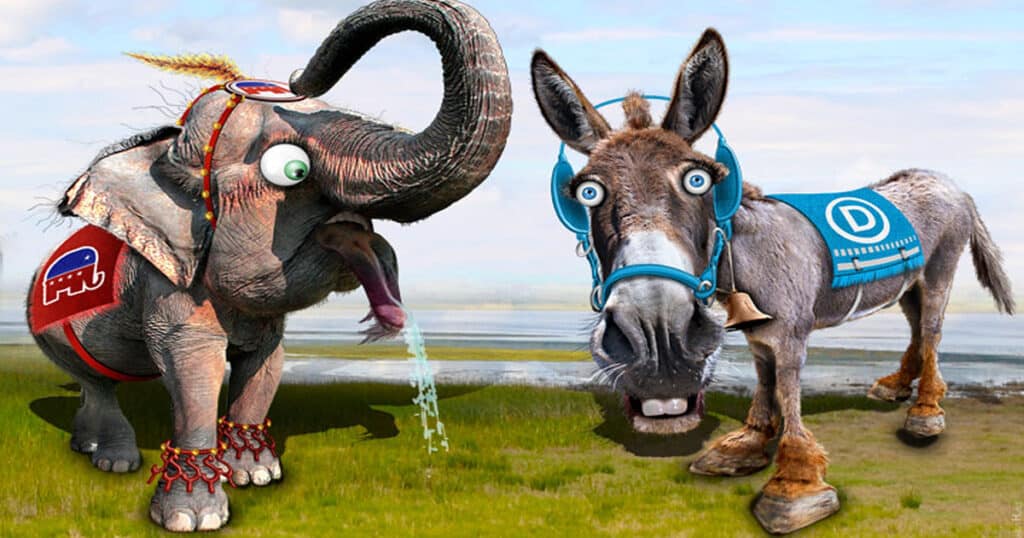
The names change. The factions multiply. The slogans mutate. But beneath the noise, American politics has always been a war between two moral systems: Republican constitutionalism and Democratic state-defined rights.
There are not six political parties in America.
There are not ten.
There are not twenty.
There are two.
There are Republicans, in the deep moral sense: those who believe rights come from God, human beings possess inherent personhood, the family is prior to the state, conscience is not a government permission slip, citizenship has meaning, law must be anchored in the Constitution, and government exists to secure rights it did not create.
And then there are Democrats, in the deep moral sense: those who believe rights are defined, expanded, redistributed, balanced, licensed, or withheld by courts, agencies, legislatures, experts, movements, and political power.
Everything else is branding.
Some smaller parties on the right are aligned allies of Republicans on selected planks. They are not necessarily Republican in their first principles. They may like guns, low taxes, borders, deregulation, anti-war policy, local control, or free markets. But if they reject the deeper moral spine — Creator-endowed rights, legal personhood, natural marriage, religious conscience, ordered liberty — then they are not Republican in the full historic sense.
The left is different.
The so-called minor left parties are rarely philosophically independent of the Democratic Party’s moral system. They are usually Democratic factions with different names. Greens, Democratic Socialists, Working Families activists, Socialists, progressives, left-populists — they fight Democrats over speed, money, tactics, purity, personnel, foreign policy, and control of the machine. But on the great moral questions — abortion, sexual autonomy, gender ideology, redistribution, state-administered equality, anti-capitalist suspicion, secular public order, court-created rights, and administrative enforcement — they are not different political species.
They are Democrats with sharper elbows.
That is my thesis. Now I bring the receipts.
The American party system did not flip. It clarified. The masks changed. The moral machinery did not.
The Republican Party Was Born on Personhood, Family Order, and Constitutional Rights
Let’s start at the beginning.
The Republican Party’s first national platform in 1856 did not begin as a tax club. It was not created as a chamber-of-commerce coalition. It was not founded as a consultant spreadsheet.
It was born as a moral and constitutional resistance movement.
The 1856 Republican platform declared that the principles of the Declaration of Independence and the Federal Constitution were “essential to the preservation of our Republican institutions.” It then stated the core truth: all men possess the inalienable right to life, liberty, and the pursuit of happiness, and the federal government exists to secure those rights to “all persons” under its jurisdiction. Most importantly, it denied the authority of Congress, a territorial legislature, or any individual to give “legal existence” to slavery in federal territory.
There is the whole argument.
The state cannot manufacture non-persons.
The state cannot say, “This human being may be excluded from the circle of rights because our political coalition finds it inconvenient.”
That was the slavery question.
It is now the abortion question.
The issue changed clothes. It did not change its soul.
The same platform also condemned “Polygamy, and Slavery” as the “twin relics of barbarism.” That sentence matters because it proves something the modern political class desperately wants to obscure: from the beginning, the Republican Party’s moral architecture linked human personhood and sexual/family order. Slavery was a violation of the created person. Polygamy was a violation of the created family. Both were understood as civilizational corruptions that law had no moral right to bless.
That is not an incidental plank. That is the foundation.
Then the 1856 platform moved from metaphysics to civil liberties. In Kansas, Republicans charged that armed force, fake officers, unconstitutional laws, infringements on the right to keep and bear arms, test oaths, denial of jury trial, unreasonable searches, deprivation of life and liberty without due process, abridgment of speech and press, and destruction of representative choice had been used to crush free government.
Read that again.
Right to bear arms. Due process. Free speech. Free press. Jury trial. Representative government. Lawful elections. Protection from government-backed violence.
That is the Republican platform in 1856.
Now compare it to the modern platform. In 2024, Republicans again pledged to uphold the Constitution, defend life, liberty, and the pursuit of happiness, stop weaponized government, dismantle censorship, protect free speech online, defend religious liberty, stand for families and life, invoke the Fourteenth Amendment’s protection of life and liberty, oppose late-term abortion, reject state-funded gender transition policies in schools, and secure elections with voter ID, paper ballots, proof of citizenship, and same-day voting.
That is not a party flip.
That is an eternal straight line from heaven.
The vocabulary changed because the battlefield changed. But the core question remains identical: Can government redefine reality, personhood, family, conscience, speech, citizenship, and law for political convenience?
The Republican answer, the whole time, every time, since 1856, has been clear and resounding NO !!!
The Democratic Party’s Original Sin Was State-Defined Personhood
Now look at the other side.
The Democratic platform of 1856 did not speak like the Republican platform. It did not say that government must secure the inalienable rights of all persons under its jurisdiction. It defended “non-interference by Congress with slavery in state and territory, or in the District of Columbia.” It also defended the admission of new states “with or without domestic slavery” as the people might elect.
That is the Democratic moral engine.
Not merely “states’ rights.”
Not merely “local control.”
The issue was whether a class of human beings could be held outside the full legal protection of personhood because a political community chose it. Voted for it. Raw democracy without any protections from the mob. Democrats.
And the Democrats said yes !!
They dressed it in constitutional language. They wrapped it in union language. They sold it as peace, compromise, local democracy, and non-interference. But the principle was clear: the law could recognize or deny the rights of the vulnerable based on political settlement.
That is not a dead issue. It is the same issue with a different victim.
In 2024, the Democratic platform pledged to restore Roe as national law, strengthen access to contraception, protect IVF, repeal the Hyde Amendment, support medication abortion, and appoint judges who uphold these freedoms. Democrats call that reproductive freedom. But the philosophical claim is the same as before: legal status depends on state definition, court doctrine, and political power. The unborn child is not treated as a rights-bearing person because the coalition’s autonomy framework requires the child to be treated as something less.
That is not new.
That is old. As old as Eden. And just as wicked.
It is the 1856 engine running on 2024 fuel.
The Democrats did not flip. They adapted.
The So-Called Party Flip Is a Historical Fog Machine
The party-flip argument survives because most people are taught politics as color maps and voting blocs instead of moral anthropology.
Yes, individuals switched parties.
Yes, regions realigned.
Yes, coalitions changed.
Yes, some segregationist Democrats later became Republicans. Strom Thurmond is the example everybody throws on the table, as if one man’s political migration proves a metaphysical exchange between two national parties. Britannica identifies Thurmond as a states’ rights and segregation advocate who ran on the Dixiecrat ticket in 1948 and later served as a Republican senator.
But that does not prove the parties swapped souls.
It proves that politicians defect.
The Dixiecrats themselves were not Republicans. They called themselves the States’ Rights Democratic Party. Their 1948 platform openly said they stood for segregation, opposed the elimination of segregation, opposed federal civil-rights enforcement, and condemned the Democratic Convention for sponsoring a civil-rights program.
Notice what actually happened.
The segregationist faction was a Democratic splinter fighting over whether the Democratic Party would continue protecting the old racial order. It was not the Republican Party confessing its real beliefs. It was a Democratic family fight.
And in 1964 — the very year used by party-flip storytellers as Exhibit A — the Republican platform opened with the question of whether man would live “in dignity and freedom under God” or be enslaved by men in government.
The same 1964 GOP platform called for full implementation and faithful execution of the Civil Rights Act of 1964 and all other civil-rights statutes to assure equal rights and opportunities guaranteed by the Constitution to every citizen. It also said the Party of Abraham Lincoln would live up to its heritage of equal rights and equal opportunities for all.
That is the record. The actual written and undisputed facts of history.
The Senate passed the Civil Rights Act of 1964 by 73 to 27, and the House passed the amended bill 289 to 126. That was a national legislative coalition. It was not evidence that the Republican Party became the Confederacy. It was evidence that America was still fighting the same question: whether the rights guaranteed by the Constitution belong to persons by nature or only to groups recognized by power.
The party-flip story collapses because it mistakes coalition movement for moral transformation. Or outright lies about it to hide their guilt.
A man can switch jerseys without the team changing its constitution.
The Republican Line: Rights Come Before Government
The Republican line is not hard to find. It is printed in the platforms.
In 1856, Republicans said all men have inalienable rights and no government body can give legal existence to slavery.
In 1896, Republicans argued for protecting American labor and industry from degradation by foreign wage competition, and also demanded that every citizen be allowed to cast one free and unrestricted ballot that would be counted as cast.
In 1964, Republicans framed the issue as human dignity and freedom under God versus domination by men in government.
In 2016, Republicans explicitly affirmed that God bestows inalienable rights, that government exists to protect those rights, that man-made law must be consistent with God-given natural rights, and that when God-given rights conflict with government-granted rights, the God-given rights prevail.
In 2024, Republicans again defended religious liberty not merely as a right to worship in a building, but as the right to act according to conscience in everyday life. They tied life and family to the Fourteenth Amendment, opposed late-term abortion, and rejected gender ideology in taxpayer-funded institutions.
That is the spine.
Creator. Person. Family. Conscience. Constitution. Citizen. Nation.
That is Republicanism in the deep nature of the party.
I AM A REPUBLICAN !!!
Every lesser plank flows from it.
Election integrity is not a procedural hobby. It is the belief that lawful citizens choose their government, not bureaucrats, machines, judges, NGOs, or imported voters.
The Second Amendment is not a gun-catalog issue. It is the belief that a free citizen is not merely a managed subject.
Religious liberty is not permission to sing hymns on Sunday. It is the belief that conscience belongs to God before it ever answers to the state.
Parental rights are not a school-board fad. They are the belief that children belong first to the family, not to the administrative state.
National sovereignty is not xenophobia. It is the belief that citizenship is a covenant with duties, borders, laws, and mutual obligations.
Economic nationalism is not new. The 1896 GOP platform called protection and reciprocity “twin measures of American policy” and said protection builds domestic industry and secures our own market for ourselves.
The words change. The stack remains.
The Democratic Line: Rights Are Managed by Power
The Democratic line is also easy to trace.
In 1856, Democrats defended non-interference with slavery and admission of states with or without slavery.
In 1896, Democrats framed the economic order as a fight against the “money-lending class,” gold policy, debt burdens, and the impoverishment of the people.
In 2024, Democrats framed rights through courts, agencies, national legislation, federal enforcement, reproductive autonomy, LGBTQI+ protections, gender-affirming care, federal education rules, and religious freedom balanced against other civil rights.
That is also a straight line. The long Highway to Hell.
It is not the same policy list. It is the same operating system.
The Democratic worldview treats rights as claims administered by public authority. The unborn child has no legal personhood unless courts or statutes say so. Marriage may be redefined because the state is treated as the licensing authority over the institution. Sex may be subordinated to gender identity because agencies, schools, courts, and medical authorities are empowered to enforce the new definition. Religious liberty may be honored, but only insofar as it can be balanced with the other civil-rights claims the state has chosen to elevate.
That is why the Democratic platform can say it protects religious freedom and then immediately say Democrats will honor religious freedom and other civil rights together, not put them “at war with one another.”
That sounds reasonable until you ask the real question: who decides when conscience must yield?
The answer is obvious.
The state. Sieg Heil.
That is the Democratic line.
The Right Has Allies, Not Copies
Now come the smaller parties.
The right-aligned minor parties are not simply Republicans wearing different hats. Some are allies on selected issues. Some are purists. Some are protest vehicles. Some are morally serious but economically divergent. Some are anti-state individualists. Some are Christian-democratic. Some are reformist. Some are single-issue moral parties.
But they are not all “Republican” in deep nature.
The Libertarian Party is the clearest example.
Libertarians share Republican concerns about government power, surveillance, property, guns, taxes, and speech. But the Libertarian platform begins with individual sovereignty: individuals are “sovereign over their own lives.” It opposes government actions that either aid or attack religion. It says government has no authority to define, promote, license, or restrict personal relationships, regardless of the number of participants, and that all consenting adults should be free to choose their sexual practices and relationships.
That is not historic Republicanism.
It is not the 1856 Republican argument about created personhood and moral order. It is not the 2016 Republican argument that God-given natural rights prevail over man-made rights. It is not the 2024 Republican defense of marriage, parental rights, and religious liberty in public life.
Libertarians are allies against Leviathan. They are not Republicans.
The Reform Party is another example. It is fiscally and ethically reformist. It wants election reform, government ethics, fiscal responsibility, job-market reform, balanced energy and environment policy, and reduced government overreach. Fine. Much of that aligns with Republicans. But the Reform Party expressly takes “NO STANCE” as an organization on pro-life/pro-choice and gay marriage.
That settles it.
If a party refuses to stand on personhood and marriage, it cannot be Republican in the deep moral sense. It may be useful. It may be allied. It may be right-leaning. It may be anti-establishment. But it is not Republican in nature.
The Constitution Party is the closest right-side cousin to historic Republicanism, and in some ways it is more explicit than the GOP. Its 2024 platform says the sole purpose of government is to secure unalienable rights given by the Creator. It affirms God-given legal personhood from fertilization to natural death, says the first duty of law is to protect innocent life created in the image of God, and condemns legalized abortion, infanticide, euthanasia, and suicide as violations of the unalienable right to life. It declares marriage to be the union of one man and one woman under the law of the Creator and says no government may legitimately redefine marriage contrary to what God instituted.
That is deeply aligned with Republican moral metaphysics.
But even here, the Constitution Party is not merely Republican. It is a constitutional restoration party. It wants to “bring government back home,” restore the balance of federal and state authority, and limit federal power to enumerated constitutional powers. That makes it a purist ally, not the same broad governing coalition as the GOP.
The American Solidarity Party is also not Republican, though it is strongly aligned on life and family. It says its policies are informed by Christian democratic values and that it is committed to defending life and the intrinsic dignity of the human person from conception until natural death. But it is Christian-democratic and economically communitarian, not Republican in the historic American party sense.
So the right is not one thing with many labels.
It is a coalition field.
There are natural-law conservatives, libertarians, constitutional restorationists, Christian democrats, populists, reformers, national conservatives, anti-war constitutionalists, and moral traditionalists. They overlap. They cooperate. They sometimes vote together. But they are not all Republicans in deep nature because they do not all accept the full stack.
That is why the GOP has RINOs.
That is why the right fights over first principles.
That is why right-side third parties can be genuinely different from Republicans.
Some reject the family plank. Some reject the life plank. Some reject the national plank. Some reject the governing-coalition plank. Some reject the economic plank. Some reject the religious foundation. Some accept all of it but reject the GOP as too compromised.
Those are real differences.
They are not just branding.
The Left Has Factions, Not Different Moral Universes
Now compare the left.
The Green Party does not represent a different moral universe from the Democrats. It represents a more radical, more ecological, more anti-capitalist version of the same moral direction.
On abortion, the Greens say women’s right to control their bodies is non-negotiable, safe legal abortion must remain available, abortion must be available regardless of age or marital status, and contraception and abortion must be included in health insurance. On sexual orientation and gender identity, the Greens support full legal and political equality regardless of sex, gender, sexual orientation, gender identity, characteristics, and expression, and support adding sexual orientation, gender identity, and gender expression to civil-rights law.
That is not a deep break from Democrats. It is an intensification of the Democratic platform, which pledges the Equality Act, gender-identity and sexual-orientation protections, gender-affirming care, opposition to bans on such care, and transgender student protections.
On economics, the Greens go further than Democrats, but in the same direction of state/corporate restructuring and egalitarian redistribution. They call for publicly owned enterprises, democratic cooperatives, alternative economic structures, progressive taxation, universal basic income, and an eco-socialist economy. They explicitly say the Green Party opposes capitalism and seeks an eco-socialist economy based on green public works, municipalization, workplace democracy, and community democracy.
That is not a separate political species. That is the Democratic moral premise pushed leftward.
The Democratic Socialists of America are even more obvious.
DSA says Americans face a choice between “far-right Republicans” and “corporate Democrats,” and that neither major party can meet the needs of Americans. That sounds like a break. It is not. It is a fight over ownership of the left’s machinery.
DSA says Democrats are too corporate. Too weak. Too donor-controlled. Too compromised. Too militarist. Too slow. But DSA’s platform also says the far right attacks abortion and gender-affirming care, says DSA helped defend abortion rights, and calls for reproductive and gender-affirming care under Medicare for All. It calls for guaranteed basic needs, putting the largest corporations under public ownership and democratic control, public ownership over major transportation, energy infrastructure, and natural resources, a wealth tax, universal rent control, tuition-free public higher education, student-loan cancellation, expansive paid leave, free universal childcare, noncitizen voting rights, abolition of the Electoral College, and reduced Supreme Court power.
That is not a Republican alternative.
It is not even a neutral third way.
It is the Democratic Party’s moral and economic trajectory without the consultant polish.
The Working Families Party is cleaner still. Its “Working Families Guarantee” calls for affordable housing, guaranteed health care for all, a national jobs program placing workers in union jobs, guaranteed low-cost childcare, twelve weeks of family and medical leave, taxing the rich, and getting big money out of politics.
That is not a separate worldview from the Democratic Party. It is a pressure campaign inside and around it.
The Socialist Party USA says it stands for abolition of exploitation based on class, gender, race/ethnicity, age, sexual orientation, and other characteristics, and supports replacing capitalism with a socialist society in which the working class assumes democratic control over the means of production. Its platform supports birth control and reproductive health services including abortion, affirmative action, expanded childcare, comparable-worth laws, and legal recognition of same-sex unions or marriages.
Again, not Republican. Not center. Not separate from the left’s moral arc. It is merely more explicit.
So here is the pattern.
The left’s minor parties do not reject the Democratic definition of rights. They radicalize it.
They do not reject abortion autonomy. They demand more of it.
They do not reject gender ideology. They constitutionalize, subsidize, and institutionalize it.
They do not reject redistribution. They escalate it.
They do not reject court/agency/state enforcement of equality claims. They expand it.
They do not reject secular public order. They harden it.
They do not reject the administrative state. They want to command it.
They do not reject the Democratic coalition’s moral premises. They accuse Democratic leadership of cowardice, corruption, compromise, or insufficient revolutionary zeal.
That is not divergence.
That is family resemblance.
Historical Third Parties Prove the Rule
This pattern is not new either.
The Free Soil Party was a genuine precursor to the Republican Party. In 1848, it assembled “for the sake of freedom,” to maintain the rights of free labor against the Slave Power and secure free soil to a free people. It invoked God and planted itself on the “National platform of Freedom” against slavery.
That is proto-Republican.
Why? Because Free Soil shared the moral engine that would become Republican: slavery was a national moral question, not a private arrangement to be hidden behind process.
The Progressive Party of 1912 was different. It was not Republican in deep nature, even though Theodore Roosevelt had been a Republican president. Its platform demanded expanded public power over labor conditions, child labor, minimum wages, industrial regulation, social insurance, and court limitations in the name of democratic social welfare. That platform was morally and administratively closer to the later Democratic state-building tradition than to the original Republican natural-rights tradition.
The Populist tradition likewise fed the leftward economic stream: anti-bank, anti-railroad, graduated income tax, currency manipulation, public control, and redistributionary politics. The 1896 Democratic platform absorbed that spirit by attacking gold policy, debt burdens, the “money-lending class,” and the impoverishment of the people.
Again, the labels shift. The moral machinery persists.
Right-side minor parties often break over first principles.
Left-side minor parties usually break over intensity, tactics, class theory, or control.
That is the difference.
Jefferson, God, and the Democratic Religious Instinct
The Democratic Party’s older religious instinct also matters.
Thomas Jefferson was not a modern atheist in the blunt internet sense. But he was religiously unorthodox, rationalist, and Deistic. The Smithsonian says that around 1820 Jefferson cut and pasted verses from the New Testament to create The Life and Morals of Jesus of Nazareth, distilling Jesus’ ethical teachings from miracle accounts and other elements he considered distortions; the Smithsonian describes Jefferson as a Deist. Britannica says the Jefferson Bible arranged the Gospels in a way that avoided supernatural or miraculous elements and emphasized moral teaching.
That does not mean every Democrat is an atheist. That would be false. But, it does mean that every one from this root is, in fact, a Democrat.
Because it means the Democratic tradition has long been comfortable separating public morality from orthodox Christian supernatural claims and relocating moral authority into reason, process, majority will, courts, equality language, and administrative law.
That religious instinct still shows.
In 2012, Democrats amended their platform to restore language about God and Jerusalem after public controversy. ABC News reported that the convention floor burst into chaos and that the chairman called the vote three times. RealClearPolitics reported that delegates booed after the motion to recognize God and Jerusalem was ruled passed.
Again, that moment was symbolic because symbols reveal foundations.
The Republican instinct says rights come from God and government secures them.
The Democratic instinct says rights come through social recognition and legal enforcement, while religious claims must remain subordinate to pluralist state balancing.
That is the divide.
The Lesser Issues Are Not Lesser at All
Once you see the two foundations, the so-called “lesser issues” stop looking random.
Free speech: Republicans fear government censorship because speech is a pre-political liberty. Democrats increasingly frame speech through misinformation, harm, hate, safety, platform governance, and protected-class impact. The 2024 GOP platform vows to ban federal collusion to censor lawful speech and protect free speech online.
Education: Republicans treat parents as primary. The 2024 GOP platform says Republicans will restore parental rights, trust parents, reject gender indoctrination, promote patriotic civics, defend prayer and Bible reading in schools, and return education to the states. Democrats treat schools as civil-rights enforcement zones, including gender identity and sexual orientation rules. Their 2024 platform celebrates federal action to guarantee educational environments free from sex discrimination including sexual orientation and gender identity, and promises transgender students will be treated according to that framework.
Religious liberty: Republicans say religious liberty includes acting according to conscience in everyday life. Democrats say free exercise must be honored alongside other civil rights and not put “at war” with them. That is the whole dispute in one sentence.
Voting: Republicans connect voting to citizenship, lawful ballots, and counted votes. The 1896 GOP platform demanded that every citizen cast one free and unrestricted ballot and have it counted as cast. The 2024 GOP platform calls for voter ID, paper ballots, proof of citizenship, and same-day voting. DSA goes the opposite direction and calls for voting rights for noncitizens, abolition of the Electoral College, and reduced Supreme Court power.
Immigration: Republicans distinguish lawful citizenship from unlawful entry and national sovereignty from open-ended membership. The 1896 GOP platform demanded enforcement of immigration laws to protect American citizenship and wages. Modern Republicans speak of borders, citizenship, and American workers. DSA calls for “freedom of movement,” demilitarizing the border, ending detention and deportations, amnesty for all immigrants regardless of status, and access to jobs and social services for all immigrants.
These are not disconnected policy disagreements.
They are applications of the same first principles.
Who is a person?
Who is a citizen?
Who defines family?
Who owns children’s moral formation?
Who governs conscience?
Who decides truth?
Who controls language?
Who restrains government?
Who counts the vote?
Who has authority: God and the Constitution, or the administrative state and its allied movements?
That is the American argument.
The Final Verdict
There has been no grand party swap in the deep nature of American politics.
There have been defections.
There have been regional shifts.
There have been tactical retreats.
There have been coalition changes.
There have been cowards, opportunists, consultants, and careerists in both parties.
There have been Republicans who did not live up to Republican principles. That is why the word RINO exists.
But there has not been a metaphysical flip.
The Republican Party was founded on the proposition that human beings possess rights before government touches them. It opposed the legal manufacture of non-persons. It condemned the destruction of family order. It defended constitutional liberties against state-backed lawlessness. It has carried that framework through life, marriage, religious liberty, parental rights, lawful citizenship, national sovereignty, election integrity, speech, and limited government.
The Democratic Party defended the political/legal framework that allowed slavery to remain a local option and territorial choice. It later translated the same state-defined-rights instinct into abortion autonomy, sexual revolution, gender ideology, redistribution, administrative enforcement, court-centered rights expansion, and secular balancing of religion against state-approved civil-rights claims.
The smaller parties prove the case.
On the right, minor parties are often aligned but not Republican because they reject pieces of the Republican moral stack. Libertarians reject the natural-law family foundation. Reformers refuse to take a stand on life and marriage. Constitution Party members may share the deepest premises but reject the GOP’s broad coalition as too compromised. American Solidarity shares life and family principles but follows Christian-democratic economics. These are real differences.
On the left, the minor parties are overwhelmingly Democratic subsets in principle. Greens are Democrats with eco-socialist acceleration. DSA is Democrats with class-war clarity and public-ownership demands. Working Families is Democrats with union-populist pressure tactics. Socialist Party USA is Democrats with the mask off economically. They do not reject the Democratic moral trajectory. They demand control of it.
So stop calling this a party flip.
It was not a flip.
It was a sorting.
It was not a swap.
It was a clarification.
It was not history changing sides.
It was power changing costumes.
The ballot may list many parties. But the moral choice is still binary.
There are those who believe rights come from God, personhood precedes politics, family precedes bureaucracy, conscience precedes permission, and government must be chained to the Constitution, and those are REPUBLICANS !!
And there are those who believe rights are administered by power, and they are DEMOCRATS.
That is the case.
That is the record.
That is the verdict.