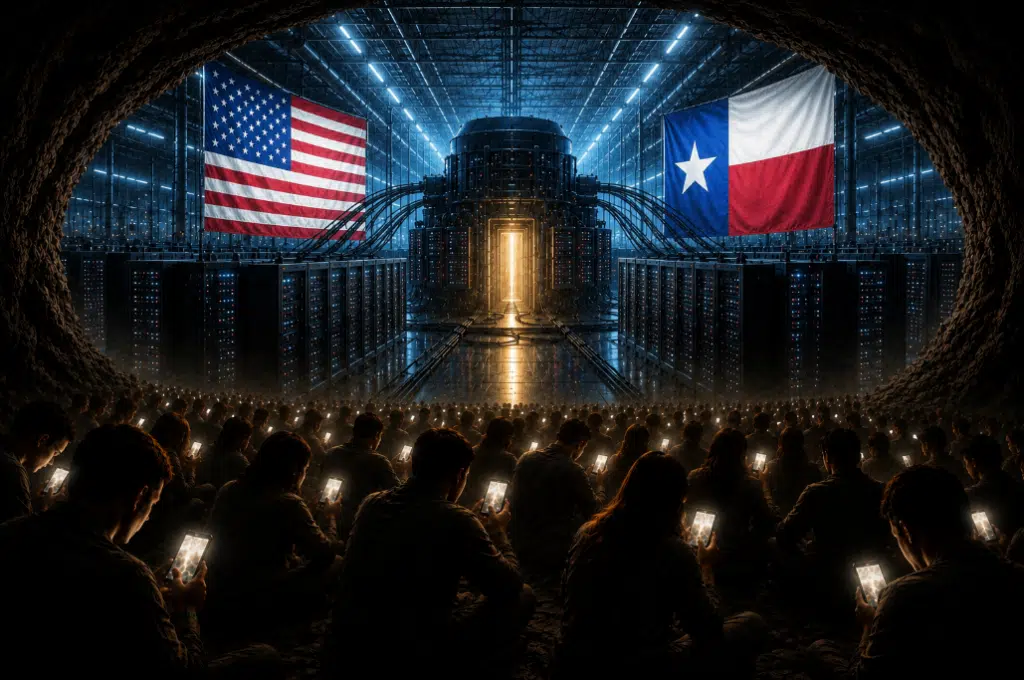
CLOUDS, CAMPFIRES & CAVES: The Massive Infrastructure Beneath America’s Digital Future
The “cloud” was always physical, regardless of what company or app we were dealing with. Only now are the majority of Americans beginning to see just how physical it really is.
The question is do we wonder if it was always meant to lead here, and most concerningly, beyond.
Texas continues to be a leading driver in America’s exploding data-center boom, with massive AI infrastructure projects consuming mind-numbing amounts of land, electricity, water, and military attention. From Bethany Blankley at The Center Square:
Texas appears to be ground zero for a large number of data centers, at least 140, planned to be built in rural communities statewide unless local governments and the state legislature act to impose restrictions.
As of April 2026, Texas has 84 operating data centers and 140 planned projects, according to an analysis by Cleanview, “a software platform that helps visualize clean energy data.” Operating data centers in Texas have a total capacity of 3,789 MW. Planned data centers would add another 75,089 MW of capacity, it says.
The Bloomberg Energy 2026 Data Center Power report says this:
[B]y 2028, “Texas is projected to exceed 40 GW of capacity – nearly 30% of total U.S. demand – representing a 142% increase in market share relative to today.”
It also notes a market shift in growth. Last year, Bloomberg found that “AI driven computer demand was beginning to outpace the grid’s ability to deliver power at scale.” Within six months, if found “clear signs of stress – widening interconnection timelines, rising uncertainty, and growing interest in alternative power strategies.”
“Within three years, Texas is poised to become the nation’s leading data center market,” Bloomberg projects. “Legacy markets, such as California and Oregon, are expected to lose more than half of their relative market share. Despite Tier 1 markets largely driving capacity growth, emerging markets are collectively expanding their share by over 20% in aggregate.”
It also notes that data center campuses are expected to exceed gigawatt scale nationally. “By 2030, about one in five data center campuses are expected to exceed gigawatt scale, rising to one in three by 2035. At this scale, power delivery remains the primary constraint, but cooling capacity, water availability, permitting complexity, and network infrastructure will emerge as critical challenges,” it says.
According to a JLL Capital Markets report, “more than 35 GW of data center capacity is under construction in North America, an extraordinary volume by historical standards. For context, this is roughly equivalent to the annual electricity consumption of the UK or Italy.”
None of this is necessarily sinister on its face. So-called artificial intelligence, or digital assistance as I prefer, will likely help bolster many industries as it already does. Civilization, for better or worse, increasingly runs through servers, fiber optics, and giant climate-controlled buildings vibrating with electricity.
But those who aim to bolster the spiritual life first and foremost generally should at least notice the direction of the civilization around them, and more, take at least a cursory look at how today’s progress links organically to other leaps forward we’ve made in the past.
Seeing them as connected, if things turn for the worse in a visible way, can help us realize there was an enemy behind it the whole time. It wasn’t just that all of a sudden AI became the villain. If we don’t link it all, there’s a good chance we won’t identify the root enemy, and worse things will likely happen to us.
What is one tell that this is a single slowly moving organism?
The modern world, even the conservative world, constantly speaks the language of decentralization, personalization, freedom, and connectivity, while simultaneously constructing unprecedented centralized infrastructure underneath it all. The digital world is sold to us as unseen and abstract, even harmless, yet the physical footprint beneath it grows larger and louder, perhaps even more power-hungry by the year.
That contradiction alone should provoke reflection.
Something else to ponder is the fact that our president is in support of it all. There is even speculation that the famous ballroom being built is more about what lies beneath it. I wouldn’t dismiss anything you might see as baseless conspiracy theory. Just some charitable counsel.
The deepest danger is probably not that Americans will become enslaved overnight by some made-for-movie dystopia—that typically isn’t how the enemy works, as he prefers the slow boil in our destruction. But lest I be too presumptuous, it isn’t out of the realm of possibility either, for our deteriorating moral civilization to receive a sudden wake up call from above. Indeed, such a physical chastisement, a beating of the alarum, as Whitman would say, might be our only hope in the wake of wedding ourselves to systems we neither understand nor control.
Convenience, comfort, and fun have a way of making people spiritually apathetic, indeed.
All of this is why those seeking Christ and His Church should not merely use or debate topics on technology, but strengthen the parts of life technology cannot replace, like prayer, silence, the sacramental life, fasting, wholesome family and friendship, sincere study, and detachment from the electronic cave wall.
Get out and look at a campfire to nullify the blue light once in a while.
For if the future truly will be digitized, centralized, and inescapable, and if Agenda 2030 has anything to do with it, then strengthening those habits we learned from generations before us may soon become a matter of not just our earthly assumptions, but eternal salvation.