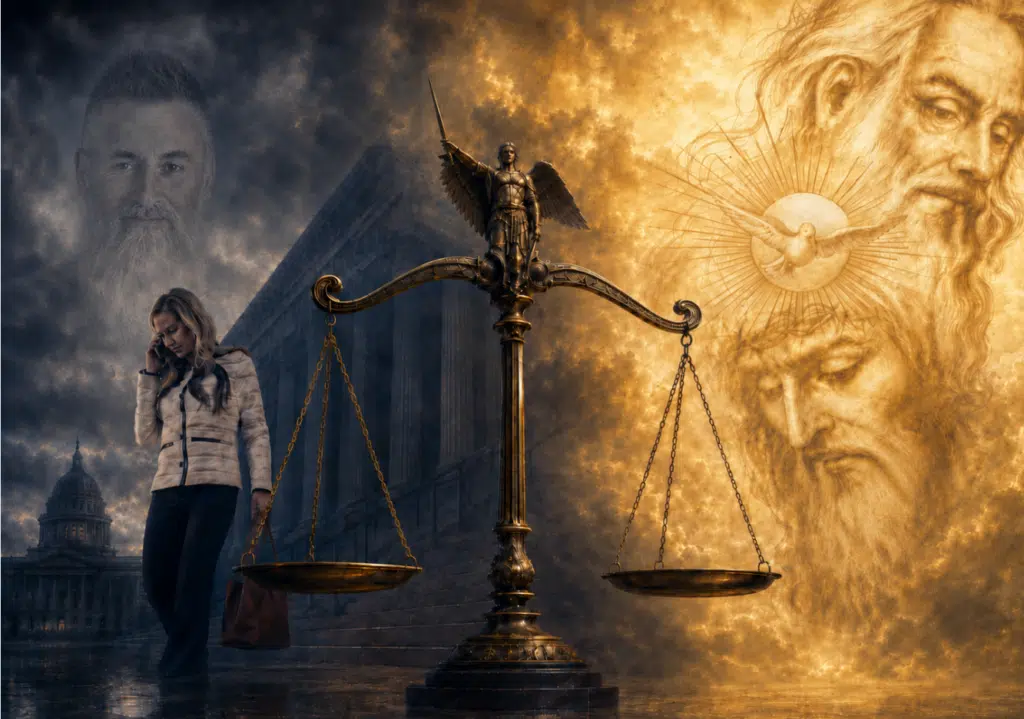
A Story of Justice and the Final, Single Sentence
This piece is not meant to be antagonistic toward Protestants, who do not believe in Purgatory, or modern Catholics, who by and large don’t believe in it either.
It certainly isn’t to strike fear into anyone who has lost a loved one. Mostly, it is just an invitation to see a political situation practically, fairly, and most importantly, charitably.
Finally, it is written by a soul who understands the terrors of his own sin, and the wake of that sin in so many other souls’ lives. I write this with a hand raised, not with a finger pointed.
RECENT: Dobbs, the Sacred Heart, and the Reparation America Refused
The Louisiana Political Mythos
Louisiana certainly has some of the most corrupt politicians in the country. Several current and former elected officials have received serious criminal indictments over the past few years alone. Few need to be reminded of how politics have typically worked in this state. It has become a sort of myth all unto its own.
Recently it was handed yet another story that forces honest people to ask what justice even means anymore.
One former mayor who need not be named here was convicted in a criminal case involving an underage teenage boy. The details, according to reporting from the trial, were disturbing enough on their own: alcohol, a party, a juvenile, the mayor’s own children testifying, and an untold number of souls now forced to live with the damage long after the headlines fade.
The judge gave her ninety days.
That is the sort of sentence that makes ordinary people feel as though the entire system is mocking them in broad daylight—perhaps my readers will recall our recent emphasis on the Revelation of the Method. The victim and his family received no real earthly justice; neither, of course, did the perpetrator. The public received another lesson in how power, status, legal maneuvering, and judicial discretion can combine to produce an outcome that looks less like justice and more like a shrugging equivalent to how Americans treated the JFK files last year.
And perhaps that is one of the incidental points that may come across today—we are a people who expect justice outside of ourselves, but for the most part don’t really do what we can to show God that we are willing to do our part too, as disparate as a tragic local story like this and a more notable one like the JFK assassination may seem to be.
This story should not merely drive us into another round of outrage about judges, laws, politicians, and elections. Yes, those things are important, but they fall woefully short of the ultimate ends we seek. Yes, laws should be changed where laws are weak. Yes, judges should answer for grotesque leniency when leniency becomes a scandal. But the deeper question is not merely political, and deep down inside—or maybe not even that deep—we all know that.
But few of us have been trained to know what the answer is.
The deeper question is what sort of civilization produces people who no longer understand the actual physics of justice in the first place. And that should not be a surprise, since we have also lost touch with the eternal connection between this world and the world to come for each and every soul.
RELATED: The Four Last Things & the Old Faith: A View on the Death Penalty
The Old Faith and the Physics of Justice
Realize that what follows is nested in the context of centuries, not mere years or even decades. There is a whole history behind the sometimes-slow and sometimes-abrupt break from a Faith that once provided the divine answers necessary to an unknowing and fragile creation seeking answers to questions increasingly on the rise.
We are seeing the consequences when Old Catholicism is removed from the bloodstream of a society. It is what happens when a people inherit Christian language, Christian instincts, Christian moral externals, and Christian assumptions, but gradually lose the doctrinal structure that once held it all together. It is the milk without the glass.
America has had many good Christians, many conservative clergy, many faithful laymen, and many sincere souls. But America, as a civilizational project, was never truly Catholic; I’ve heard some clergy even assert that even the best of Catholics had to compromise to such a degree early on in our history that one might argue we never had fully faithful shepherds in this country. From the beginning, it was built on handshakes that may have seemed prudent, even necessary, at the time, bearing in mind that souls were not merely traipsing to the next town over but were investing their entire lives and families in a far off land. But such compromises become pregnant unto themselves, and they bear children that are not entirely straight. Then grandchildren. And then, centuries later, a society, even the Catholic minority inside it, looks around and wonders why justice is so elusive for even the worst of us as sinners.
The reason may be mysterious but only because of our ignorance, whether that be our fault or our forefathers’ fault. But the reason resides in history, in the memory of an Old Faith that worked once and can work again if only we’ll have the humility, courage, and leadership to find it.
One of those memories is the old teaching that each and every soul sincerely reflect on what is called “The Four Last Things” every day of their lives.
When a civilization loses even a cursory focus on the Four Last Things—Death, Judgment, Heaven, and Hell—it will eventually lose its earthly understanding of justice too. When it forgets Hell, or even Purgatory, it forgets that God’s mercy and justice are not enemy combatants. When it forgets the doing of penance, it forgets that mere mental repentance does not erase consequences for either the sinner or the wronged in some sentimental flash of emotion. And when it forgets the eternal order of God, it begins to treat justice as either vengeance or therapeutic pity. The first cannot be considered when a loved one dies—who wants to consider that such a cherished soul is making right with God in a place of purification, no matter how merciful the Old Faith taught it was? Who wants, even more still, to picture a loved one burning in Hell forever?
So we’ve revised or even destroyed both Hell and Purgatory to make life’s inevitabilities and unanswerable mysteries more palatable, more acceptable.
Seeing justice in such a binary way, and choosing the latter steeped in therapy to soothe our hearts, is why the trap of the false dialectic is so dangerous to the modern soul. And after generations of this, including a most perfidious false teaching inside the Catholic Church herself, no one believes in such merciful justice in the afterlife anymore. To many an eye, all it is is a myth made up by men.
Purgatory, Penance, and the Wake of Sin
Before we continue, know that Purgatory has been taught in a way that of course would push people away from it. People, not even modern Catholics, understand its beauty. But I can’t delve too much into such instruction here, as it would take the piece too far afield. If you’ve made it this far, just continue to fight through the difficulty and ask God to lead you to the truth.
Purgatory is not some medieval embarrassment that has been debunked by more modern, intellectual, sophisticated thinking, but one of the most humane (if terrifying, yes) doctrines ever spoken in Scripture.
Purgatory is a great mercy for repentant sinners. It is also divine justice for those same repentant sinners whose sins spread damage through the lives of others. Both are what modern sentimental Christianity often cannot bear to consider—when it comes to ourselves and our loved ones. We like forgiveness for ourselves. We like instant healing for ourselves. We like the idea that God wipes the slate clean for ourselves.
For ourselves and our loved ones.
Here is where this might prick the nerve of a non-Catholic: Can we summon the courage to see that it is this very American understanding of mercy—the notion that all we have to do is ask God’s forgiveness and Christ’s Blood washes our soul’s slate clean in a flash, perhaps going as far as to summon the “once saved always saved” doctrine—is not very different from a judge’s sentence of ninety days for a felon?
That may sound harsh, but it is not meant as an attack on Protestants or modern Catholics poisoned by Modernist teaching, much less as a casual jab at any sincere soul who loves Christ and is trying to follow Him. It is an invitation to see that ideas, particularly innovative ones that disturb the good of the whole, have consequences on that whole. If a society is trained to believe that guilt can be acknowledged without due satisfaction when it comes to the personal, that confession can be made without a real reckoning or real penance, that forgiveness means the disappearance of consequence as soon as we close our eyes at night, then it should not surprise us when the courtroom has long reflected the same sentimental instincts. The judge’s gavel and the preacher’s pulpit may seem far apart, but after enough generations they often begin speaking the same civilizational language.
That language is not the language of Old Catholicism. The word “Catholic” means universal. It is meant for all peoples, Jew and Gentile, as we learn in Scripture. But also, it is meant for all peoples—both the sinner and the wronged.
This space has often brought to the fore the notion of God’s “operation of error” for a people who refuse to do it His way. The Psalms even illustrate that He will wait with patience to exact justice, to where we won’t even see the crime-punishment correlation. If we understand the mind of God from the Scriptures, we will know that it is no one’s fault but our own that the powers in America are so corrupt.
The truly Catholic understanding is different because it refuses to separate mercy from order. It fits the Old Testament into the figure of Christ, not making Christ out to be some great eraser of how God had always been. God forgives the repentant sinner, yes, and more completely than any human mind can comprehend. But sin still has a wake. It damages families, communities, the Church, the body, the imagination, the innocent, and the sinner himself. It is not enough for a man to say he is sorry while the ruins of his sin remain scattered through other people’s lives. That is why penance is not some medieval cruelty or priestly power game. Christ gave us the priesthood and sacraments so that our fragile, fleshly selves could see His mercy even as he remained as most would term it “invisible,” even as earthly judges time and time again made poor decisions. Christ still orders mercy through justice, through the power of the Holy Ghost through consecrated vessels—and that is why Catholicism holds so dear its tangible, visible structures that allow God’s loved ones to see Him at work, even when fallen humanity is not.
All of it is Christ holding us up. All of it is the sinner, by grace, beginning to make right what he has helped destroy, most of it long behind us as we age and we forget the people we’ve even wronged.
God loves the wronged. Just look at the outrage toward that former mayor and the judge right now. They love the wronged too, and rightly so.
But do they love the wronged equally so when it is themselves who have done the wronging? Do they exact punishment on themselves for that, beyond a slap on the wrist?
What if the judge had given her zero days? Think of the outrage.
And yet zero days is exactly what so many of us give ourselves and our loved ones when we are on the side of indiscretion.
I am not outside this problem. I am not sitting on a Mardi Gras balcony throwing accusations at a former mayor, a soft judge, a corrupt politician, a criminal, or a Protestant neighbor who sincerely loves Our Lord but has never been taught these things. I am in the great number of sinners who will have to answer for the wake of my own sins. I have confessed sins that were mine, but the effects were not mine alone. Other souls have had to live with things I did, said, taught, failed to do, failed to say, or failed to repair. That is why Purgatory is so terrifying and so beautiful at the same time.
God satisfies everyone.
That is why I fast from food for days and a week at a time, especially in Lent and Advent. There is a reason I pray so much and write on the topics I do. There is a reason I allow myself the gift of tears, admittedly not rigorous enough, to make up for the pain I have caused so many. Some of the justice of the afterlife, if not all of it for particularly holy souls, can be satisfied here.
Some people, even many modern Catholic leaders, will call that scrupulosity. And I would return those people to the very thesis of this article.
God’s justice tells the truth. No, better yet, it speaks to the truth we know in our souls without even thinking about it.
A truth that makes itself plain perhaps not with ourselves unfortunately, but with the sins of others, with the terrible indiscretions so often made public on social media now.
It tells us that God’s mercy is not some cheap sentiment. It tells us that repentance and purification go hand in hand. It tells us that the sinner who dies in friendship with God may still need to be cleansed of attachments, disorder, debt, and the temporal consequences of sin before entering the glory of Heaven, for “There shall not enter into it any thing defiled…” (Rev 21:27).
Perhaps most importantly, though, it tells the victim something corrupt modern courts can never tell: What was done to you has not been forgotten simply because men moved on to something else.
Final Sentences
This is where the Four Last Things return, so to speak, to the local courthouse.
Death.
Judgment.
Heaven.
Hell.
Why is Purgatory not listed? Because the Old Faith understood it as a given that actually meant Heaven. Purgatory was looked up with great joy.
Now the teaching has been inverted. We look at it as a punishment exiling one out of Heaven instead of a mercy rescuing him from Hell.
The afterlife is not detached from this life, but is the extension and fulfillment of it, very much like the relationship between the New and Old Testaments. Every hidden thing is revealed there. Every motive is weighed there. Every injury is known there. Every false appearance finally collapses there.
Earthly courts may fail. Judges may be compromised. Legislators may posture for re-election. Victims may be denied justice in a certain predetermined time.
But man’s time is not the final courtroom.
God’s is.
And that should comfort the wronged while terrifying the guilty—which essentially is every single one of us.
This is the part Louisiana, America, and the modern Christian world can recover together. We do not need merely another election cycle, another bill, another campaign slogan about being tough on crime, another judge promising law and order, or another round of outrage on Facebook that burns hot for a week and then disappears into the same electronic cave where everything else goes to die. We need conversion of mind. We need the fear of the Lord. We need a people who understand that justice was not invented by the state and mercy was not invented by Modernists.
One way or another, and in one time or another, justice will be served. It will be. Just because the story is over in the headlines doesn’t mean it’s over in the only book that matters, where a single sentence will determine every single one of our destinies.