Questions Still Swirl Around The Brown University Shooting
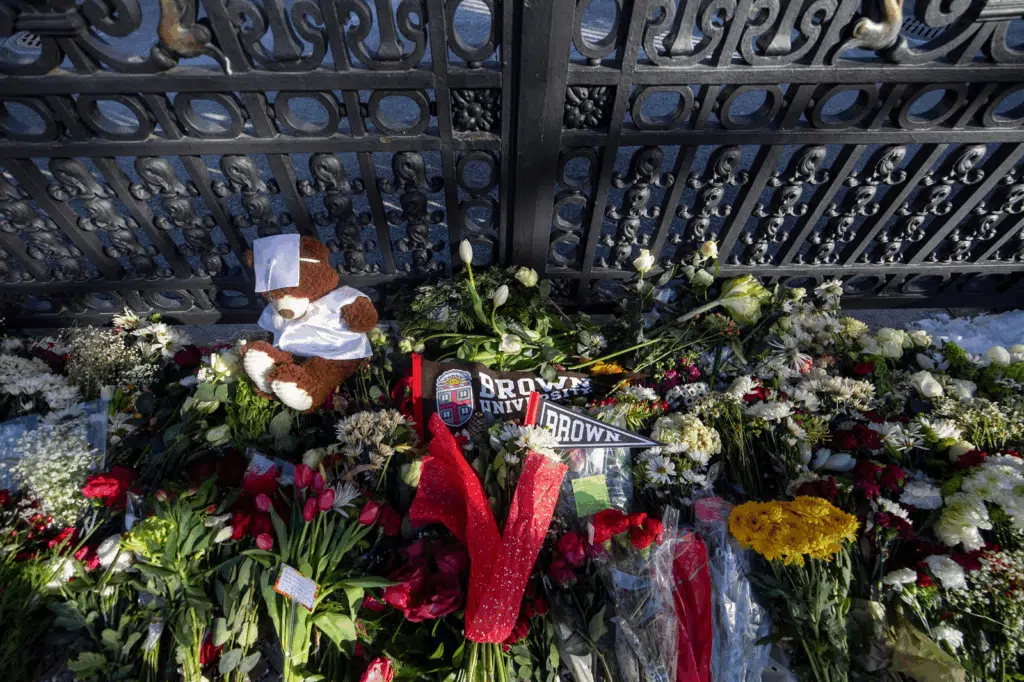
On Saturday, December 13th, around 4:03 pm, an armed man with his face partially covered walked onto the Brown University Campus. He entered the Barus & Holley Engineering Building and room 166, where final study sessions were underway. Once in the room, he fired 40 rounds, killing two students, 19-year-old Ella Cook and 18-year-old Mukhammad Aziz Umurzokov. He wounded nine others, seven of them critically.
The murderer was eventually identified as 48-year-old Claudio Neves Valente, who, after leaving Brown University, drove approximately 75 miles to Brookline, Massachusetts, where he killed MIT professor Nuno Loureiro in his home two days later.
Police report that a significant lead originated from an anonymous Reddit user who posted online, urging authorities to investigate the suspect’s car. After a search that covered multiple states, they located the vehicle and ultimately found the suspect deceased at a storage facility in New Hampshire.
Many questions are swirling around this tragedy. What was his motive? Why was the CCTV camera footage so scarce, and why does there seem to be so much secrecy attached to this case?
Sometimes, the identity of the person asking the questions is just as important as the questions themselves. In this context, retired FBI criminal profiler James Fitzgerald raised important concerns about the investigation. If you are not familiar with Fitzgerald, he is an American criminal profiler, forensic linguist, and author. He is a retired FBI agent, best known for his role in the UNABOM investigation, which led to the arrest and conviction of Ted Kaczynski.
In recent discussions on various programs, including Jesse Watters’ Primetime, Fitzgerald emphasized the importance of fully understanding the context of events as more information becomes available. This understanding is crucial not only for the safety of the community but also for maintaining the integrity of the investigation.
Fitzgerald recently highlighted a new video featuring a second individual who was present during the incident. This person’s connection to the main suspect raises questions. When someone is seen near a crime scene but doesn’t come forward right away, it can lead to suspicion. The profiler emphasized that if this individual is watching or hears the calls for information, they should step forward to clarify their role, or lack thereof, in the situation. This is a classic case of “better safe than sorry,” especially when public safety is involved.
The nature of the crime is under intense scrutiny. Was it a crime of opportunity, a case of mistaken intentions, or something more sinister? Fitzgerald presents theories that suggest a deeper motive, especially given the victim’s connection to the Republican club at the university. It is both intriguing and alarming to consider that someone may have had a specific target in mind, particularly in an environment that is not very welcoming to conservative viewpoints. The coincidences seem too convenient in such scenarios, and the profiler’s instincts indicate that there is more to uncover in this tragic story.
The situation is further complicated by the questions surrounding video evidence that the university has not yet made public. Fitzgerald pointed out that withholding critical information, such as statements made by the suspect, could lead to legal issues in the future. Transparency is essential, especially in a context where public fear and anxiety are high. The reluctance or failure to share what is known could be seen as insensitivity or negligence, which would only increase public frustration.
Speaking about that video evidence, that building had only two exterior cameras, and room 166 had zero. Same with the building’s hallways and exits, so no cameras were there to capture the shooter entering or leaving, and not one camera caught his face head-on.
On the other hand, Brown’s president has lived in the official presidential residence since 2012, which is protected by dozens of exterior security cameras.
This is not an accident; it reflects the school’s priorities.
In comparison, a 400,000-square-foot Walmart store typically has about 300 cameras to monitor items such as shampoo, razors, and laundry detergent. Brown University, an Ivy League college with an $8 billion endowment, operates around 1,200 cameras across 146 acres.
On average, a Walmart has about four times as many cameras focused on its underwear as Brown University has to protect its students. While cameras don’t prevent violence as it occurs, they can help prevent future acts of violence. Shooters are not invisible; someone always knows who they are.
The Brown administration made a number of errors that contributed to the severity of this incident. For instance, they did not circulate the photos they did have of the shooter for nearly 48 hours. However, most egregiously, they decided not to integrate their campus camera system with the Providence Police Department’s Real-Time Crime Center, one of the most powerful crime-fighting tools in modern law enforcement.
Real-Time Crime Centers (RTCCs) create a phenomenon known as identity convergence. This involves a unified operational system that integrates city, traffic, and transit cameras, license plate readers, and private-sector video in real time.
New York City has used such a system for years through initiatives such as the Lower Manhattan Security Initiative and the Domain Awareness System, achieving remarkable results.
In this case, a campus custodian saw the shooter casing the engineering building more than a dozen times before the attack. According to the witness, the shooter walked with a very distinctive limp, which is a massive identifier — if cameras exist to capture it.
In this case, modern video systems could have made a significant difference—if experts had been able to conduct gait analysis, a tool not widely understood outside law enforcement.
Gait—arm swing, hip rotation, and posture—serves as a biometric signature, unique like a fingerprint. You can disguise your face, alter your clothing, and wear a mask, but you cannot conceal how you walk.
For years, Brown has upheld a culture that prioritizes privacy, opposing surveillance and evidence collection. It views cameras as political symbols rather than life-saving instruments.
Michael Greco, an 18-year veteran of the Brown University Police Department who became a whistleblower, stated that the security program under now-suspended Chief Ronald Chatman was referred to as the “Queen’s Army” — a system built around what they called “perception-sensitive enforcement.”
Another leftist stance that has now cost lives. Brown made surveillance cameras political instead of understanding that they are simply inanimate objects that capture images; whatever they capture is dictated by the people in the videos. The cameras themselves do not control what the people do.
This is the same argument that baffles the left about guns. Guns are not intrinsically good or bad; the person in possession of the gun makes that decision.
In this tragedy, the person with the gun chose to use it for harm, but another life could have been spared if only liberals could see past their flawed ideals.