Dispatch From October 2029: The Debt Crisis That Destroyed America
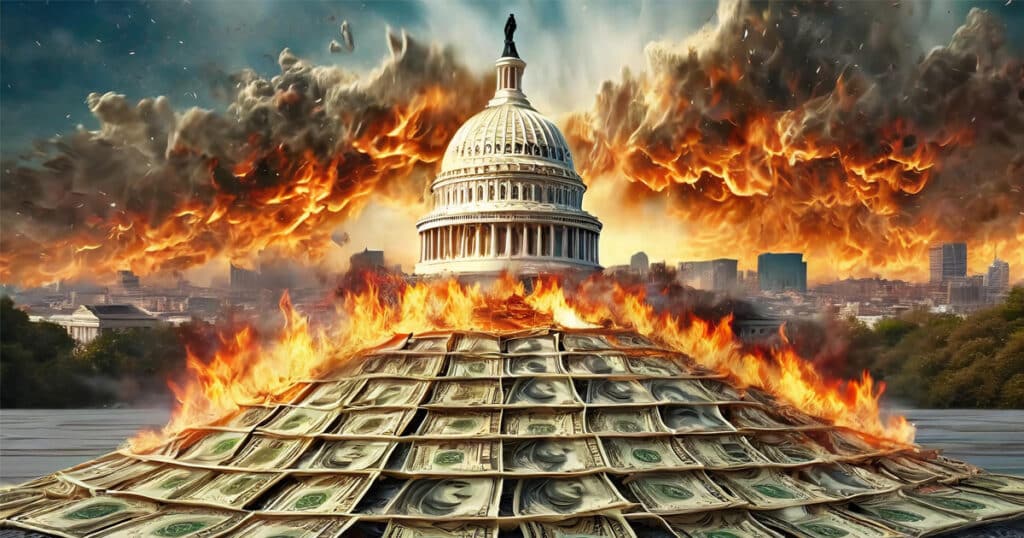
The kindling for catastrophe was piled high. It only needed a match.
The 2020s began with a pandemic that shut us in and shattered our shared reality. America became a country of strangers, speaking the same language but inhabiting different worlds. It was often noted at the time that Americans had come to embrace strange and conspiratorial beliefs. In retrospect, our elected officials had embraced the most fantastical belief of all: that the United States government could indefinitely run astronomical deficits and pile up debt without consequence.
By the middle of this decade, anyone paying attention knew this was a dangerous fairy tale.
Government debt as a share of the U.S. economy approached levels unseen since World War II. Investors began demanding higher interest rates on Treasury bonds and buying more gold and other precious metals. Foreign countries were holding a smaller share of their currency reserves in dollars. Each development could be explained away on its own. Together, they sent a clear message that America would pay dearly if it stayed on the same path.
We did it anyway. Each year, we piled more logs on the pyre – our deteriorating public finances just one ingredient in an increasingly volatile mix.
The government shutdowns and near-debt-ceiling defaults.
The assassination attempts and executions of political and business leaders.
The protests, escalating to violent confrontations between citizens and their government.
The collapsing mistrust in our institutions.
Each was a sign that America could no longer govern itself and that more Americans were unwilling to continue living peacefully alongside one another.
America outran its problems for longer than many anticipated, thanks to the AI investment boom. But the kindling was piling up the whole time, and the match was finally lit in September 2028 by the weak Treasury bond auctions, which revealed that domestic and foreign investors had finally lost confidence in the creditworthiness of the United States.
So began a societal crisis that is worse than any living American has ever endured. There have always been Americans without work, enough food to eat, clothes to wear, or a roof over their heads. What’s different now is that one in four American adults is in some form of severe financial distress, along with the millions of children in their care. Everyone knows someone who has lost everything, and those still hanging on are living in fear that they could be next.
Last September’s weak debt auctions were not destined to be a calamity. Perhaps the fire could have been contained if Congress and the president had mustered the courage to level with Americans about why we found ourselves in a debt crisis and what was required to get out of it. But courage was not in the cards two months out from the 2028 presidential election. Both sides of America’s political divide responded exactly how you would expect, given the events of the last decade.
To close the budget gap and restore market confidence, Democrats demanded massive tax increases, only on the rich; Republicans demanded enormous spending cuts, only to Democratic priorities. They dug in, performed, postured, and fundraised off the chaos.
As in previous economic crises, the Federal Reserve swooped in with emergency measures to calm markets and buy time. Weeks of inaction in Congress turned into months, until it finally dawned on the world that the grownups really had left the building. This was a different kind of problem, one that required more than just Congress throwing money at it. It became clear no one was coming to the rescue.
That is when the carnage really started. That is why we are all here in October 2029 – 100 years after the start of the Great Depression – in the midst of another one.
A crisis that began in Treasury debt markets has now spread throughout financial markets, to Main Street, to every facet of American society, and around the world.
You can sense it walking down almost any street in America. The abandoned storefronts and lines in front of food banks. The sticker shock every time you buy anything. People speak of the pervasive feeling that someone is lurking around the corner to take something from you, or that you could be the next victim of the epidemic of home invasions. No one can quite believe it has gotten this bad. In the last few months, Congress has finally passed a few half-measures, though nothing close to what market watchers say is required to restore confidence that the U.S. is on a more sustainable fiscal path.
The American-led world order, already teetering throughout much of the 2020s, is now collapsing in on itself. Although our adversaries have hardly escaped from this crisis unscathed, they see opportunity in a weakened and divided America, where the most radical and intransigent forces in the Democratic and Republican parties are ascendant. If recent reports are to be believed, China could be on the cusp of asserting control over Taiwan.
Almost 200 years ago, a young Abraham Lincoln said, “If destruction be our lot, we must ourselves be its author and finisher.” Americans are unquestionably the authors of the economic and societal destruction that now surrounds us. One year into this calamitous crisis, it remains to be seen whether we can summon the strength and unity to find our way out.
This article was originally published by RealClearPolitics and made available via RealClearWire.