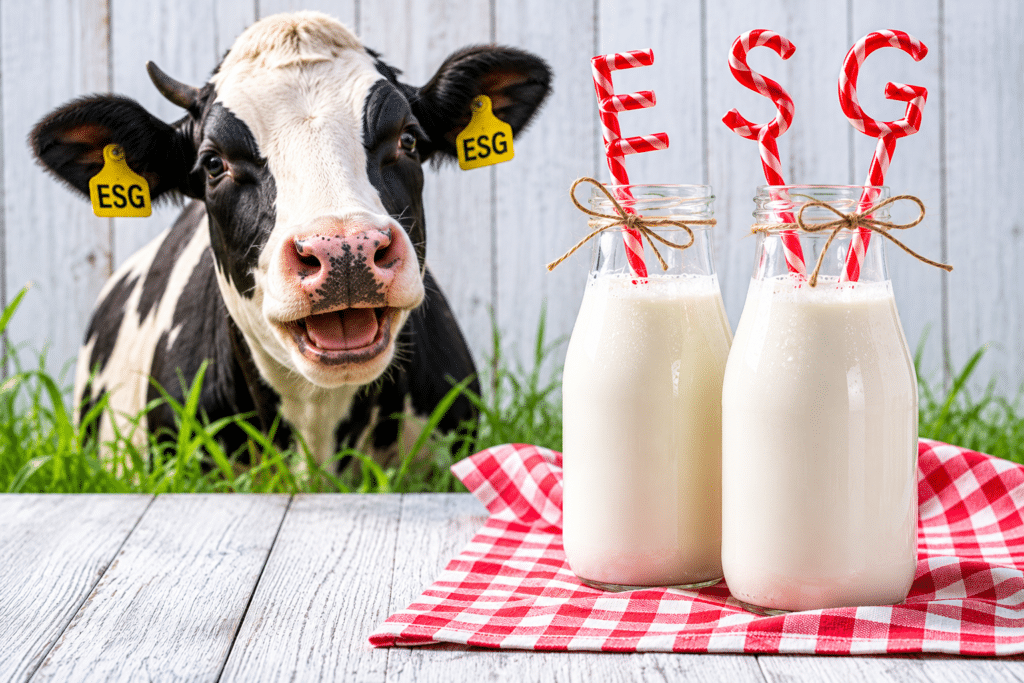
ESG Has Its Straw In Our Milk
I thought ESG had its time and was gone. A few years ago, this woke ideology was at its peak. Companies applying for loans no longer had to demonstrate profit margins or creditworthiness; ESG became the deciding factor.
ESG stands for environmental, social, and governance. It is a woke political agenda that is not in the best interests of investors or the public. Three years ago, approximately one-third of professionally managed assets in the United States adhered to ESG criteria. ESG refers to investing that is influenced by political considerations. Instead of focusing solely on maximizing returns for individual portfolios, ESG investing aims to support politically motivated policy goals, such as addressing climate change.
Large corporations and investors often focus on a specific political agenda when making investment decisions. Rather than investing primarily to generate profit or save for retirement—by choosing options that offer the highest returns—many now prioritize investments that align with Environmental, Social, and Governance (ESG) criteria, allowing their political goals to take precedence.
Investing is often guided by a specific agenda, with climate change being a primary focus. For instance, ESG criteria prioritize investments in green energy industries over fossil fuels, even if oil and gas investments may yield better returns.
This political stunt sets a dangerous precedent. It’s not just about oil and gas—ESG can apply to any agenda item that the left considers a top priority. There is a genuine risk that politically motivated investing could become a means to implement unpopular policies. Since the Left was unable to pass the “Green New Deal” in Congress and green energy is not keeping pace with fossil fuels, ESG investing appears to be an effort to artificially support the green industry at the expense of fossil fuels.
This is an attack on the free market.With ESG criteria, large governments and corporations are collaborating to determine which sectors of the economy will succeed and which will fail. Investments are no longer made primarily with an emphasis on financial stability or investor success; instead, American investment dollars are being used to advance a specific political agenda that takes priority over the overall health of investment portfolios. Most concerning is that the average American has no say in this process.
Nestlé and Danone are two major global food and beverage companies that have utilized ESG criteria to influence who can produce your food. This ESG agenda is forcing small dairy farmers into an untenable choice.
Here’s how it works. A dairy farmer opens his mailbox to find new requirements from the processing plant that purchases his milk. They now request information on his herd data, energy consumption, and emissions.
The letter suggests that compliance is voluntary, but the fine print reveals that if you do not comply, the plant will be unable to take your milk.
If the plant cannot accept your milk, then your business is doomed to fail.
Pathways to Dairy Net Zero (P2DNZ) is a global ESG compliance initiative now embedded in the American dairy supply chain. The P2DNZ initiative was not started by Congress or any agency created by voters. Instead, it originated in the boardrooms of Nestlé and Danone, was conveyed through milk processors, and ultimately reached the farmers. These farmers were never consulted, did not have a vote on the matter, and feel they have no real choice but to sign.
This is not the first industry to be blackmailed in this manner.
The oil and gas sector has experienced the introduction of ESG reporting requirements in its supply chain first. This included embedding these requirements into lending agreements, shareholder resolutions that demanded emissions disclosures, and top-level private coordination that initially made compliance seem voluntary—until it became mandatory.
Now, the dairy industry is facing similar pressures.
The costs do not fall on the multinational boardrooms that designed the program. They fall on the families that have been milking cows before sunrise for three generations.
And the numbers are frightening
In 2025, the USDA reported that 15,000 small farms were either closed or consolidated. An estimated 2,800 dairy farms were projected to shut down that same year. Meanwhile, processors are investing $11 billion in facilities designed for large-scale dairy operations—those big enough to handle compliance costs that smaller farms cannot afford. The ESG framework doesn’t need to drive any farm out of business directly; it just has to tighten profit margins enough to encourage consolidation.
Secretary of Agriculture Brooke Rollins has been actively supporting American dairy farmers.
Ten days ago, she implemented the Whole Milk for Healthy Kids Act, restoring whole- and reduced-fat milk to federal school nutrition programs after the debacle of the Biden administration’s low-fat mandates.
This week, she posted on X, calling out P2DNZ by name.
“Dairy farmers are vital in rural America, but now face radical ESG mandates disguised as ‘sustainability.’ Pathways to Dairy Net Zero will burden small farms with costly compliance.”
For years, P2DNZ operated under the radar because no one with a platform was willing to address it. Now, finally, someone is calling out this compliance scheme, and it’s the Secretary of Agriculture, no less.
Here are the details that P2DNZ’s architects will never include in their press releases.
Even if every dairy farm in America achieved net-zero emissions tomorrow—every tractor parked and every cow retired—the impact on global climate change would be undetectable.
U.S. dairy accounts for only a small fraction of global agricultural emissions, which in turn are only a small share of total global greenhouse gas emissions.
The costs of compliance with new regulations are very real.
The paperwork required for compliance necessitates new equipment to track emissions, and that equipment costs money that many family farms do not have. As a result, they often have to borrow funds. When profit margins become too tight, they may need to sell their farms to larger corporate operations that can absorb these costs without any significant impact.
Fewer people end up owning a larger share of the food supply, and those who do are accountable to the same global financial networks that established the compliance rules in the first place.
American farmers have faced challenges from all sides.
Banks have ceased providing financing for diesel equipment.
Corporate shareholder resolutions are urging food companies to reduce beef production. Pressure campaigns are promoting plant-based alternatives on store shelves. Litigation is targeting farms that refuse to comply with these demands. Each of these tactics diminishes the decision-making power of independent American farmers, transferring authority to global corporations and financial institutions that are not accountable to voters.
The consequences extend beyond the farm. Farmers face higher data costs, new equipment debt, tighter profit margins, and smaller farms are being bought out by larger corporate operations that can withstand these pressures. As a consumer, you end up paying for every step of this process in the price of a gallon of milk.
ESG is a blight on American life. Woke corporations are forcing unnecessary political agendas down the throats of Americans. Chasing ideological pipe dreams that will accomplish nothing but to inflate their already overextended egos.