James Talarico, Stephen Colbert And The Character Of Modern Political Discourse
The Talarico/Colbert controversy has me reflecting on something I’ve observed for years: why progressives and conservatives talk past each other, how they see morality itself and why so many well-meaning people can’t tell when Scripture is being twisted to sell them a political agenda.
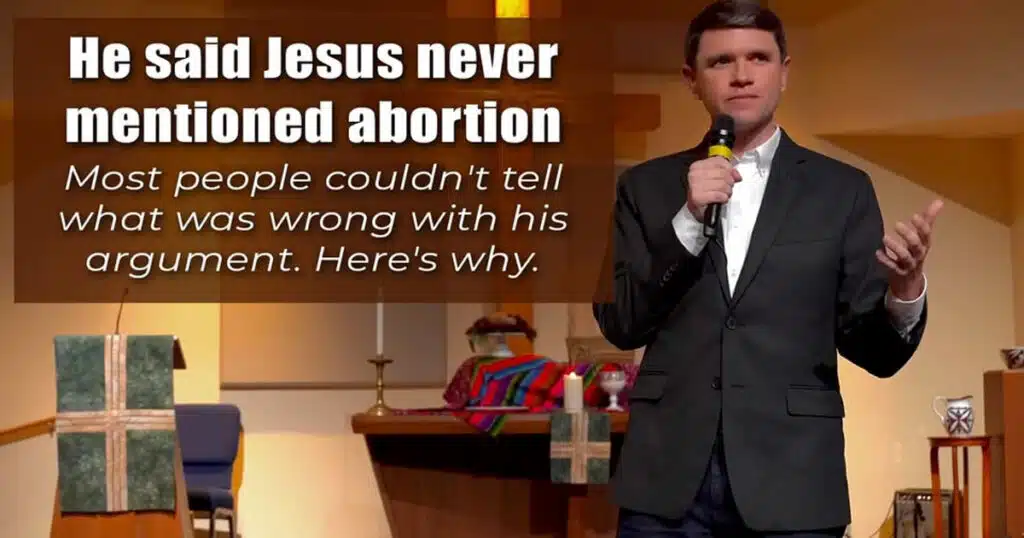
In his Colbert interview, Talarico claimed that abortion and gay marriage are “two issues that aren’t mentioned in the Bible, two issues that Jesus never talked about.”
On Joe Rogan, he argued that the Bible is pro-choice because Mary “gave consent” to God at the Annunciation… therefore it’s a model for bodily autonomy.
Millions of people heard those claims and thought, “Wow, that’s a great point.” And I think it’s worth understanding why so many people couldn’t see what was wrong with his arguments…
Because once you do, you’ll start recognizing this pattern everywhere (and you’ll have a better understanding of the people you fundamentally disagree with).
Let’s start with a few obvious things…
The claim that Mary “gave consent” and therefore the Bible is pro-choice is a wild stretch of Scripture. In Luke 1:38, Mary says, “I am the Lord’s servant. May your word to me be fulfilled.” That’s not a woman weighing her options and exercising bodily autonomy. That’s a faithful young woman submitting to the will of God.
The entire passage is about obedience and trust, not “choice” in the way Talarico is framing it. And frankly, it takes a lot of nerve to turn the incarnation of Christ into a campaign ad for abortion.
As for the claim that Jesus “never talked about” abortion…
Ok, James, but Jesus also never mentioned rape, female genital mutilation, fentanyl, or lynching. So what? Are you gonna start using the absence of their mentions to justify those things now too?
The New Testament speaks in moral categories (sexual immorality, murder, injustice, harming the vulnerable) and Christians have always had to reason from those categories to specific issues.
Saying “Jesus didn’t say the word ‘abortion'” as if that settles the moral question is either shallow theology or deliberate manipulation. And the fact that Talarico has seminary training makes it harder to chalk this up to ignorance. He should know better.
But Talarico isn’t an anomaly. He’s a textbook example of a pattern you can learn to recognize once you know what to look for.
The pattern works like this: lead with compassion language, strip away the harder moral categories, and then paint anyone who still draws from those categories as unchristian, heartless, or hateful.
“If you really care about women, you’ll support their right to choose.”
“If you really love people, you’ll affirm their identity.”
“If you’re really a Christian, you wouldn’t turn away the stranger”
It sounds loving. It feels righteous. But it’s actually a much narrower moral vision than it pretends to be, and there’s even research that explains exactly why it works so well on so many people.
Jonathan Haidt is a social psychologist who wrote a book called The Righteous Mind (It’s a non-partisan, fair-minded book and I HIGHLY recommend you read it), and his findings changed how I see almost every political and moral disagreement.
Haidt (who identifies as a liberal himself) found that progressives tend to weight two moral foundations far above the others – care and fairness – while conservatives draw from a broader palette more equally, including loyalty, authority, sanctity, and liberty. (Haidt himself described loyalty, authority, and sanctity as ‘barely on the radar screen’ of many liberals.)
Once you see this, you can’t unsee it.
It’s why progressives often genuinely cannot understand why conservatives care about things like border enforcement, traditional marriage, or institutional order. If it’s not directly about compassion or equality, it doesn’t register as a moral concern at all. It just looks like cruelty or control.
And it’s why Talarico’s arguments fool so many people. When you collapse morality down to just compassion and fairness, his reasoning sounds like love and anyone pushing back sounds like a Pharisee.
But he’s not drawing from the full moral palette. He’s erasing most of it and then characterizing the people who still use it as being unchristian.
Biblical love was never just empathy and compassion. It also includes harder edges like truth-telling, courage, justice, a willingness to say “no” when it costs you. As Thomas Aquinas put it, love is willing the good of the other… not just affirming whatever feels compassionate in the moment.
So how do you tell when a politician is using Scripture faithfully vs. using Jesus to sell you something? Here are the 5 questions I ask. I try to apply them to politicians on both sides…
(and by the way, No single question is decisive on its own, but when you run through all five together, a pretty clear picture usually emerges)
1. Is this position consistent with what the church has taught across Catholic, Orthodox, and Protestant traditions for centuries? Or did it conveniently appear in the last decade?
2. Are they engaging the full counsel of Scripture? Or cherry-picking one verse while ignoring everything around it?
3. Are they using Scripture to arrive at a conclusion? Or to decorate a conclusion they already held for political reasons?
4. Does the argument hold up when applied consistently? If “Jesus never mentioned abortion” settles the issue, then Jesus never mentioned sex trafficking either… does that get a pass too?
5. Are they inviting honest debate? Or using Jesus as a shield to shut down disagreement by making you feel unchristian for pushing back?
Apply those to Talarico and the answers seem pretty clear to me. But they’re just as clear when I apply them to someone like Paula White, whom Trump appointed to lead the White House Faith Office (and whom I publicly criticized at the time). Prosperity gospel theology fails these tests just as badly as progressive theology does. Different distortion, same problem.
Now I know some of you are thinking: “But you voted for Trump. He’s no model Christian either.”
You’re right. He’s not. And I’ve said that publicly many times.
But here’s a distinction I think is really important: when I vote, I’m not choosing a pastor. I’m making a strategic decision about which set of policies will move the country in a direction that aligns with my values (e.g. life, family, free speech, safety, rule of law). I can vote for a deeply flawed candidate without endorsing every flaw, just like voting for Harris wouldn’t have meant endorsing every decision she’s ever made.
So my criticism of Talarico isn’t that politicians must be model Christians. It’s that his specific theological claims are wrong on the merits. He’s telling millions of people that the Bible supports positions the church has overwhelmingly rejected for 2,000 years.
That’s not a character critique, it’s a truth critique. And again, I apply those same five questions to anyone on the right doing the same thing.
And for those ready to throw “Christian nationalist” at me: I’m not asking the government to enforce my denomination’s catechism. But when a politician explicitly uses Jesus and Scripture to justify his platform, it is absolutely fair for other Christians to evaluate whether that use of Scripture is faithful or manipulative.
So the next time you see any politician wrapping a policy position in the words of Jesus, don’t just ask whether it sounds compassionate. Ask whether it’s true.
Run it through those five questions. See what holds up and what falls apart.
Because the most dangerous lies almost never come dressed in hostility. They come dressed in a clerical collar, speaking gently, and telling you exactly what you want to hear.