The War Over Iran Is Really About China
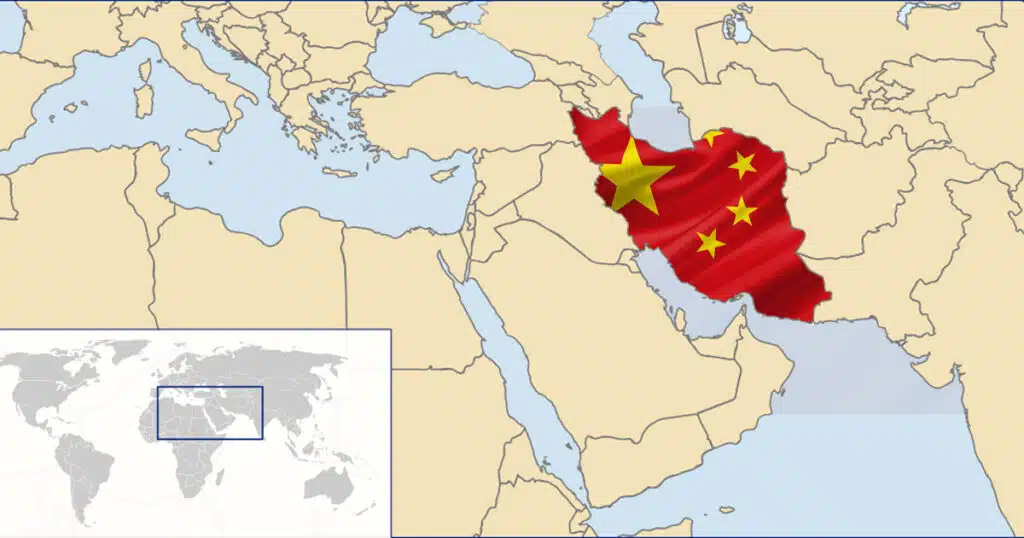
The conflict unfolding in Iran may be only one theater in a much larger strategic struggle between Washington and Beijing.
Despite recent military successes, Americans remain deeply anxious about the escalating conflict.
Tensions with Iran began in 1979 with the international spectacle of the hostage crisis. But even that pales in comparison with the risks at hand. The cauldron of troubling interactions has reached its boiling point.
The prospect of boots on the ground terrifies Americans and has created a fracture within Trump‘s support base because of his repeated and demonstrative criticism of foreign intervention. His vice president, J.D. Vance, was even more critical of foreign interventionist policies prior to joining the Trump administration.
A lot is going on here, and one thing is certainly clear—
Iran may not be merely a battlefield. It may be a harbinger of things to come. And some of those things are quite frightening.
Iran is not the central battlefield of this conflict. It is the hinge upon which a much larger struggle—between the United States and China—may turn.
Iran as a Strategic Crossroads
The Iranian conflict in its current form is something far more consequential
A geopolitical crossroads where several strategic currents intersect. Energy flows eastward from its oil fields toward China. Military technology—particularly Iranian drones—moves northward toward Russia. And influence radiates outward through a lattice of proxies and shadow networks stretching from the Levant to the Persian Gulf.
To view the present conflict simply as a Middle Eastern war is to misunderstand its strategic significance
Iran is a theater, but it does not hold the final stage. The real battlefield lies within the larger contest between the United States and China over the architecture of the international order.
Seen through that lens, American military pressure on Iran—and earlier actions against Venezuela—assume wider significance. These moves do not merely punish hostile regimes. They strike at elements of the geopolitical framework Beijing has spent decades constructing.
China’s rise has depended not only on domestic economic growth but also on the steady expansion of influence abroad. Beijing has cultivated relationships with states willing to trade with China, align diplomatically with China, or simply welcome a world less dominated by Washington.
Iran occupies a crucial place in that system.
The oil that sustains Tehran’s economy has long flowed eastward to China, often at discounted prices. Countries now under American pressure have supplied nearly 17 percent of China’s imported oil, providing Beijing with a quiet but significant buffer against Western leverage.
To remove Iran from that equation—or even threaten doing so—is to reach directly into China’s long-term energy planning and development strategy.
And yet one feature of the unfolding war reveals something about American strategic thinking. Despite strikes rippling across Iranian territory—more than 3,000 targets struck during the first week of Operation Epic Fury, according to U.S. Central Command—the country’s oil fields remain largely untouched.
The Strategy of Energy Leverage
If America were seeking to cripple Iran’s infrastructure and economy, strikes on its oil fields—or even the threat of them—would send shudders through the ruling clerics. Yet the restraint may not be accidental.
Destroying those fields would deprive China immediately. But it would also eliminate the leverage embedded within them. An intact oil field can serve as a bargaining chip in whatever settlement follows the conflict.
It is not long before you detect a strategic instinct shaped by the memory of Iraq—not simply as a war, but as a costly transaction that yielded limited structured return. Vast resources were expended. Influence was exercised. Yet the geopolitical dividends were ambiguous.
Donald Trump has mentioned this many times. He was very critical during the Iraq invasion and occupation about the fact that no oil was extracted as payment for the cost of the American excursion. George W. Bush‘s father produced not only a more efficient invasion in the first Iraq war, but he got international participation, including a hefty contribution from the Japanese, not normally noted for military activity since August 1945.
Similarly, Trump has attempted to transfer more of the cost of defending Ukraine to NATO and European Union allies, a major theme of his second campaign against Biden, and that cost has been largely absorbed by them and they have been forced by Trump into increasing their contributions to a 5% share of GDP as a required NATO affiliation fee.
Trump’s financial history—whether involving rebates or tax credits—has often relied on others bearing the subsidizing costs or investment capital while he claims the credit for ownership of the project.
From that pattern emerges a Trump belief: if American power is expended, value should follow. He feels that if a hostile regime is weakened, its economic arteries should not simply resume pumping benefits to a rival power.
The recent Venezuelan episode is further validation that he is a believer of that philosophy. There, too, the idea emerged that control over energy assets—rather than their destruction—might work towards American benefit in geopolitical outcomes.
Trump is promoting that triumph in a war should not result in chaos. He believes in the redirection of control from the vanquished to the victor – meaning an immodest Trump himself.
But that strategy may not always survive intact and mesh with the reality of the military theater at hand.
The theocratic state is a tightly controlled and resilient regime with a long history of asymmetric retaliation and strategic patience. When conventional command structures are degraded, unconventional tools tend to rise to prominence.
Tehran’s warning that the United States “will no longer be safe” should not be read as a declaration of conventional war. It is more plausibly a signal of distributed confrontation.
Iran’s strategic tradition relies heavily on indirect instruments: proxy militias, cyber operations, covert networks, and economic disruption. When pressed directly, Tehran rarely responds symmetrically. Instead, it widens the battlefield. Evidence of that doctrine is already visible.
Iran has launched strikes across the region—including against Israel, the United Arab Emirates, and Kuwait—while Israel has struck Hezbollah positions in Lebanon. The Middle East now resembles a web of simultaneous confrontations rather than a contained war.
At the same time, Tehran appears to be attempting a form of strategic rebranding.
Iranian President Masoud Pezeshkian, who joined the country’s central leadership following the assassination of Ayatollah Ali Khamenei during the first wave of strikes on February 28, has issued conciliatory remarks toward neighboring states.
“We have repeatedly said that they are our brothers,” Pezeshkian declared, expressing hope for regional peace and stability.
Iranian leadership has reportedly issued a directive instructing its forces not to attack neighboring states unless attacks on Iran originate from those countries’ territory.
The message is unmistakable: Tehran wishes to widen consequences without widening the coalition against it.
Such restraint reflects a familiar Iranian instinct—to expand instability while avoiding the creation of a unified regional front. Whether that restraint can survive the current escalation remains uncertain.
President Trump has adopted a very stark posture toward Tehran.
“There will be no deal with Iran except UNCONDITIONAL SURRENDER,” he wrote recently.
Following such surrender, Trump suggested, a “great and acceptable leader” could emerge in Tehran, after which the United States and its allies would help rebuild the country’s economy and return it to prosperity.
The language is unmistakably reminiscent of World War II. It is rhetoric designed to eliminate ambiguity about war aims. Trump has also warned that additional targets—previously spared—are now under consideration for destruction.
“Today Iran will be hit very hard,” he announced.
From the perspective of American political tradition, such clarity has advantages. Yet wars framed in maximalist terms often provoke maximalist resistance. And the American president now confronts not one battlefield but many.
The Wider Contest With China
While Iran occupies the headlines, another war grinds on in Europe. Russia’s invasion of Ukraine continues to consume Western resources and political attention. European allies remain divided over the war’s trajectory, sanctions policy, and the long-term security architecture of the continent.
Relations between Trump and several European leaders have grown increasingly strained, even if the disagreements are sometimes muted in public diplomacy.
Meanwhile another Cold War ghost stirs closer to home—Cuba.
There is increasing speculation that Washington may choose to engage Havana in a demonstrative manner—less because of Cuba itself than as a reminder that the United States intends to maintain strategic dominance in its own hemisphere.
If that occurs, three theaters of tension—Eastern Europe, the Middle East, and the Caribbean—would suddenly frame the American strategic horizon.
China is most assuredly watching carefully.
Beijing cannot easily intervene militarily in the Middle East. Despite rapid modernization, China still lacks the ability to project sustained power far from its own shores on a scale comparable to the United States. A Chinese carrier group in the region would operate without nearby land-based air support and therefore remain vulnerable to American forces.
But China does not need to respond in the Middle East. It may respond elsewhere.
Reports that the United States is considering shifting Patriot and THAAD missile systems from South Korea to the Middle East raise an obvious question because every system moved away from the Pacific slightly weakens deterrence there.
For Xi Jinping—who has long viewed the reunification of Taiwan with the mainland as a historic objective—such shifts could alter the strategic calculus.
History intrudes here.
In 1941 the United States imposed an oil embargo on Imperial Japan in response to its expansion in Asia. Japan faced a stark choice: abandon its ambitions or confront the United States militarily.
Tokyo chose confrontation. Pearl Harbor followed.
China today is not Imperial Japan. Yet the logic of strategic windows—the fear that opportunity may close if action is delayed—remains a familiar feature of great power decision-making.
If Beijing concludes that the United States is stretched across multiple theaters, it may perceive an opening.
Meanwhile Russia watches carefully. Moscow benefits from Iranian military cooperation, particularly drone technology, and has little interest in seeing Tehran collapse under American pressure. Russian leaders have already signaled broader consequences, with figures such as Dmitry Medvedev invoking nuclear escalation as a reminder that the psychological boundaries of this conflict extend beyond the Middle East.
All of this unfolds against a turbulent domestic backdrop in the United States. The economy shows signs of slowing, markets remain sensitive to energy disruptions, and political polarization continues to shape the national mood.
Demonstrations surrounding immigration enforcement, debates over border policy, and cultural disputes across the country have intensified the sense of internal division. Presidents rarely confront crises abroad while enjoying calm at home, and the widening conflict now unfolds in a nation already strained by political fatigue.
Trump’s presidency now enters its final three years, and the political calendar moves relentlessly forward.
Midterm elections are approaching. Republican prospects remain uncertain. Political fatigue after years of polarization is evident.
The question of succession—always present during a president’s second term—has already begun to surface. Two names frequently appear in that conversation.
Marco Rubio, increasingly prominent in foreign-policy debates, represents a traditional internationalist conservatism that embraces sustained American engagement abroad.
J.D. Vance, once positioned as a leading voice of restraint and skepticism toward foreign intervention, has found that position complicated by the widening array of global crises. Events often reshape political philosophies. The strategy unfolding toward Iran ultimately rests on a wager.
Preserve the oil fields. Preserve the leverage. Redirect the energy flows away from China and toward a structure shaped by American influence. It is a wager on controlled dominance rather than scorched earth.
But it is also a wager that retaliation can be contained, that asymmetric warfare can be managed, and that the American homeland will remain beyond the reach of indirect confrontation. The oil fields stand quietly beneath the larger storm. They symbolize both opportunity and risk.
They represent the promise of leverage—and the possibility that in seeking to capture value rather than destroy it, statesmen may awaken forces that refuse to remain confined to distant battlefields.
History reminds us that crises rarely arrive one at a time and in the last few months multiple crises have managed to accumulate.
The current web of conflicts and stress points have reshaped the calculations of only slightly older thinking.
Power always believes it can shape the future without unleashing chaos. History suggests that wielding power judiciously is the hardest art of all. And when the consequences of this war finally unfold, they may not be decided in Iran at all.
The real battlefield may lie far beyond Iran.
That battlefield may be TAIWAN.
Now that we see deeper driving forces and motivations emerging, we realize what we might be up against. World War III might be too bold. But two months ago, nobody could have predicted this conflict in Iran, nor the capture of Maduro in Venezuela.
Stay tuned.
Dinesh T. Chawla writes on geopolitics, strategic competition, and the evolving balance of global power.
This article was originally published by RealClearDefense and made available via RealClearWire.