Paul IV’s Teaching on When the Pope Is Not the Pope
Corrupted times do not call for the hopping of camps at every whim, no, but it does demand that we widen the lens as we work through the cognitive dissonance where every camp seems to have both definitive proofs and gaping holes in their presentations—and all Catholic in name.
My work has largely become what I’ll call stream of dissonance writing. I begrudge it to some degree, because none of this should be the job of laymen internet bloggers.
But here we are.
CONTEXTUAL & IMPORTANT
Catholicism: Clarity Amid the Camps
St Catherine of Siena vs St Vincent Ferrer—When ‘Obedience’ Turns Awkward
One of the habits of even the most well-meaning of our age, a trend as political as it is religious, is the instinctive effort to reduce every crisis to a preference of personality, tribe, and whatever feels right—whatever fits with our cognitive strongholds, regardless of the mounting of contrary evidence. Questions abound, such as which pope do I like, which bishop is too soft on doctrine, and which camp has this or that issue right in the soundbites.
That is how serious, eternity-deciding questions get collapsed into competing vibrations of the moment through an electronic screen—making it a form of lie from the start. It is how propaganda works. It intensifies the focus on one hot-button story, accelerating the emotions, teaching people to treat a theological emergency as though it were merely a flavor dispute over Coke and Pepsi.
This is all part of an organism—an anti-Christ one—intended to shape not just belief, but the structures in which we think. There are times where we are convinced to believe that there is literally only one thing happening on earth, and they tell us exactly how we should feel about it.
The older Catholic mind—and in the context of history not that old—did not think in any of these ways. Catholics did not stand for such ridiculous, petty swings of emotion predicated on who has the most likes and loves on a Facebook post. Truth was singular and non-negotiable. Truth was a Person. Truth was his Church.
The Protestant Revolution and Pope Paul IV
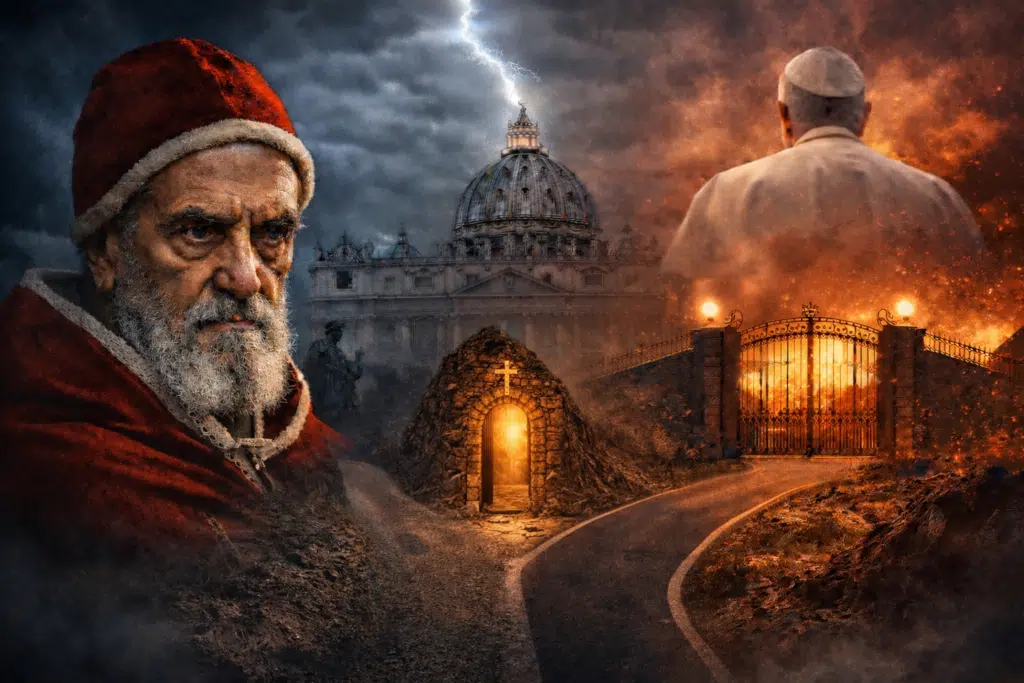
When Pope Paul IV issued Cum ex Apostolatus Officio in 1559, mere decades after the Protestant Revolution, he did not write as though the great danger to the Church were a public relations problem, or compromised credibility, or political optics. He wrote as a man who sits in the Chair of St Peter should write—well aware that wolves had indeed entered the fold, that false teachers could follow in the footsteps of Luther. And more, he knew that this wolf could very well end up being one who sits in the Chair of Peter, as many an anti-pope had before.
But what if one day practically no one paid attention enough to recognize that the assumed pope was not the pope at all? What if madness and sanity one day switched poles in a great catastrophic inversion of reality?
All are invited to read the entirety of Paul IV’s document, but paragraph 6 provides the substance of most of the issue raised here today:
6. In addition, if ever at any time it should appear that any Bishop (even one acting as an Archbishop, Patriarch or Primate), or any Cardinal of said Roman Church, even a Legate as previously stated, or even a Roman Pontiff prior to his promotion or elevation as Cardinal or Roman Pontiff, has deviated from the Catholic Faith or fallen into some heresy, then
his promotion or elevation, even if it be uncontested and carried out by the unanimous assent of all the Cardinals, shall be null, invalid, and void;
nor may it be said to have acquired validity, or to be acquiring validity, through his reception of office and of consecration, or through his subsequent tenure of government and administration, or through his putative enthronement as the Roman Pontiff himself, or through the homage paid him, or through the obedience accorded him by all, or through any lapse of time in the foregoing situation;
nor may it be held as legitimate in any part thereof;
nor may it be deemed to have conferred, or to be conferring, any faculty of administration in matters spiritual or temporal on such persons promoted as Bishops, Archbishops, Patriarchs or Primates, or elevated as Cardinals or the Roman Pontiff;
rather, each and every one of their statements, deeds, enactments and administrative acts, howsoever made, as well as anything that ensues therefrom, shall be devoid of force, and shall confer absolutely no legal privilege or right on anyone; and those thus promoted and elevated shall automatically and without need of a further declaration be deprived of any dignity, position, honour, title, authority, office and power. [1]
It is important not to allow cognitive dissonance to dissuade us from reading that plainly—yes, the Roman Pontiff is spotlighted here. Paul IV is teaching, with full papal authority as Vicar of Christ, that the pope may very well not be the pope, no matter what mind prison a populace is trapped in—even one as all-encompassing as the world.
Paul IV at this moment in history, remember, was counter-revolutionizing the Protestants. There was no room for equivocation, no room for error. The language is plain, and it is binding. Later in the document, in fact in the very serious conclusion of it, we read:
10. No one at all, therefore, shall be permitted to infringe this document of Our approbation, restoration, sanction, statute, derogation, wishes, and decrees, or with temerarious daring to go against it. However, if any should presume to attempt this, let him know that he will incur the wrath of Almighty God and of the blessed Apostles Peter and Paul.
How many a shepherd today disobey this one single item?
Does the pope?
Ramifications of Paul IV’s Words
Paul IV is not writing some outlier-decree. It is what Catholicism was for almost 2000 years. This is what Catholicism still is, because if it can change so flippantly with one council proven to be pastoral in nature only, then it was never the legitimate Faith in the first place. But if that were true, it would make every single Catholic martyr—it would make Jesus Christ himself—a liar.
Most modern Catholics, especially after decades of managed ambiguity and soft desensitization of millennia-old truth, are trained to think in one of two ways: either the Church is indefectible, which is true, and therefore every man universally recognized as pope must be treated as beyond this sort of scrutiny, which is false; or the Church has problems, which is obvious, but those problems must never be named in a way that threatens the institutional comfort of the moment.
Paul IV’s teaching should solve the issue—and yet in all its sternness doesn’t solve anything in today’s tenor of sentiment and comfort. If his words indeed seem foreign now in 2026, then something very important inside is misfiring. And even those of us who rightly believe that the Church as Bride is going through her Passion as Christ did must ask the question staring us all directly in the face—
Exactly who is inciting the crowd for Barabbas?
It is the trick of the anti-Christs of Scripture, which makes even well-meaning Catholics cast the pain of cognitive dissonance at the very people working so tirelessly to lift them to the light of reason, to rouse them to recognize that they are attempting to operate inside the Law of Non-Contradiction.
It is the ancient enmity between the seeds. The anti-Christs smile when the Church is fractured. It is precisely how the anti-Church—the likes of St Padre Pio and Bishop Fulton Sheen warned about—rises to power. The faithful, blind and battered, learn to accept the wolves wearing the Church’s clothes without even a whisper of a challenge.
Is the 21st century the time those two voices and so many others were forewarning?
Pope Paul IV did not and does not grant Catholics the comfort of ignoring our God-given reason. Because if one argues that we must respect everything the pope says in 2026, then surely every sane mind will understand that we must do the same for every pope that came before.
And if there are blatant breakages and contradictions between one and the other, something is terribly amiss. A pull from one of the articles linked above may provide permission for those still struggling with the notion of such conscientious objection:
Perhaps a third saint’s voice today, one who lived at the time of the Revolt, can provide fresh insight to the pleasure God likely feels with a soul sincerely, and doggedly, trying to do the right thing by both his Son and everything mapped out in relation to Apostolic Christianity in Acts. Cardinal Thomas Cajetan, writing in the sixteenth century, could cut a path to bring the tribes together:
“If someone, for a reasonable motive, holds the person of the Pope in suspicion and refuses his presence, even his jurisdiction, he does not commit the delect of schism nor any other whatsoever, provided that he be ready to accept the Pope were he not held in suspicion. It goes without saying that one has the right to avoid what is harmful and to ward off dangers. In fact, it may happen that the Pope could govern tyrannically and that is all the easier as he is the more powerful and does not fear any punishment from anyone on earth.”
In other words: suspicion is not schism, provided you’re not using it as a permanent hiding place for pride, provided you have spent at least a dedicated portion of your days sincerely seeking the truth about such things as the teachings of pre-conciliar popes, Modernism, Vatican II, the Alta Vendita, Leo XIII’s long version of the St Michael Prayer, Pius V’s Quo Primum, and so many other telling topics. There are folks that have opinions on this that spend exactly zero time studying their faith and its history; some of us may be wrong with where we stand in this story—which I have purposely not focused on out of charity and bridge-building—but at least we’ve devoted our lives to full repentance for our old wine and seeking first the kingdom of God and his justice, as the evangelist Matthew writes.
Consider which four souls stayed with Christ at the foot of the Cross.
Is it possible the true Catholic Church right now is unthinkably small, as it was that day at the foot of the Cross?
Even I have difficulty with the very questions I write.
I don’t know if what I am saying should lead to any earth shattering discovery, such as there being another pope altogether validly elected. I don’t know. But I do know that it has always been my way to help people in my charge navigate uncertainty before the assuredness comes—if it comes.
Most Catholics won’t read documents like the one presented today because they believe that invincible ignorance will help them escape judgment. The instinctive and obvious response is that Leo is the pope, so if I go with the crowd there’s no way God can condemn me. He is all-merciful after all, and how can he condemn me for something I never knew?
And that may be true, but in the end, our reckoning will still come. God will most assuredly ask us, why did you not at least try? Why did you choose to support such obvious digressions from my Son instead of taking the leap of faith to which I was inviting you?
How could you say you never had time for any of this when you chose to devote your time to so many meaningless things?
If the courageous Catholic does indeed take a leap of faith, he is forced to confront a possibility he has been carefully trained not to entertain: that the crisis is not merely one of shaky leadership within the Church that can change with the next papal election, but of a more dreadful juxtaposition between Church and anti-Church, between true Catholicism and a sheep-clothed counterfeit.
He is forced to see Paul IV not like a relic from a harsher century before the Church “caught up with the times,” but like a witness from a saner one.
Beware the Operation of Error
That is why I venture into these most dangerous waters. Despite many a previous hesitation, I am not burying this gift in the name of prudence. It is a fact that the modern world does not love the truth. And because it does not love the truth, it is very likely operating under a very Biblical consequence of “error.” Those of us who understand Genesis III.15, John VIII, and certain telling passages in the Apocalypse know we cannot stay silent.
Adding to those are Romans 1 and 2 Thessalonians, respectively, where St Paul says that men can be “given over” to their desires and that an “operation of error” can come upon those who refuse the love of truth. Paul IV’s severity and the possibility of the impossible make more sense when read under that light. A Church that refuses to ask whether her shepherds still hold the faith, a Church that chooses the secular world and all its time-eaters over God Almighty’s commands, may find herself handed over to that exact operation of error, where the entire matrix of deception appears real. Under such a God-ordained consequence, a regime of appearances, where the signs remain but the reality has been thinned, managed, and redirected, is embraced over Christ and true Christianity. And because such chastisements often arrive by our own permission, many do not notice them, and even when they do, most double down on the delusion out of pride and a refusal to admit that they’ve been wrong.
That is why so many chose Barabbas over Jesus that fateful day. Just send Jesus to the Cross, and the mirror will go away. The guilt will go away.
Do we not do the same thing today?
It is why Leo XIII’s warning about Americanism belongs in the same conversation, even if it came centuries later. Once the spirit of the age becomes the measure of faith, once the faith is softened to attract modern man, the institutional body becomes easier to occupy by men who speak Catholic while thinking otherwise. Anti-Church logic does not arrive wearing a nametag that says “enemy.” It arrives dressed in pastoral concern, religious flexibility, and the soothing language of managed tolerance.
If we love the truth and go to God sincerely for it, he will show us the truth. If we choose other charms in life, we very well may be operating inside the error warned of by St Paul.
RELATED
Gregory XVI and the Roots of Liberal Disorder
‘Mirari Vos’ and the Theater of American Politics
Final Words: Christ or the Crowd?
Corrupted times demand that we widen the lens.
And when we do, the question ceases to be which camp feels safest, which accumulation of evidence checks the most boxes, or which faction best flatters our already-formed belief. The question becomes whether we still love the truth enough to follow it where it wounds our pride, strips our illusions, and leaves us standing without the drug of false certainty.
If this age is indeed laboring under an operation of error, and all the signs indicate that it is, then visibility is not proof. Familiarity is not proof. Popularity is not proof. Normality itself may be the most effective disguise, and perhaps the most unsettling evidence of all that something is deeply wrong.
That is the terror of it. And that is why people flinch.
While Paul IV does not solve every modern canonical argument by himself, the teaching—and the clear warning—in Cum ex Apostolatus Officio is unambiguous. The Chair of Peter is the Chair of Peter, whether we’re talking about the 21st century or the 16th. Catholics are being bombarded from every conceivable angle, and the most comfortable response to that is the exact last thing we should choose.
It is more important than ever that we go to Our Lady and the Rosary with this. It is paramount that we consecrate ourselves to her Sorrowful and Immaculate Heart so that the truth can set us free.
For Our Lord did not ask whether the Son of man would find influence when he returns. He did not ask whether he would find platforms, viral posts, or a million subscribers. He asked whether he would find faith. And that faith was never attached to whatever happened to be most visible, most applauded, or most easily defended before the world.
He also told us that the gate is narrow and that few would find it.
Few. Narrow. That alone should break the spell.
In times of chastisement and confusion, the wider road may look more stable, more reasonable, more normal, and even more Catholic to the crowd. But that is precisely why Catholics in times like these cannot afford to ask first where the crowd is, where the comfort is, or where the appearance of order is.
The faith Christ finds when he returns will not be because many learned to make peace with confusion. It will be because, by grace undeserved, some still chose the narrow path even when the wide one looked more Catholic, more secure in their own circles. It will be found among those few who feared losing eternity more than they feared losing the crowd.
The broad way always has more company.
And the crowd once chose Barabbas.
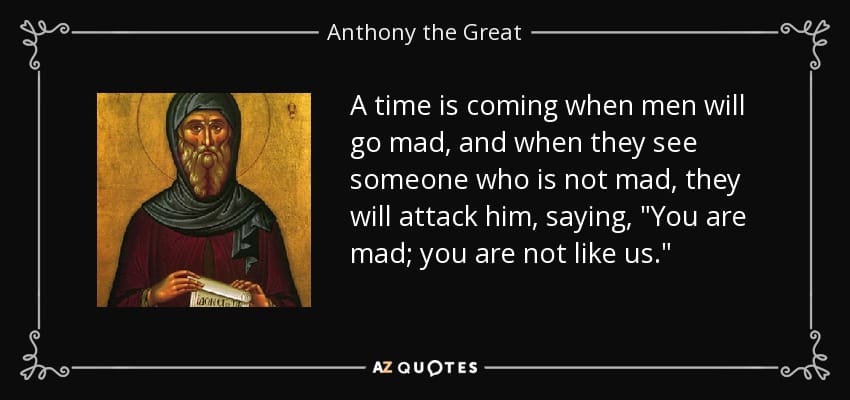
A time is coming….
1. Apostolic Constitution of Pope Paul IV, Cum ex Apostolatus Officio, 15th February 1559 (Roman Bullarium Vol IV Sec I, pp 354-357)