The Noble Savage Was Always A Fairy Tale
Several things brought this train of thought into the station: I had a little back and forth with a friendly, but terribly misinformed, trollette who argued for contemporary “traditions” supporting her positions while ignoring 2000 years of Christian tradition that didn’t, contrasted against Gad Saad’s commentary about the societal impact of Christianity (that moderated interpersonal violence), contemporary videos on X of “migrants” randomly sucker-punching white women on the street, and an evolutionary biologist/archeologist talking about large volumes of evidence showing how violent human civilization actually has been.
Years ago, I wrote about the myth of romantic primitivism – the fable of the “noble savage.” This myth/fable is, in literature and philosophy, an idealized concept of uncivilized man, a natural being who symbolizes the innate goodness of one isolated from the corrupting influences of civilization. It presupposes that before technology and development, men and women were living in an innocent and harmonious state with nature and each other. It was a belief that the indigenous people, unsullied by the advancement of civilization, existed in a pure, natural state of symbiotic perfection.
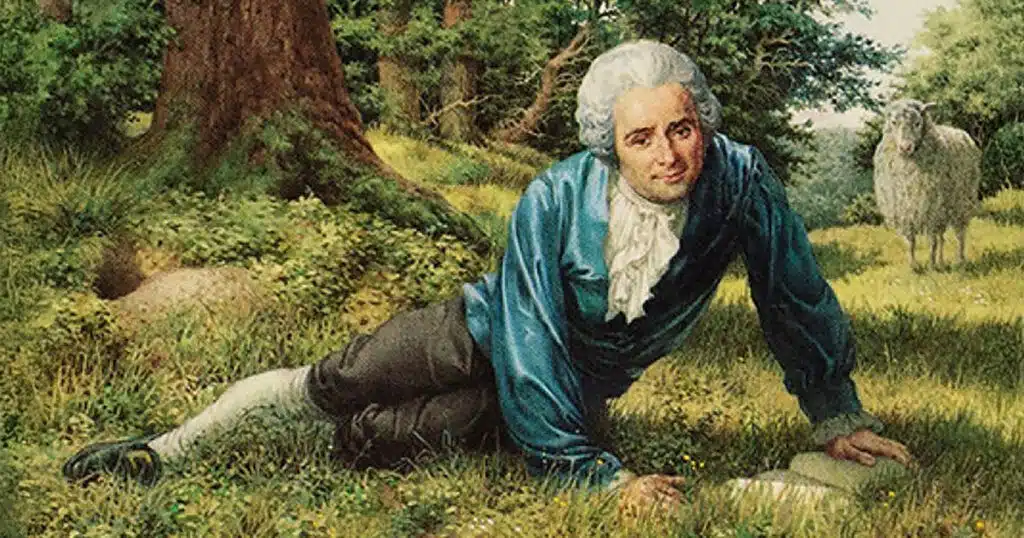
Jean-Jacques Rousseau, a major political philosopher of the Enlightenment, is often cited as espousing the most sympathetic version of the noble savage myth. In his Discourse on the Origin and Basis of Inequality Among Men and The Social Contract, he wrote that men in a state of nature do not know good and evil, but their independence, along with “the peacefulness of their passions, and their ignorance of vice”, keep them from doing ill.
Rosseau’s idea was less of a real theory and more of a pure myth—just how much of a myth is now being understood through DNA and archeological finds of mass killings and extreme extinction level events. The idea that violence and vice came about because of civilization is complete BS and for a long time, we have been sold a comforting fiction about the past. It is the kind of story modern people like to tell themselves: that before institutions, before hierarchy, before the hard edges of organized society, human beings lived in some loose, cooperative harmony. Conflict was rare, violence incidental, and brutality largely a byproduct of civilization itself.
With mounting evidence, that framing is coming apart at the seams now that evidence suggests life before civilization was not a pastoral utopia interrupted by progress, but a far more uncomfortable reality: human beings have always been capable of violence, and in many cases exercised it more directly, more personally, and more frequently than we might like to admit. The difference is not that violence didn’t exist. It’s that it wasn’t hidden behind systems, it was intimate, immediate and visceral.
Archaeology, inconveniently, does not deal in narratives. It deals with bones, and bones, examined without ideological filters, tell a story that is hard to romanticize. Mass graves with signs of blunt force trauma. Skeletons with projectile points embedded in ribs and skulls. Entire communities that appear to have been wiped out in what can only be described as coordinated violence. Not isolated incidents, either, but patterns—repeated across regions, cultures, races, and time periods.
That doesn’t fit neatly with the Rousseau-flavored idea of the “noble savage.”
That’s not to say human life was a nonstop bloodbath. There also exists strong evidence that human societies were built on cooperation, albeit that cooperation was often tightly bounded. Inside the group was cohesion and cooperation, while outside it, there was suspicion, competition, and sometimes lethal force.
In other words, the line between “us” and “them” was largely cultural and crossing that cultural line could be fatal.
This matters because it reframes a modern assumption that violence is primarily a failure of systems rather than a feature of human nature. The popular instinct is to believe that if we could just fix institutions, redistribute resources, or improve communication, conflict would largely dissipate. The fallacy is that position assumes the underlying material is neutral when the historical record suggests otherwise. The capacity for violence is not something civilization created, rather it is something civilization has attempted, however imperfectly, to manage and implying that what we call “progress” may not have eliminated violence so much as reorganizing it.
Modern societies have reduced interpersonal violence. You are less likely to be killed by your neighbor over a dispute than your prehistoric counterpart, but we have also created systems capable of scaling violence and even excusing it in ways earlier humans could not have imagined.
The emerging picture of early human life strips away a layer of comforting illusion and forces us to confront something far more durable than any particular political system or social arrangement: human beings are both cooperative and combative, capable of building communities and destroying them, something just as true today as it was at the dawn of mankind.
The real question is how violence is expressed, contained, and justified in any given era.
The contemporary fascination with illegal immigrants and “migrants” as always the good guys and Western society and culture as always the baddies seem an echo of 400-year-old romantic primitivism reverberating across time to Western societies today.
Rosseau’s theory is just as wrong today as it was when he proposed it. There is no nobility in savagery – or in continuing to allow it.