Spielberg’s Film, the Sacred Heart, and the Hildebrand Claim
Happy Tuesday inside the Octave of the Most Sacred Heart of Jesus.
Steven Spielberg’s film Disclosure Day was already generating headlines before its release for its promise to raise theological questions among Christians should extraterrestrial life ever be “officially” revealed.
Perhaps the more interesting question is why anyone believes a movie would be capable of doing that in the first place.
Disclosure Day as Miniature
The filmmaker’s confidence tells us something about the age in which we live. It also helps to confirm any suspicion that Operation Mockingbird was and is, perhaps under a different name inside the files, both a government and Hollywood psyop mechanism. The screen has become the new arena or stage—the new cave—emerging as the instrument through which modern man is trained to receive and shape reality before he ever asks whether the reality being delivered is true.
From an article on The Christian Post, Spielberg said:
“There’s a faction in the film that represents a pretty good position of why—possibly because of ontological shock, social dislocation—if this truth… were just known overnight, if the government announced, ‘Yes, we have been keeping this from you since 1947,’ that would mess up a lot of people.”
Spielberg also said the film, one of whose characters is a former Roman Catholic nun, “also takes the position of the [Catholic] Church.”
“What does this do to the fundamental beliefs that many of us have? Is God, our God, only on this planet, or is God a God for every system where there’s civilization, intelligent life and even developing life?”
A great deal is being packed into that most audacious premise.
For most of the last 2000 years, a Christian’s understanding of reality was shaped through Christendom, liturgical worship, inherited Tradition, family, direct experience, the saints, the liturgical calendar, the Mass, and the visible Church.
But in the premise, there is the unflinching assumption that a fictional Hollywood story has surpassed all of that. There is the assumption that “the position of the Church” is available to the entertainment industry as a narrative prop. There is also a subtler assumption, more powerful than the others perhaps because of its invasiveness, that millions of people now receive their metaphysical foundation and even religion from film, television, search engines, podcasts, social media, state narratives, and the entire humming operation of curated reality. It is all crafted by people we will never meet, none of whom have our souls, our families, our children, or our eternal destiny in mind.
That reality should concern Catholics far more than any hypothetical alien disclosure through a Hollywood film.
And yet the two may be wedded at this point in history.
If Disclosure Day does anything of use, it may be that it forces Catholics to ask whether they have already been softened for disclosure—or acceptance—in other forms: acceptance of this new morality, acceptance of this new liturgy, acceptance of this new global order, acceptance of this new human anthropology, acceptance of this new synodal “Church,” all of which speak in the language of the world Our Lord warned about while still pilfering the symbols of the Old Faith.
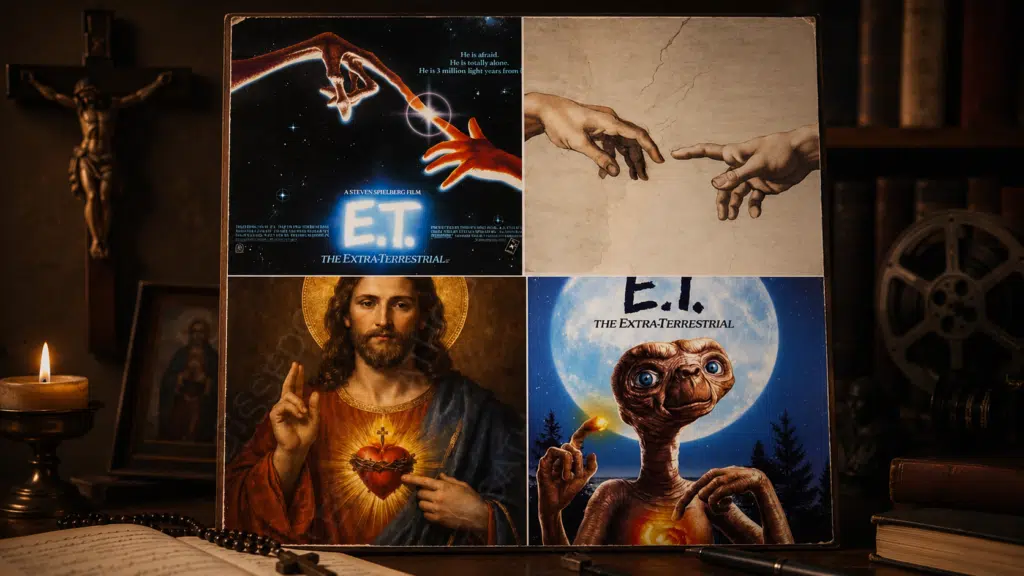
The problem is not outer space or aliens, even if Spielberg’s original imagery around E.T. has long invited, to be charitable, its own theological questions. The problem is and has long been desensitization.
Thus, such a force to make Catholics ask such questions would have to be strong indeed.
The modern Catholic has been slowly trained to tolerate contradiction. Not that long ago, most would have recoiled at the open desecration of sanctuaries, the casual reception of Communion in the hand, the therapy that has replaced penance, the disappearance of fasting, the profanation of marriage, and the papal suggestion that the Roman Rite of Saint Pius V belonged to the past as a museum piece. Modern Catholics have been conditioned to tolerate it all in the name of obedience, so long as someone in a collar tells them to remain calm, to trust that God will come to the rescue.
While we misunderstand entirely what that likely will look like, what it quite possibly is already looking like.
The Sacred Heart and Hildebrand
As we sit inside the Octave of the Sacred Heart, that conditioning should be juxtaposed with something older, more demanding, and far more Catholic.
And that juxtaposition may have us looking toward a hidden papal claimant having to remain in the shadows for now while his teaching reminds us of a purer Catholic memory.
Saint Paul instructed believers to work out their salvation “with fear and trembling” (Phil II.12). He did not describe the Christian life as casual or synodal religious affiliation, nor as the new age therapeutic posture absent of challenge, penance, and conversion. The soul requires vigilance and discipline, the repeated turning away from the illusions provided by the screens and toward the only true reality that is Christ. That is why true Catholic life has always included confession, fasting, abstinence, dogma, morals, hierarchy, worship, penance, family order, religious vocation, and the public honor due to Christ the King.
The screen and Elon’s algorithm hate that kind of holy austerity, a life that the Pope Hildebrand we have been investigating for some time now preaches in his agenda.
Regardless of the legitimacy of Hildebrand, his teaching may be the providential irritant Catholics need to burn through the fog. Yes, the legal question is more important than many Catholics realize. Yes, I hope the claim is true. But even before that question is settled, the agenda itself has exposed how little appetite many Catholics have for actual restoration.
Hildebrand does not fit comfortably inside the catechism of the screen—both of the secular and modern Catholic varieties. That is why you have Catholics who would agree on the evils of Modernism and be on completely opposite ends of the spectrum concerning Hildebrand. The question of Hildebrand forces us out of the mere lamentation of the synodal clown show or the collapse in morals. It forces us to admit that there is no one in the Catholic world besides him spotlighting the upcoming collision between Agenda 2030 and the 2000th anniversary of Christ’s Redemption of the World.
Facebook and Twitter can teach us to react. A legal claim such as this asks us to pray and fast for wisdom inside the distinct possibility that God may be answering many a traditional Catholic’s prayers in a way few ever expected.
Remember, His grace builds on nature far more than His granting of an out-and-out supernatural miracle. A little Romans VIII.28 is all we need.
Whatever one finally concludes about Hildebrand’s claim, one cannot reasonably deny that his 33-point agenda is unapologetically Catholic in its stated aims. It is clearly an attempt to think in terms of kingdom restoration rather than YouTube’s never-ending repetition of the Modernist decline. Consecrate Russia to the Immaculate Heart of Mary. Declare the non-binding nature of the documents of Vatican II. Restore the Roman Rite according to the Missale Romanum of Saint Pius V. Declare that Benedict XVI’s Declaratio had no juridical effect. Declare the conclaves of 2013 and 2025 uncanonical if the law demands it. Restore the Catholic hierarchy. Define the obligation of Sacred and Apostolic Tradition. Define the salvific necessity of observing Church law. Reform the election mechanism of the Roman Pontiff. Restore fasting and abstinence. Reform penance. Restore religious orders and monasteries. Call apostate priests and religious to repentance. Denounce Freemasonry and Agenda 2030. Prepare for the 2000th anniversary of the Redemption of the World. Restore the preaching of dogma and morals according to the model of the Roman Catechism.
That summation, at minimum, shows what a Catholic looks like when he is no longer content to be hoodwinked by Taylor Marshall.
The difference is not small.
One offers perpetual reaction, clicks, and $$$$$$$$$$$$$$.
The other offers, simply, kingdom restoration.
The older and sterner language of the Church knew that mercy without reparation can make an unconverted soul soft, forever unwilling to truly repent. Hildebrand’s agenda is more in line with the devotion to the Sacred Heart, which calls for more than feelings and sentiment, but instead the rigor of the Nine First Fridays and Friday penance. It calls for Christ’s enthronement in the home, where mothers and fathers will love each other and raise their children inside the ark of the Church’s protection.
So when Spielberg’s film asks what alien disclosure might do to Christian belief, the answer is almost embarrassingly simple. True Catholic belief has survived pagan empires, heresies, schisms, persecutions, heretical antipopes, bad priests, false philosophies, secular revolutions, Freejasonry, Communism, liberalism, Modernism, sexual revolution, Vatican II ambiguity, and so much more, not to mention the ongoing “operation of error” described by Saint Paul in II Thessalonians II. Spielberg’s Hollywood science fiction is not the threat to the Catholic Faith.
The threat is pride, amnesia, and soul-level sloth. It is that many Catholics no longer know the Faith well enough to distinguish contemplative stillness from cowardly paralysis, or prudence from a softened refusal to act.
Is that what is going on here with Hildebrand? I don’t know. But one thing is possible too: There is room for both Mary and Martha in this march toward the truth.
Final Thoughts
Something is going to happen.
Perhaps it will happen next month. Perhaps next year. Perhaps more slowly than those of us watching closely expect. But the collision between Agenda 2030, the breakdown of external reality and Christian order, the 2000th anniversary of the Redemption, the Vatican II crisis, and the ever-growing desensitization of Catholics cannot remain parked in neutral forever. God is not mocked, as Scripture says. A stiff-necked people may delay repentance, and even God will allow it in his justice, but no one will ever outrun His judgment.
This is why Spielberg’s words are a joke, and why “disclosure” is the wrong thing to fear. What should concern us is not whether governments reveal a hidden archive or whether Hollywood prepares the masses for some new ontological shock. What should concern us is whether Catholics have become so dependent on controlled narratives that they can no longer receive the older Catholic summons when it arrives: repent, repair, restore, and submit to Christ the King.
Hildebrand has presented that summons with unusual concreteness.
True claim or not, his teaching creates a hard test. Many Catholics say they want restoration, but when restoration begins to look less like nostalgia or actually moving on from our addiction to writing about the same thing, some will discover a sudden affection for delay.
As we have been saying, it hurts no one to investigate the Hildebrand claim. It is something like Simon of Cyrene being drawn into Christ’s Passion before he understood the full weight of it all. It is something like Saint John and the holy women remaining near the Cross while seeing the Crucifixion more incompletely than Our Lady, yet remaining there all the same.
Spielberg worries about ontological shock from the sky. Catholics should worry more about refusing the truth when it comes through the Church’s own law, especially if God is answering our prayers before we know how to recognize it.
If nothing else, the faithful of Rome deserve that much.
Most Sacred Heart of Jesus, have mercy on us.