THE FIX: Hegseth, Trump, and an Election-Security Endgame Question
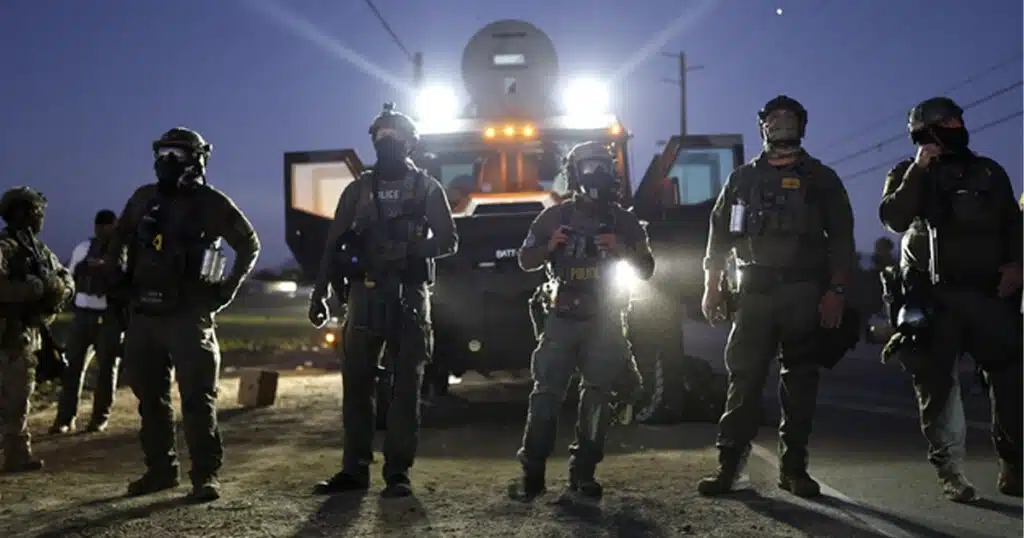
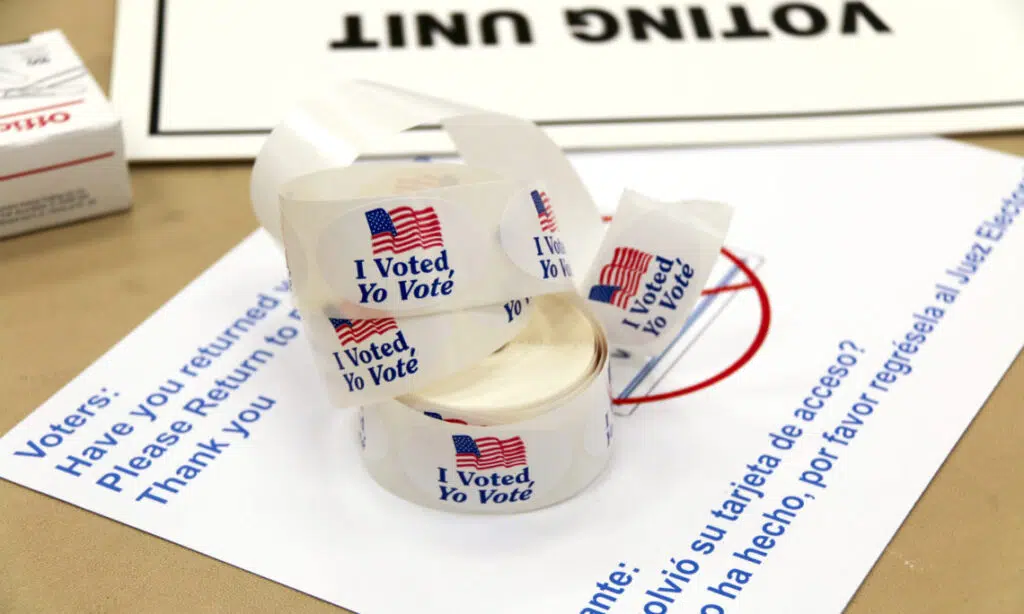
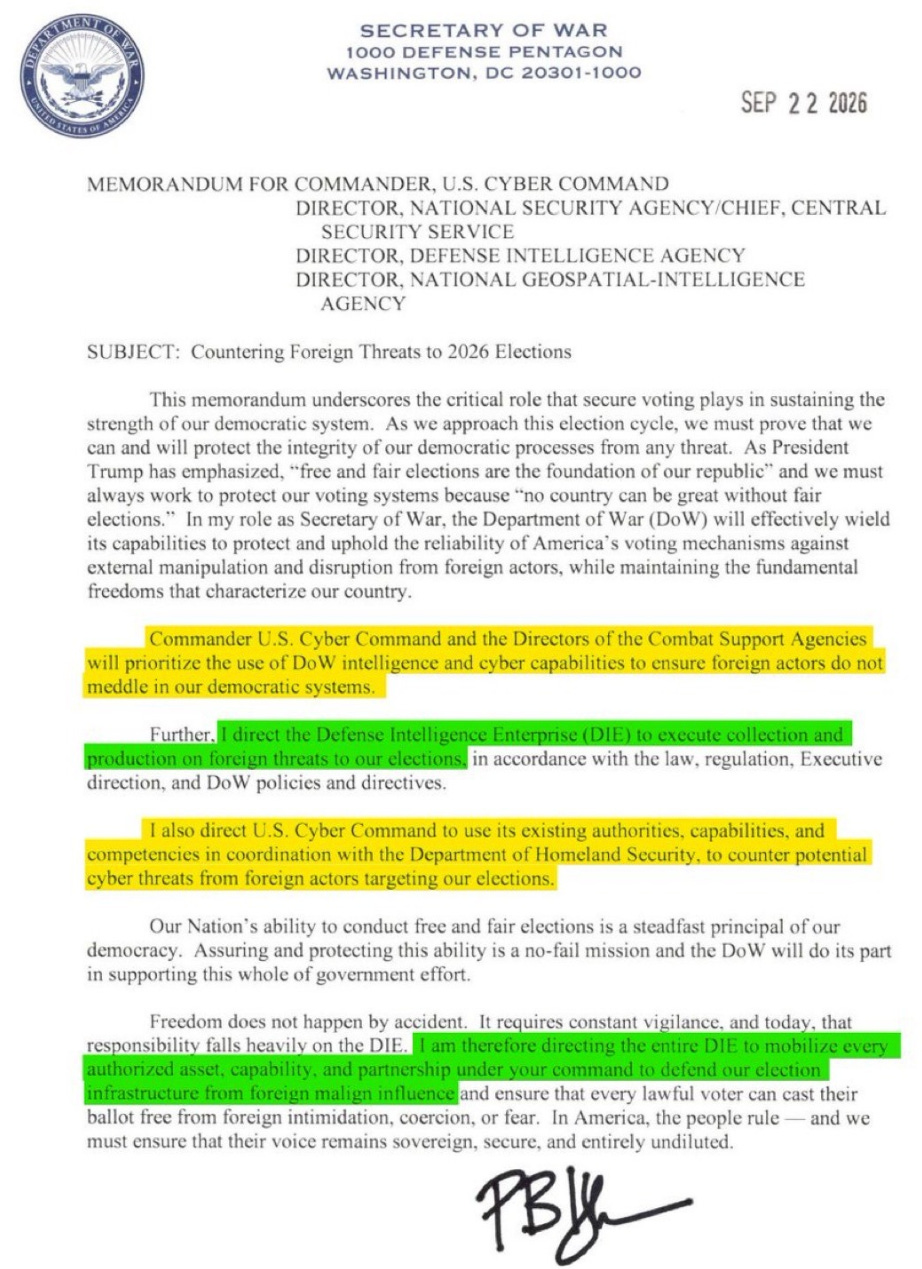
Secretary of War Pete Hegseth has directed U.S. Cyber Command and the Defense Intelligence Enterprise to mobilize their authorized capabilities against foreign interference in the November midterms.
“In America, the people rule,” Hegseth wrote, “and we must ensure that their voice remains sovereign, secure, and entirely undiluted.”
The attention to this matter itself is not new. Election infrastructure received its federal critical-infrastructure designation in 2017. Trump’s Executive Order 13848 followed in 2018, declaring foreign election interference a national emergency and creating an intelligence-assessment structure involving agencies across the federal government. So Hegseth’s directive mobilizes and potentially enhances that attention.
Good news, right?
Well, maybe.
Think about it. If Americans must trust an unseen intelligence operation to tell them whether or not their votes are real, something essential to self-government—in all its supposed sovereignty, security, and undilutedness—has already been comprised, perhaps even surrendered to the shadows. It’s like trusting an AI tool to determine how much of a writer’s text is AI-generated. It is sort of absurd if you think about it, which may make it an example of something we have addressed before but will not get into today: the Revelation of the Method.
If the answer to this question today is in the affirmative, then they’re all laughing at us with this whole election thing too.
I invite you to avoid the cynicism. The point of this piece is not to prove that Hegseth is knowingly participating in a scheme against the American people. We are simply asking whether years of election distrust, together with the mimetic momentum that has followed that distrust, have conditioned conservatives to blindly accept a more expansive national-security role for the government as the already-planned remedy—the Hegelian synthesis produced by the original conflict itself—rather than as an organic course correction.
Sorry for the mouthful there. Read it again and you’ll at least see it in theory, if in fact this is the first time you’re being introduced to the dynamics of the Hegelian Dialectic.
On the surface, in other words, this looks for the world like the long-coveted response that election skeptics have been writing on since 2020, at least. For those who were beating that drum and being dismissed as conspiracy nuts, such ongoing stories in the “real news” and with so many other than Trump linked to them may feel like sweet vindication.
I was in that number back in 2020 and, I’d say, through sometime in 2023.
My observations, however, gradually began moving me toward a possibility I had consciously suspended during the year leading up to the 2024 presidential election, and then Trump’s first months back in office. At the time, for the sake of my loved ones more than anything, I was willing to wait and see whether his return would address these world-changing concerns in the way so many of us had hoped, those same concerns that pushed us to supporting him in the first place.
Those concerns included election integrity, yes, but, most importantly, they included that occult world and the children caught within it.
Now all of that, which he first brought up with the famous Clinton line to Sean Hannity back in 2015, isn’t worth anyone’s time anymore?
This isn’t just one issue being glossed over. This is a matter of integrity, at least it was and is for me. A matter of integrity that sullies every other issue, no matter how much the changes in those issues are seemingly vindicating anything I’ve said before. In this case, election integrity.
Eventually, as no wave of arrests arrived for those involved in the heinous underworld thriving right beneath our feet, that suspension of disbelief concerning Trump’s intentions—and maybe his ability—to confront the deeper system began knocking at my cognitive door.
I know the audience and content of the site for which I write, and I certainly am not announcing that I am switching to the side of the donkeys. What I am doing is what this space has done for a long time now—to simply consider the question raised here, if only to suspend it in their minds as I once suspended it in mine.
Here are two similar ones:
Trump, the Media, and Something for Conservatives to Consider
A Deep State Built to Fall? Considering the Conservative Trust Trap
In March 2025, we called Trump’s executive order on election integrity “a great first step.” Even then, we argued that no executive order could fix elections at the state and local levels, questioned whether voting had become a sort of worship service in America’s civic religion, and wondered whether the entire system existed primarily to preserve an illusion of popular control, or the sovereignty and security Hegseth points to in the document.
Where I had greater confidence then was in Trump’s role—his conscious role. For my readers navigating their own cognitive battlefields, I treated the order as the beginning of a larger exposure, believing that the truth he continued releasing would eventually help the people dismantle the fraud—regardless of whether Trump turned out to be the real deal. That was the hope, and it formed an important part of my cognitive suspension. Time, however, has made that interpretation increasingly difficult to maintain, even though ultimately, I still do believe that God Himself is revealing things to us through Trump and Co. that we absolutely need to know.
What has changed since 2020, therefore, is not my distrust of the election system as it was described back then. It is my willingness to assume that exposing the system necessarily means leading us out of it, and in a helpful direction. Exposure can awaken people, yes, and that was the theme of this space for a long time. But realities have to evolve our thinking if they’re no longer walking in step, because exposure can also frighten people into accepting a proposed solution merely because a favored politician appears to be fighting Big Brother, and we think Big Brother is Joe Biden or Kamala Harris.
Consider whether the Hegelian Dialectic is potentially at work here. We’d smell it from the start of a movie if we were watching it. Could real life be presenting us the same puzzle?
First comes the “problem”: insistent claims by the Left that American elections are secure and that anyone questioning their legitimacy is dangerous.
Then comes the reaction: the entire system is corrupted, and only Trump, military intelligence, or some hidden counteroperation like Q has the power to expose it.
Then comes the possible solution: elections are so vulnerable that the permanent national-security apparatus must assume a larger role in protecting them.
Both sides of the apparent—and potentially staged—conflict can therefore arrive at the same destination, possibly a most sinister end goal intended from the start.
We buy car and home insurance and usually never use it. My thinking is that we should muster the same insurance in a cognitive way when the patterns of behavior by people on “our side” start looking a little like those on the other.
Better safe than sorry?
The people must be able to understand, examine, and verify the process through which their authority is supposedly transferred, not just trust it allegedly working for us in the shadows. And to me, theorizing aside, even the practicalities of that seem impossible: Can elections conducted across a country this large—through thousands of human jurisdictions, databases, courts, media tentacles, political organizations, and maybe even technologies—ever be assumed unquestionably legitimate, when control of the entire system and world has at stake such extraordinary wealth and power?
Remember, “Trust the plan” on the alternative right—or simply trusting the Trump administration in general—can very quickly become the right’s version of “trust the experts.” My hope today is simply that we continue keeping these questions in mind, that we don’t accidentally find ourselves being the fools inside a Truman Show so many are watching.