Nicholas II & the Papal Election Crisis—When All Appearances Collide with Catholic Law
“For there shall arise false christs and false prophets, and shall shew great signs and wonders, so as to deceive (if possible) even the elect.”
— Matthew XXIV.24
That preface is why I hesitate.
I also hesitate because I know I haven’t read all of history, and yet the history that follows is so very clear….
When Catholics today hear arguments about the legitimacy of a pope, many within the default Novus Ordo world, often with sincere trust, default to a posture of confidence in the visible structures of the Church even when questions arise that might otherwise warrant closer examination. That is putting it nicely, as I know of many a soul that turns his nose up at what I must call “Traditionalists,” and claim that we are in schism with Rome, particularly when the conversation collapses into more fringe camps—recognize-and-resist, sedevacantist (of various forms), or some hybrid formulation in between. [1]
Know that here, fringe does not at all imply error.
The instinct is understandable, because the modern Catholic mind has been conditioned to process complex ecclesiastical questions through both a misunderstanding of papal infallibility from Vatican I and, what I am more concerned with in my work, those diabolical, pre-packaged binaries that hypnotize a people into irrationally assuming there are only two choices in any given matter. It’s all a trap, and we’ve seen it with Trump and Leo just recently.
“Prove all things; hold fast that which is good” (1 Thess V.21).
RELATED
Trump vs Leo XIV! (Or, the Shape of a Manufactured Squabble)
Fatima’s Errors of “Russia” and the Catholic Camp-Trap
Catholicism: Clarity Amid the Camps
This is where what appears to be a maximization of positions inside a single pair, in reality, functions as a Hobson’s Choice, a false dilemma in which the available options—whether framed as Trump or Leo in the political sphere, or as competing ecclesial camps within the Church—serve less to illuminate the truth than to confine emotions within carefully curated boundaries. Such binary traps, while offering the cognitive comfort of clarity and alignment with one tribe or the other, often operate in a more insidious way, distracting and depleting the faithful from pursuing the more obvious—but less algorithmicly friendly—task of stepping outside the frame altogether in order to seek the actual truth and its corresponding solution.
Stepping out of the frame and having the courage to abandon the crowd often involves reading and studying, which of course is the problem altogether. No time with the American way of life. Too crowded.
“Enter ye in at the narrow gate: for wide is the gate, and broad is the way that leadeth to destruction… and few there are that find it” (Matt VII.13–14).
Returning to the Law Before the Sentiments
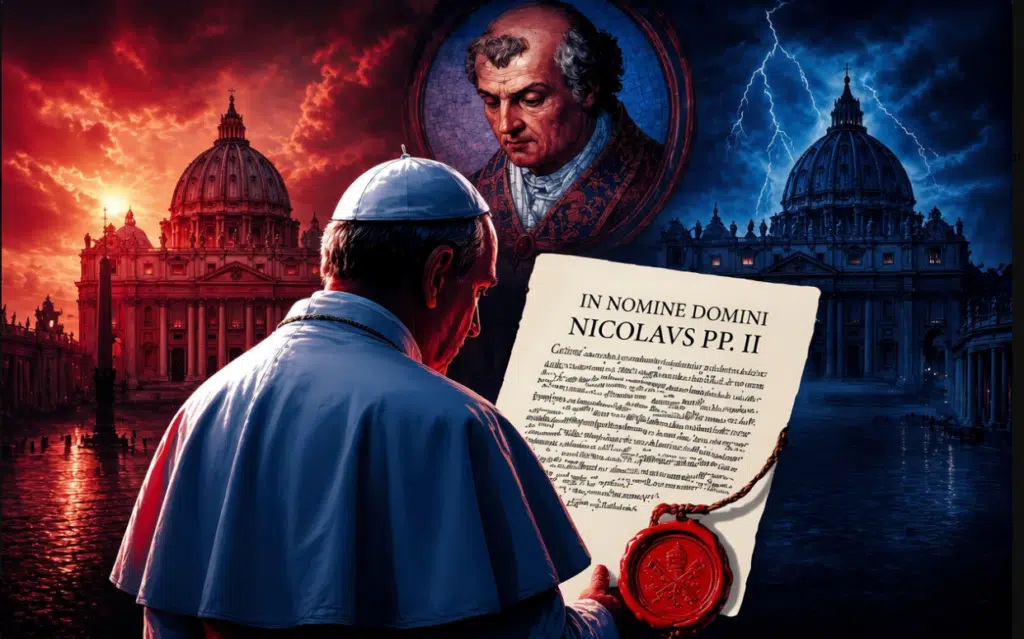
One study being done at the moment, for example, that even “Traditional” Catholic podcasters are not touching, examines the underlying principles that governed papal elections a thousand years ago, which is precisely where Pope Nicholas II’s Bull In Nomine Domini (1059) becomes terrifyingly fascinating.
Terrifying because of what it may mean for the man most every Catholic calls “Pope Leo.”
Also terrifying because it is the story of how Nicholas II became pope despite not receiving the higher number of votes—and a fast-forward to 2026 and the choice of papal name for one “Pope Hildebrand.”
If true, this would make Leo an antipope, just as Benedict X was a thousand years ago—despite absolutely all appearances in public, despite a dispute that raged for 130 years after his death—except for one small yet deciding factor. More on that in a future article.
Until then, consider the historical record below. Note that it speaks not to Modernist sentiment as we’ve come to understand the Faith, but to cold and hard history:
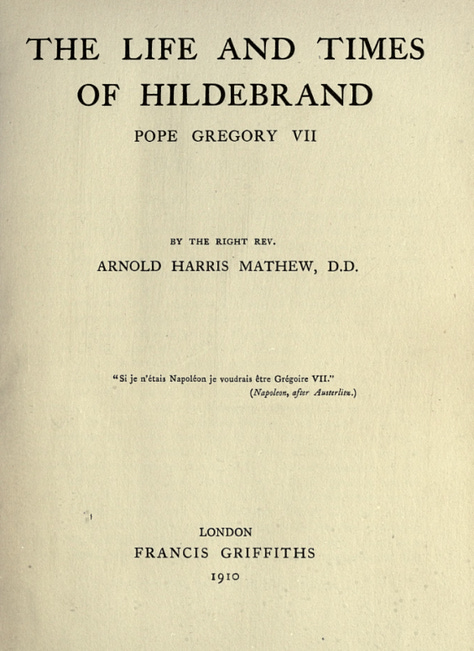
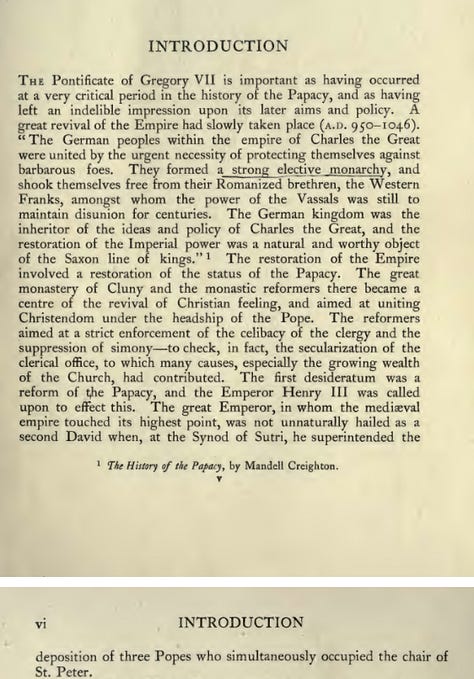
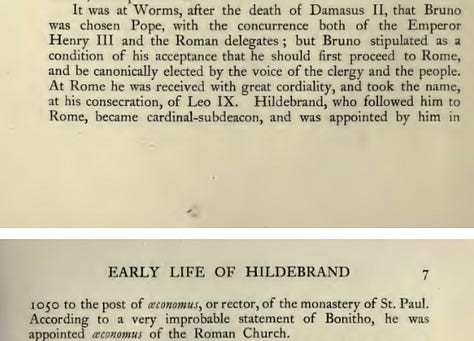
This is the world Nicholas II was legislating against. This is the world that has created the alleged “Pope Hildebrand” of today.
In the bull, Nicholas II established a structured role for the College of Cardinals in papal elections, prioritizing their function in order to stabilize what had often been a chaotic and politically manipulated process (which helped create, again, Benedict X). This was not merely introductory administrative housekeeping. It was a historical attempt to safeguard the integrity of the election itself, limiting the influence of external powers—particularly secular rulers—whose involvement had, in many cases, distorted or outright corrupted the process.
That should make sense to the modern Catholic—Cardinals indeed do elect the Pope.
§ 1. Wherefore, if it please thy Brotherhood, We ought, with God assisting, take care prudently for future cases and this by Ecclesiastical statute, provide in the hereafter that (these) evils, revived, not prevail. On which account, having been instructed by Our predecessor and by the authority of the other Holy Fathers, We decree, and establish, that with the passing of the Pontiff of this universal Roman Church, first of all, the Cardinal Bishops, treating (the election) together with the most diligent consideration, summon immediately the Cardinal Clerics to themselves; and in this manner let the rest of the Clergy, and the People, approach to consent to the new election, so that, lest the deadly disease of venality insinuate itself by occasion, the most religious men be the chief leaders in the election of the Pontiff to be promoted, but the rest be their followers.
That last part is not bolded, but it will come back to more importance in a moment.
Understand that this is not some obscure thousand-year-old document that should be relegated to the dustbins of ancient history. Paul VI himself, he who is hailed by the Vatican II sect as being the shepherd to modernize it all, alluded directly to the bull:
This Bull of Pope Nicholas II is no obscure document, since it is the first Papal Bull which restricted the election of the Roman Pontiff to the Cardinals, two centuries before the first Conclave was ever held. It is even mentioned by name in the Apostolic Constitution of Pope Paul VI, Romano Pontifici eligendo, promulgated October 1, 1975, in its third paragraph, where it is called a “celebrated” constitution, that is, frequently used. Its importance for today is that it explains, what other Papal Laws currently in force today do not, namely, “What is to be done if all the Cardinals forfeit their right and competence to elect the Roman Pontiff by reason of grave malfeasance, in conducting an illegal election or one which is declared invalid by papal prescriptions?”
It is also referenced by almost every Catholic’s favorite pope, John Paul II:
It is implicitly referred to also in the current Papal Law of Pope John Paul II, Universi Dominici Gregis, promulgated Feb. 22, 1996, where it says in its preface, that “the institution of the Conclave is not necessary for the valid election of the Roman Pontiff”, and again, wherein in n. 76 it declares any election violating its norms null and void, without however expressing what is to be done if the Cardinals fail to return into conclave because they maliciously will to hold as pope a man who is illegally elected.
A man who is illegally elected? And all of this—from Paul VI to John Paul II—despite the bull’s very first paragraph above giving the Cardinals the right of election in the first place.
Strange, isn’t it? That such a monumental decree to have elections be satisfied by Cardinals be perhaps more known and more warned about in the modern age because of possible future deficiencies or failures in those same Cardinals.
RELATED
Paul IV’s Teaching on When the Pope Is Not the Pope
When Tradition and Modernist Sentiment Collide
So Catholics—who base their entire system of trust on the tradition of Catholic teaching—must come to terms with the fact that these older documents are in direct conflict with newer ones, and are, in effect, more traditional than the current ones. And when one juxtaposes the modern dynamic with that historical record, the inadequacy of a simple binary becomes more apparent. The Church has, as an intrinsic historical reality, navigated periods of contested elections, rival claimants, and profound uncertainty regarding the identity of the true pope. We were never promised that the identification of the pope would always be free from difficulty or dispute, and the assumed absence of such a case in this generation’s lives has made us ignorant even to the possibility. But it is possible, and absolutely so. As a connection to bishops, just look at the Acts of the Apostles—when it was time to replace Judas Iscariot.
History’s precedent does not give us school textbook chapters in which the faithful were excused from discernment in favor of blind trust that those in power would do their jobs—as we understand it today; they were moments in which discernment became unavoidable—a duty as a follower of Christ.
So, in short, yes, Nicholas II’s bull does establish the Cardinal voting precedent we all know. But it does something else, and it is no less important or legal in the reading—
The Church of Rome, in extraordinary circumstances, retains a role in recognizing and securing a legitimate successor to Peter. Nicholas II’s reform narrowed and defined the ordinary process; it did not extinguish the Church’s previous and perennial capacity to act when that process is compromised:
§ 3. Wherefore, if the perversity of depraved and iniquitous men, so prevail, that a pure, sincere and free election cannot be held in the City, let the Cardinal Bishops with the religious Clerics, and the Catholic laity, though few, obtain the right of power (ius potestatis) to elect the Pontiff of the Apostolic See, where they might judge it to be more fitting. Plainly, after the election has been completed, if there be a bellicose conflict, and/or if the struggle of any kind of men resists by the earnestness of wickedness, such that he, who has been elected, cannot prevail to be enthroned in the Apostolic See according to the custom, nevertheless, let the elect obtain as Pope the authority to rule the Roman Church and to dispose of all Her faculties, which Blessed Gregory, We know, did, before his own consecration.
Read that again. Read it ten times if you must. I know the cognitive dissonance will be great.
Nicholas II continues his holy inferno. There is nothing to bold because the entire thing is ablaze:
§4. On which account, if anyone has been elected, or even ordained, or enthroned, against this Decree of Ours promulgated by Synodal sentence, whether through sedition, and/or presumption, or any guile, let him be cast down by the Divine Authority and that of the Holy Apostles, Peter and Paul, by a perpetual anathema with his promoters and supporters and followers as one separated from the thresholds of the Holy Church, just as the Anti-Christ, both invader and destroyer of the whole of Christendom, and let no audience be given him over this, but let him be deposed from every ecclesiastical grade unto whatever was before his, without any objection made, to whom if anyone whatsoever adheres, and/or exhibits any kind of reverence as to the Pontiff, or presumes to defend him in anything, let him be abandoned by equal sentence, which if anyone shows himself to be a violator of this sentence of Our Holy Decree, and has tried to confound the Roman Church by his presumption, and to raise disturbance against this Statute, let him be damned by perpetual anathema and excommunication, and let him be reputed among “the impious“, who “shall not rise again in judgement” (Psalm 1:5), let him know the wrath of the Omnipotent One against him, and that of the Holy Apostles, Peter and Paul, whose Church he has presumed to fool, let him know a ravaging madness in this life and in the future; “Let his dwelling become deserted, and let there be no one who dwells in his tents” (cf. Psalm 69:26): “Let his sons be orphans, and his wife a widow” (Psalm 108:9), “Let him be shaken completely” (cf. Psalm 108:10) to madness, and “may his sons go about begging, and be cast out of their dwellings” (Psalm 108:10). “May the money-lender ravage all his substance, and may the foreigner lay waste all his labors” (Psalm 108:11); “Let the whole world fight against” (cf. Wisdom 5:21) him, and let all the other elements be against him, and may the merits of all the Saints, at rest, confound him and in this life may they show open vengeance upon him. [2]
Read that again too if you must. Read it. I’m still reading it months after I first saw it and still can’t believe it.
What happened to this clarity, this conviction, this holy fire?
“He that is not with me, is against me: and he that gathereth not with me, scattereth” (Matt XII.30).
The ramifications of such non-neutrality are in direct conflict with the Modernist approach to both religion and life in general—that it is all based on sentiment and what we feel about God. (See my work on the Piuses and Gregories of Church history for a wealth of context there). Clearly, the question of a valid papal election is not reducible to sentiment, personal preference, what the electronic screens tell us, a totally-real-online squabble between Trump and Leo, or even the perceived orthodoxy of the man elected. None of that matters—the man could be the holiest man alive, but if certain legal steps aren’t followed, all of it is void. We see it in Benedict X in the historical example above. “For God is not the God of confusion, but of peace” (1 Cor XIV.33). It is a juridical and theological reality governed by laws, precedents, and principles—order—that developed over centuries, often in response to crises that bear more resemblance to our own unintelligible moment than many Catholics would like to admit. It is, essentially, confusion vs peace.
When those laws are invoked—whether in reference to the number of electors (which plays into the Leo question, another topic for another article) or the validity of the procedures followed—they cannot simply be dismissed as fringe concerns without, in effect, conceding that the Church’s own legal framework is secondary to the appearance of continuity—which is a false peace.
The Spectacle, the Frame, and the Loss of Discernment
We understand the need for the coach’s timely intervention in such crises in sports, and we agree with it as gospel when the team wins. Yet we cannot do the same in matters so much more important, so much more eternal. We will look at and even understand Nicholas II’s bull and still find a way to wiggle out of it mentally.
To avoid the trap requires the time we spend on those sports being devoted instead to the task at hand. It requires the intellectual discipline to resist the pull of the spectacle, which thrives on rapid judgment and emotional alignment—all of which stoke our short attention spans—rather than sustained, sincere, prayerful analysis. It requires a willingness to engage with primary Church sources, to compare current events with historical norms, and to distinguish between what the Church has always required and what has become customary and comfortable in recent times.
The flattening of complex issues into plain pairs is perhaps the most central way the enemy keeps us from these truths. The result is a feedback loop in which the most visible narratives gain credibility simply by virtue of their repetition, while more nuanced arguments are dismissed as fringe or overly complicated. This article itself will likely be an example of the latter. When such nuance is so quickly diminished into online narratives that can be easily consumed, fought over, and shared, invariably our tribal instincts emerge. The soul is practically forced into choosing a side before fully understanding the question, and the most nuance expressed is when the person—with well-meaning ignorance—encourages us to “pray for both sides.”
You see, that “sides” thing is still in the encouragement—no man can serve two masters (Matt VI.24).
This is not accidental. It is the natural outgrowth of an anti-Christ system that goes back to Genesis III.15, through the time of the direct enemies of Christ, through history and the pernicious “evolution” of a most central world religion, through to the here and now where we are seeing it play out in real time with everything we see. And that spectacle—that infernal circus—rewards constant engagement over trimmed accuracy, and embarrassing reaction over prayerful reflection.
And oftentimes, in what should be one great tell, the defense of either side is dubbed “Catholic.”
“God shall send them the operation of error, to believe lying” (2 Thess II.10–11).
Exiting Sentiment and Sodom—And Being an Inspiration
All of this teaches us that the real issue is not whether every single well-meaning Catholic–including my beloved family and friends–can en masse resolve the current debates surrounding papal legitimacy, but whether each soul is willing to ask the right questions in the first place. This requires being leery of the binary trap, refusing the pressure of premature emotion, and engaging with sources that anticipated the current crisis with Jeremian precision.
It also requires a certain intellectual humility, an acknowledgment that the problem may be more complex than any single framework can fully capture.
Catholics are being trained—slowly, imperceptibly, diabolically—to process information inside boundaries they did not choose. Nor did the Church. And once those boundaries are accepted, the outcome is largely predetermined—based on emotion, and, in a word, incorrect—regardless of how we feel.
Sadly, the arguments will continue, and the tribes will likely hunker down even more. The spectacle will grow even more colorful, especially when time for the SSPX consecrations rolls around. And the questions that actually matter will remain untouched—
Whether the Church’s own laws have been followed and whether what appears legitimate is, in fact, so.
Those are not emotional questions. They are not tribal ones.
They are juridical ones, and they are binding ones.
And they do not disappear simply because they are inconvenient, uncomfortable, or disruptive to the appearance of unity or to the happy flow of our worldly lives.
So I challenge all these camps to consider this: The task is not to win the argument.
The task is to save souls, and to do that, we have to understand how people learn, how people change, how people grow to feel comfortable in breaking the concrete driveway in their minds where the foot traffic in one wrong direction has persisted their entire lives. [3]
Until that happens, no one will be moved to act and no one will be saved from the trap. Catholics will continue to be yanked between positions that feel opposed, yet function within the same frame—expending energy, defending wrong assumptions, and mistaking participation in the spectacle for fidelity to the truth.
They think it’s Christian to do what they’re doing. They think it’s Catholic.
They don’t think we’re Catholic.
And that is how the most obvious and legal questions go unread and unasked, and in a cruel twist—condemned as null and void.
—
FOOTNOTES
[1] It is important to keep in mind the ultimate purpose and approach right now in my work—a stream of dissonance attack that is more intent on lighting a fire under family and friends to say the Rosary with discipline and consecrate themselves to the Hearts of Christ and his mother. From there, I trust that the actual truth will surface from holier voices than mine. Being “right” is the least of my concerns.
One question worth asking, however, given even the little piece of history presented here today–which is a microcosm of a much more prodigious mass of information still to come: Why are all the famous Catholic podcasters not at all talking about these stories, this history, these very real possibilities?
[2] A translation for those in disbelief as I was: In addressing questions about papal legitimacy and succession, the argument is made that the faithful—under conditions where the ordinary processes fail or are rendered doubtful—retain the ability to recognize and, in a real sense, participate in the election of a true pope.
[3] Lead people to the Rosary, to the Sacred and Immaculate Hearts. Lead them to fasting, maybe even a rule of life in the Divine Office. Then trust that God will move in their lives in ways we can never move in their intellect.