US Doctrinal Warfare and the Pernicious Reprogramming of the Catholic Mind
“…But the Catholic Church was the biggest prize, and the hardest nut to crack. The goal was to convince the bishops that their old exclusive claims were obsolete and that they must embrace the American model of religious liberty.”
-Aloysha, “The Engineered Revolution: How the American Establishment Installed Globalist Software in Catholic Church”
Before I begin, first a disclaimer I shouldn’t have to make, but remember that the exploration here is just one small piece of a much bigger and absurdly complex picture that goes back centuries and centuries, that would be fully mitigated if America and at least most individual souls turned back to God as he wishes.
As he commands.
That said, here is my latest effort to nudge friends and family out of the concrete while I do the same for myself, if only a little….
One of the most persistent assumptions among modern Catholics is that the Church’s posture toward the world simply “developed” over time, that earlier tensions between Catholic doctrine and the “We the People” variant of liberal democratic order gradually resolved themselves through better thought processes, more tolerant reflection, and basic historical maturity. It allows continuity to be presumed by even the well-meaning Catholic, even where clear contradiction and cognitive dissonance is sensed.
It is such a reassuring narrative that convinces most Catholics—without even a raised voice—that they are indeed living a good Christian life. Once the evidence is set side by side, however, and once older magisterial texts are juxtaposed with later texts-turned-habits of thought, the story begins to look less like organic development and more like a most wicked curated transition.
One “Alyosha” on Substack quips, “Many historians of the church will usually tell us it was just the ‘Spirit of the Sixties.’ They say this spirit drifted in through the open windows of Vatican II like a fresh spring time breeze. We are told it was organic. Spontaneous change. I don’t buy that.”
Nor should any clear-thinking Catholic, regardless of what we might hear from pastors formed in those same infiltrated seminaries. The instinct to question in conscientious objection matters, because it pushes past the modernist, sentimental myth of “updating” a Faith meant to be guarded and asks a harder yet obvious question: How does an institution that appeared to stand firm for two millennia, more or less, pivot so drastically and inorganically in a single decade, indeed less than that, and then insist that nothing essential has changed?
The answer is obvious. The problem didn’t begin in the 1960s. In fact, I’ve come across numerous “starting spots” for the beginning of the end, one going as far back as 1130. How true that is, I’m not sure, but it would not be inconsistent with God’s manner of chastisement and punishment of his Chosen People. When the Israelites were chosen in the Old Testament, it was often centuries and centuries God gave them to repent and listen to his prophets.
We can discern through prayer, fasting, and study—through knocking on the door—if this problem goes back 200 or 500 years, and that it is certainly well within the timeline of God, who also works outside of time anyway.
And there are many of us who hold the belief that there is no way we could be living under an operation of error for a mere seventy years? Modern life has killed the concept of God’s schedule. He maneuvers over generations, not days and weeks or even single lifetimes as we do.
While the 1130 thesis seems extreme, it should at least nudge Catholics who believe absolutely nothing bad happened at Vatican II a mere seventy years ago. Regarding the current landscape of “news” on our electronic screens, it is a good guess we are dealing with a series of Hobson’s Choices, i.e. Vatican II bad vs Vatican II good, or Novus Ordo bad vs TLM good, or SSPX (good or bad) vs Sedevacantism (good or bad) or or or or….
If we are privy to such squabbles in the anti-Christ run public sphere, it’s also a good guess that the rot runs much deeper than any of us can even imagine—well beyond the binaries we are allowed to see.
RECENT
Trump vs Leo XIV! (Or, the Shape of a Manufactured Squabble)
Paul IV’s Teaching on When the Pope Is Not the Pope
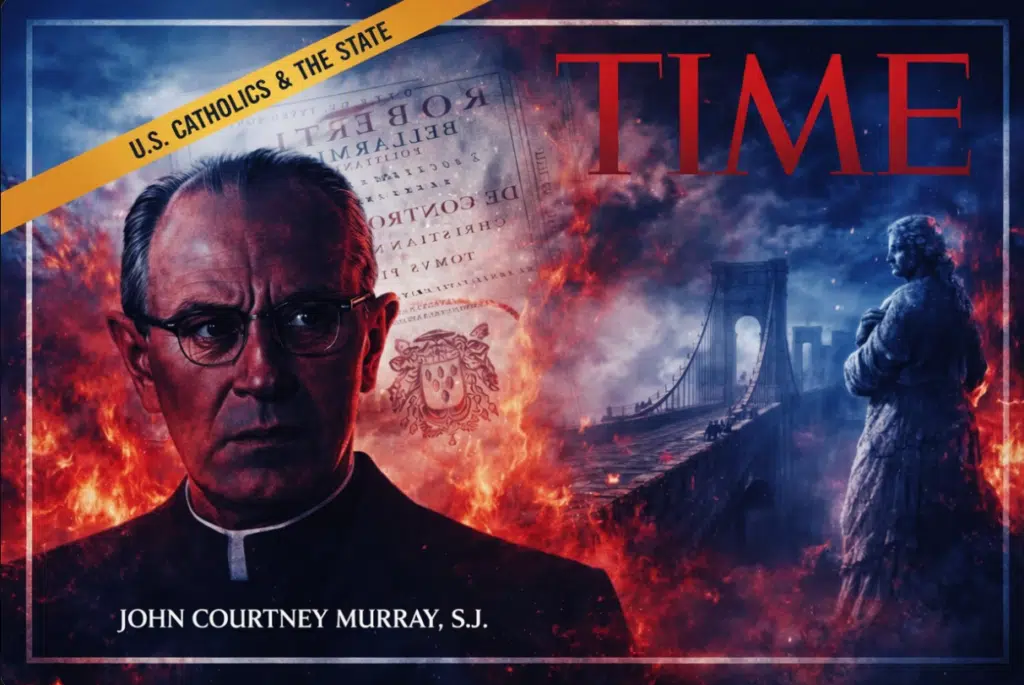
John Courtney Murray and Continuing Doctrinal Warfare
Before Vatican II, the magisterium had already spoken on the rot in many varied ways, all while perhaps allowing it to perpetuate by not being specific enough with names and sources. Regarding the hidden heresy of what was called back then Americanism, Pope Leo XIII in Testem Benevolentiae Nostrae had already condemned the Catholic Church’s tendency to “shape her teachings more in accord with the spirit of the age and relax some of her ancient severity and make some concessions to new opinions.” He outright rejected the notion that “the Church in America” could be “different from what it is in the rest of the world.”
What would Leo write now, 127 years later?
Lest we continue to think that the story of the Catholic Church is distinct from the story of America, one John of Rochester provides the tiniest of glimpses with the following:
As stated by President Roosevelt in his Four Freedoms speech of January 6, 1941 Americanism promoted 1. freedom of speech, 2. freedom of every person to worship God in his own way, 3. freedom from want, and 4. freedom from fear. Since truth is foundational to the Faith, the Catholic Church did not accept concepts of freedom of speech or freedom of religion that would put truth at the same level as lies, so it was considered hostile to Americanism, and a prime target for the US Doctrinal Warfare Program. Being founded on June 29th, the feast day of St Peter and St Paul, is of particular significance as it suggests that the undisclosed prime target was the Catholic Church, who commemorates the founders of the Roman Church on this day.
Here is where “Father” John Courtney Murray comes into focus, specifically in the book by David Wemhoff, a 20th century work titled John Courtney Murray, Time/Life, and The American Proposition: How the CIA’s Doctrinal Warfare Program Changed the Catholic Church.
The claim is not that every theologian was a conscious operative or that every plot point was scripted. The claim is more troubling than that, precisely because it is more plausible—that in the context of Cold War geopolitics, American intelligence interests found it useful to encourage a version of Catholicism that had been long been fought for even before—that could be harmonized with the American political order—and that this encouragement helped elevate certain theological thought structures while marginalizing others. As Alyosha puts it, Wemhoff’s thesis is that the shift at Vatican II “wasn’t an accident. It was the result of a long-term intelligence operation by the American ‘Eastern Establishment.’ They didn’t just want to change the Mass. They wanted to change the Church’s underlying operating system.”
Catholic priests fighting for the precepts of the old Faith and their books were squashed.
Would modern priests, even among those considered most conservative, dismiss this? Of course they would. Would they even know that this battle once existed? No, they wouldn’t, because the books weren’t taught, and God the Father has left us to our own operation of error because of a mass moral degeneracy I admittedly helped build.
That is not conspiracy theory, and given the absence of God and miracles in the world, it really could fall into the category of common sense. The whole thing is the long, patient strategy of the enemy, chillingly consistent with tactical warfare on the political level and, to less profound degrees, levels involving infiltration inside the Catholic Church. It doesn’t take a tinfoil hat to know about the sanitized, easy one in Taylor Marshall’s Infiltration, and it may not even be a stretch for many a Catholic to know about things like the Alta Vendita and The Plot Against the Church. None of this should be that surprising, and yet—in all its plainness that runs consistent with so many concerns and grumblings we’ve had about “what the world today is coming to”—so many simply run from the investigation. Indeed, the chosen course of action is often to shame those trying to pull Catholics out of the cave, trying to find the actual remedy that can reverse said world’s degeneracies.
Such war tactics, especially at the level of ideas, does not usually arrive with a pitchfork and horns. It arrives through priests like Murray, official institutions, textual publications, YouTube priest endorsements, and the shaping of what is respectable enough to say aloud. Wemhoff defines the strategy:
Doctrinal Warfare is the systematic use of psychological warfare to change the fundamental beliefs, or doctrine, of a target group… The goal of Doctrinal Warfare is to assimilate the target group into the worldview of the attacking power.
Even before Leo XIII, Pius IX had already condemned, in the Syllabus of Errors, the assumption that claimed “The Church ought to be separated from the State, and the State from the Church.” Pius X would echo this teaching in Vehementor Nos when he wrote “That the State must be separated from the Church is a thesis absolutely false, a most pernicious error.”
Clearly the enemy manipulated this Catholic insistence on the relationship between Church and State by both working to separate them in the spirit of the French Revolution and perniciously conflating them under a most hideous Frankenstein mash-up. The true Church’s intent—represented by shepherds perhaps muzzled into whispers or compromises—was never to compromise its millennia-old teaching with the State.
Never.
Murray is important because he becomes the theological face—a face with a collar at that—of that conflation, that compromise, that monstrous harmonization that most every Catholic today thinks nothing of–including my immediate family. He is often presented as the thinker who reconciled Catholicism with the American ideal, the same ideal we erroneously equate with Catholic virtue: religious liberty, pluralism, constitutional order, democratic coexistence. Said Wemhoff:
Murray provided the theological rationale for the Catholic Church to accept the American Proposition. He was the bridge over which the Church could cross from the old world of dogmatic exclusivism to the new world of American pluralism.
Concerning Vatican II and his extensive contribution to it, Murray would write:
The statements in Gaudium et Spes [The Church in the Modern World], like those in Dignitatis Humanae [Declaration on Religious Freedom], represent aggiornamento. And they are programmatic for the future. From now on, the Church defines her mission in the temporal order in terms of the realization of human dignity, the promotion of the rights of man, the growth of the human family towards unity, and the sanctification of the secular activities of this world.
This is not Catholicism, all gooey and charitable as it may sound.
All of this occurred after Murray was censored by Pope Pius XII for his Modernist gobbledygook in 1954–a mere eight years before what Modernists call his “vindication” at Vatican II.
Think about it. It is human nature for us to seek out and attach “witnesses” to our claims, especially the questionable ones, and we know that the claims most difficult will need support from the inside. As a sort of parallel, it is like the race-oriented person pulling a quote from a black person to make a racist point. See, even Denzel says it!
The enemy knows this penchant inside us, and it preys on it, specifically in the form of controlled opposition—a concept akin to the Hobson’s Choice. Murray was controlled, a seeming opposition to the outside world (Catholic, wore the collar) that wasn’t an opposition at all. (See, even Fr Murray says it). For decades, as the papal teaching above shows, the true Roman Church (and not its growing imposter) had treated separation of Church and State, in its American formulation, as bound up with the condemned spirit of “Americanism.” Murray’s usefulness is expressed by Aloysha in the following:
His specific genius was to reframe the First Amendment. For decades, the Vatican had viewed the separation of Church and State as a heresy (condemned as “Americanism” in 1899). They saw it as the State refusing to acknowledge God.
Murray flipped this on its head. He argued that the First Amendment wasn’t a theological dogma of state atheism, but a practical “Article of Peace.” He claimed that the American Constitution didn’t reject God, it simply declared the State incompetent in spiritual matters. By limiting its own power, he argued, the American State was actually fulfilling the Catholic ideal of the freedom of the Church better than the old Catholic monarchies ever had.
This theological verbal judo was exactly what the CIA needed. It provided a “Catholic” justification for American pluralism.
Such highway robbery of the language should make all the sense in the world even to the more politically bent among us. It is a most sinister tactic in war—to change the meaning of words. What also should make sense is how this pluralism helped birth the woke left every conservative condemns.
Anything goes. There is no objective truth.
There is real tension here. The question is not simply whether Murray built a bridge, but what was carried across it. Bridges do not move in only one direction—forward, as most laymen see it. They can also carry confusion back into history, back into a time that enjoyed more clarity, more of that objective truth, as admittedly political and unclear as it could sometimes be itself, where it begins to alter that history and therefore the entire landscape from within. It is how our ancestors are made to look cruel, even while the same history shows that they—the Leos and Piuses of the Church—were not being cruel enough for the eternal benefit of sheep and souls.
It is how Catholicism is made to look wrong, when most of us don’t even know what the true Catholicism of the Fathers really is. I admit that I am in that number, but effeminate quietism isn’t the answer to this ongoing tragedy either.
RELATED
St Catherine of Siena vs St Vincent Ferrer—When ‘Obedience’ Turns Awkward
Final Thoughts—The Necessity of a Desert Experience
What makes this so dangerous is that it does not ask Catholics to reject the Faith outright. It asks them to keep the shell and accept a new substance, and most of us have two centuries of our American ancestors kowtowing to compromise as our unfortunate precedent and guide. All of this asks Catholics to say the same words of the Fathers while meaning something else entirely by them. It asks us to call compromise maturity, rupture development, and surrender peace. And because the operation is so insidious, because it comes clothed in collars, credentials, and appeals to “freedom,” millions never realize they—we—are not watching Catholicism mature. We are watching it be translated into a language the modern world can tolerate.
We’ve already watched it. And some still younger are inheriting this abomination thinking it is the truth. When I think back to what the supposed good, conservative priests were teaching when I was growing up…
And once that infernal translation takes hold, the consequences do not remain theoretical. The foot traffic keeps moving, through Vatican II, through the seminaries, through the church offices, through the book clubs, through the Friday fish fries, through summer vacations, through Catholic family living rooms and Suburbans. It moves until the modern Catholic can hear Leo XIII, Pius IX, or Pius X in an online history course and conclude not that something was stolen from us, but that the past itself must be reinterpreted to fit today.
Or that they must not have been that serious since they didn’t name anyone.
Or if all of this is true surely our good priest would tell us in a homily.
That is not development or maturity or even remotely good.
That is menticide by wrong catechesis.
And it leaves us standing at the bridge with this strange eraser in our hand, not knowing what to do with it.
“You shall know them by their fruits….”
The question now is not whether a bridge was built. It is which direction we are walking on it. One direction leads deeper into a language where Catholicism is continually adjusted, softened, and anti-Christed to the world. The other leads back toward what was handed down, at least in much of the language, toward a Faith that does not need to be retranslated in every age.
That is why Catholicism, properly understood, is not nostalgia for the past. It is the refusal to keep crossing a bridge that should never have been built.
And that refusal is harder than most Catholics realize, because once a soul begins to turn around, he sees how much of his religious imagination was built on the crossing itself. He sees how often he was taught to mistake movement for maturity and accommodation for prudence. He begins to see that the problem was never simply what lay on the other side of the bridge. It was that he had been trained to believe he must keep walking.
That is where Lot’s wife becomes a warning.
The great danger is not in turning back toward “Tradition.” I have come to believe even that is a part of the deception, a crucial trick of the false Hobson’s Choices being presented to us. No, the great danger is clinging to the broad, familiar landscape of adaptations and compromises simply because it has become normal to us. It is in wanting the safety of Sodom after having once glimpsed the road out.
That is how judgment works on a soul made comfortable by contradiction, a soul not willing to really embark on a season of harsh discipline and prayer to plead with God to reveal the truth of history.
And what they’ve done to our Faith.
The bridge keeps carrying traffic in one direction. Grace commands the soul to turn around and away—to a much-needed desert experience. But if, after all the warnings, we still prefer the country of compromise to the hard desert season, we should not be surprised if we are fixed in place by the very world we cannot bear to leave.
That is the terror of it.
Not that we don’t sense we’ve lost the truth, but that so many have been taught to fear the escape from Sodom.
FURTHER READING: Catholicism: Clarity Amid the Camps