Trump Trip to China is Historic, Multifaceted
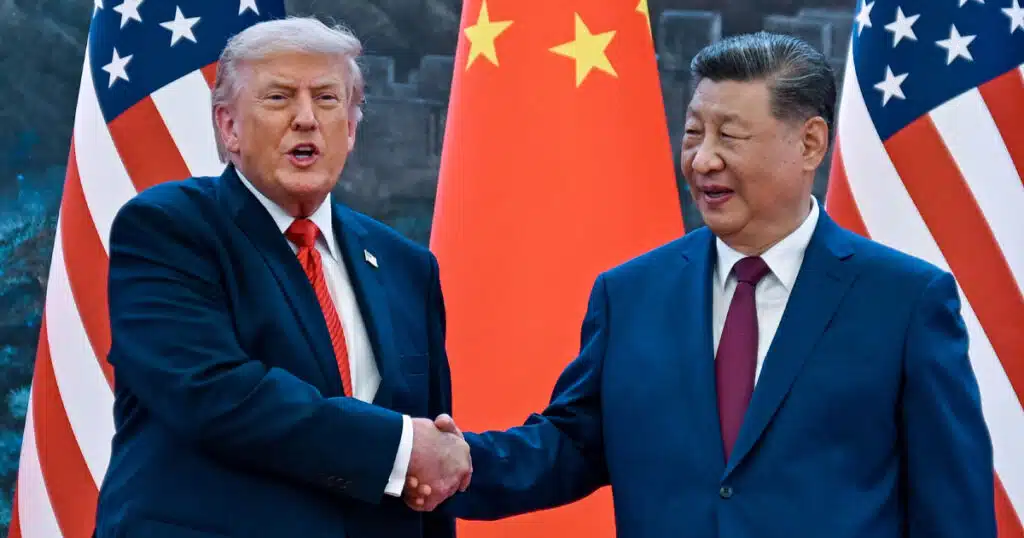
President Trump traveled to China last week to meet with Chinese President Xi Jinping and he didn’t go alone. Accompanying him were some of the most influential Trump Administration officials, including Secretary of State, Marco Rubio, Secretary of War, Pete Hegseth, Secretary of the Treasury, Scott Bissent, U.S. Trade Representative, Jamieson Greer, and White House Deputy Chief of Staff, Stephen Miller, to name a few.
Perhaps even more notably, on the trip were some of the most prominent leaders of business and industry in the world, including Elon Musk, CEO of Tesla and SpaceX, Tim Cook, the CEO of Apple, Jensen Huang, Nvidia CEO, to whom the Trump Administration gave its approval, with new security requirements, to sell to China one of its most powerful AI chips, as well as Robert “Kelly” Ortberg, CEO of Boeing, and a host of other CEOs and business titans.
The effort appears to have been rewarded because the Chinese President told those business leaders that China will further open its country to American business, which must have been quite encouraging to hear given that a major goal of many of these CEOs is to increase their presence in the world’s second-largest economy. Perhaps this pledge from China to welcome more foreign business is even more remarkable given that it comes after years of escalating trade tensions between China and the U.S.
The formal summit agenda included crucial topics that ranged from the Iran controversy to trade to technology. Some experts have observed that “on trade, the best outcome may be ratifying the status quo—a truce on tariffs with a promise from Beijing not to hold the world’s rare-earths supply hostage again, as it did after Mr. Trump’s tariff threats last year.” (Wall Street Journal, 5-11-2026).
In the area of foreign relations, WSJ further notes that “on Taiwan, Mr. Xi wants veto power over U.S. arms sales to the island, and he is pressing for the U.S. formally to “oppose” Taiwanese independence, as opposed to the current posture of ‘not supporting’ it.” In fact, President Xi reserved his sharpest language for Taiwan, calling it “the most important issue” in the bilateral relationship. But President Trump didn’t waiver or change our long-standing policy of ‘strategic ambiguity’ with respect to the relationship between China and Taiwan.
I also note Trump never forgets his beloved farmers and endeavored to persuade China to agree to purchase more U.S. farm goods, as well as addressing the issue of pharmaceuticals. On the issue of export limitations, the U.S. previously agreed to pause some export restrictions, while both sides previously agreed to halt reciprocal port fees. No doubt there is an interest in maintaining the status quo.
In sum, the Chinese President agreed to build a “constructive China-U.S. relationship of strategic stability” and said that “China’s door to opening up will only open wider.” China expressed interest in purchasing more U.S. oil to wean off its reliance on Middle Eastern crude. China also agreed to buy 200 Boeing jets, with a potential for the order to rise to as many as 750 planes, and that the planes would have GE Aerospace engines.
Notwithstanding this strategic progress in the bi-lateral relationship, I have written previously that the Chinese Communist Party has made clear it will do whatever it determines is necessary to win what it sees as an inevitable war with the United States, including conventional—and even nuclear— warfare, terrorism, and biological, cyber, economic, data and political warfare. That is why economically, militarily, and geographically the United States faces a stark threat from China.
It is also foolish to ever forget that China continues to be the main financial backer of the world’s worst actors, including Russia, Iran, and North Korea. That cannot have gone unaddressed at the summit. In fact, China could conceivably end up persuading Iran to come to a resolution with the U.S. by foregoing its nuclear ambitions, both because it will calm down trade and world commerce, which benefits China, and because China needs to resume the uninhibited flow of crude oil from Iran that it relies upon and that is impeded due to the blockade of the Strait of Hormuz.
The U.S. must plan to aggressively counter this multi-pronged threat to America while also increasing economic ties where we can. I think President Trump realizes all of this and judges every interaction he has with Chinese leadership based upon whether it puts America in the strongest position possible.