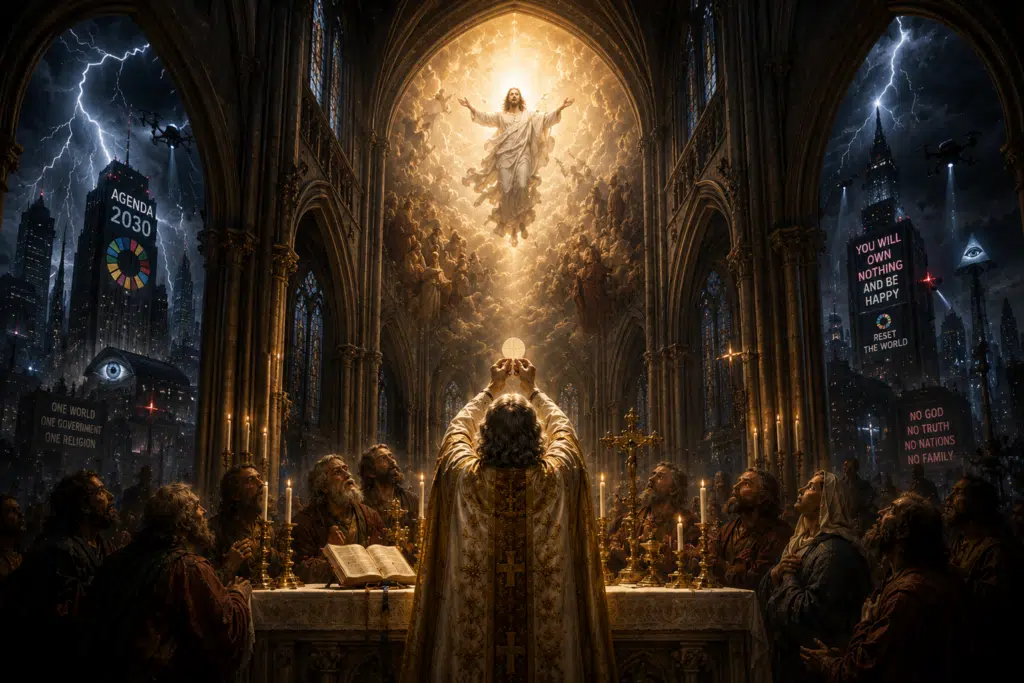
The Ascension and Agenda 2030
“Besides, He thus enlarged His household on earth, that is, His Church, which was to be governed by the power and guidance of the Holy Spirit. He left Peter, the Prince of the Apostles, as its chief pastor and supreme head upon earth; moreover he gave some apostles, and some prophets, and other some evangelists, and other some pastors and doctors. Thus seated at the right hand of the Father He continually bestows different gifts on different men….”
-Catechism of the Council of Trent, Article VI (on the Ascension)
—
Before Catholics can fight a counterfeit kingdom, they have to recover the soul, the altar, and the Church Christ actually founded.
When a recently published agenda attributed to one Pope Hildebrand includes the call to “Prepare for the 2000th anniversary of the Redemption of the World,” it gives us a useful launching point into a timely exploration of perhaps the most underrated scene and feast of the Faith—the Ascension—which we celebrate on Thursday.
It also forces a question most Catholics would never even dream of:
What would the Church actually need to recover before such an anniversary could be treated as more than just a calendar event filled with pomp and circumstance, or just another empty ceremony wrapped in fruitless religious language?
RELATED
Paul IV’s Teaching on When the Pope Is Not the Pope
Nicholas II & the Papal Election Crisis—When All Appearances Collide with Catholic Law
Because Christ’s Redemption of the world is not an abstraction, and because Christ did not die on Calvary in order to inspire a vague religious civilization that lives by the least common denominator of “all you need is Jesus,” any serious preparation for the 2000th anniversary of the Redemption would have to begin where Christ Himself began with the apostles.
Not with the earthly kingdom first.
Not with political winning first.
Not even with the triumph over wokeness and cultural restoration first.
It would have to begin with conversion of the soul, the visible formation of the Church, the sacramental order of worship, and only then the eventual bending of nations beneath the Kingship of Christ.
That is why the Ascension matters, and that is also why Agenda 2030 matters.
Regardless of who the true pope ever is at any given point, if a truly Catholic agenda is going to be taken seriously, the point cannot be that Catholics merely discover a fresh political enemy, get angry for a news cycle here and there, and then return to the same spiritual disorder that created the enemy in the first place and made possible our being hoodwinked by the “news” yet again. Agenda 2030, with its carefully managed language and narrative deployments, its environmental deceptions, its population control instincts, its economic centralization, and its pungent totalitarian scent, is not merely a political program meant to be discussed only on Rumble; intrinsically, it is an anti-Kingdom program. It is a vision of man, earth, authority, economy, and destiny without Christ the King. It is, in a word, Luciferian.
Catholics should know by now that opposing an anti-Kingdom with mere politics is not enough. It is an old mistake we keep making, and despite the occasional gain we make in perceiving what government and media are doing to us, we invariably slip back into the trap of the false dialectics—
And we forget again.
The Apostles’ Mode of Thinking: Nature, Not Grace
Well-meaning Catholics, myself included both in the past and at intermittent points even now, can become enslaved to the notion that nature is the final arena of virtue, rather than the realm grace must heal, elevate, and order toward God.
This downward instinct is where the apostles were before Pentecost.
When the Transfiguration, the Ascension, and Pentecost are read together rather than treated as isolated devotional scenes, a pattern emerges with enough power to correct several centuries of Christian amnesia. The apostles, even after having walked with Christ, eaten with Christ, watched Christ command devils and raise the dead, seen Christ transfigured in glory, and encountered Christ risen from the dead, still did not fully understand.
The proof is right there in Acts I. In the very moment before Christ ascended to the Father and left them physically for good, they were still thinking in earthly categories.
“Lord, wilt thou at this time restore again the kingdom to Israel?” (Acts 1:6).
This is not the question of wicked men. It is not the question of unbelievers. It is the question of Israelites whose minds had been formed by the Old Law, the prophets, the Temple, the memory of David, Roman occupation, and centuries of longing for restoration. They were not wrong to expect a kingdom. They were wrong to assume they already understood the physics of it.
St John Chrysostom, preaching on this passage, puts his finger exactly in the wound: “Indeed, to me it appears that they had not any clear notion of the nature of that kingdom; for the Spirit had not yet instructed them.”
Note that Chrysostom is not mocking the apostles here. He is not treating them as rebels or fools. What he is seeing is men whose understanding has not yet been fully instructed by the Holy Ghost.
That means even sincere expectation needed the power of Pentecost to drive it.
Christ answers them, “It is not for you to know the times or moments, which the Father hath put in his own power,” and then He redirects them toward the mission that will define the Church, saying, “But you shall receive the power of the Holy Ghost coming upon you, and you shall be witnesses unto me in Jerusalem, and in all Judea, and Samaria, and even to the uttermost part of the earth” (1:7-8).
Similarly, at the Transfiguration, Christ had taken Peter, James, and John up the mountain, and St Matthew tells us that “he was transfigured before them,” that “his face did shine as the sun,” and that “his garments became white as snow.” Then Moses and Elias appear, speaking with Him, and Peter, seeing heavenly glory break into visible history, says: “Lord, it is good for us to be here: if thou wilt, let us make here three tabernacles, one for thee, and one for Moses, and one for Elias” (Mt 17).
St Mark adds that Peter “knew not what he said,” because they were struck with fear, and St Luke likewise records that Peter proposed the three tabernacles “not knowing what he said” (Mk 9; Lk 9).
Although Peter’s impulse is not evil, it is—exactly as Christ expected when he took him, James, and John up the mountain in the first place—incomplete. Christ intends to foreshadow his Ascension here, not just in his glory, but in imparting the practical, the divine lesson that will one day build the Church. Because Peter sees glory (grace) but still thinks from below (nature), he reaches for a form he understands: tents, tabernacles, visible arrangement, a way to hold the moment in place. This is Peter before Pentecost, before he comes to hold the keys to the Kingdom as Vicar of Christ on earth. This is Peter witnessing something heavenly while still interpreting it through an earthly instinct, and this is why the scene matters for more than a fluffy meditation on divine glory that we don’t even understand.
It is more practical and powerful than that.
In both indelible scenes, Christ tells them, and us: The Kingdom will come, but not first as a national restoration project. It will come through witness, apostolic authority, sacrament, doctrine, worship, conversion, martyrdom, and the slow conquest of souls. It will move from Jerusalem to Judea to Samaria to the uttermost part of the earth. Catholicity is already beginning to appear in puffs before they can fully articulate it.
“Eye hath not seen, nor ear heard, neither hath it entered into the heart of man, what things God hath prepared for them that love him.”
That is why the Church is Catholic and was labeled such in the early second century mere years after the apostles were being martyred—and by a disciple of St John the apostle himself, St Ignatius. It is not just another denomination.
The word Catholic literally means universal.
Agenda 2030 Is a Rival Universality
This is where the political angle comes in, because Agenda 2030 also imagines a kind of universality. It speaks and plots and maneuvers globally—to the uttermost part of the earth, if you will. It assumes that nations, economies, families, farms, diets, borders, energy, education, and consciences may be managed by a transnational priesthood of technocrats who do not answer to Christ, His Church, or the natural law except when those words can be redefined to fit their aims.
This is where the Noahide Laws become the terror they are but hopefully never will be.
Such laws create counterfeit catholicity, and many will fall for the deception if it comes to pass. They already are as we speak.
Because man is religious by nature, he does not stop being religious when he rejects Christ. He simply finds another code, another altar when it really comes down to it. He will worship the climate, the state, the market, the comment section, the billionaire class, the self in perpetual therapy, the unrepentant sinner on Facebook, Trump, or the abstract “humanity” somewhere out there that always seems to require the crushing of actual human beings who refuse to take part in what amounts to one big humiliation ritual.
We’ve spoken of the Revelation of the Method here before.
When Hildebrand denounces Agenda 2030 and calls Catholics to take practical and political steps against it, the instinct is correct. The question is whether Catholics still possess the interior order necessary to oppose it as true militant Catholics rather than as timid conservatives looking for hope in fake election after fake election, year after year after year.
Modern men, like the apostles before Pentecost, see Christ and think first of a political savior. They see the Church and think first of a social structure. They see the Mass and think first of community and how it makes them feel. They see Scripture and think first of private interpretation and how they can fit a passage to mitigate their indiscretions. They see the Kingship of Christ and think first of platforms, parties, campaigns, personalities, and influence.
They may even think specifically of Trump.
This does not always make them wicked or even diametrically opposite of many Christian virtues. Sometimes it makes them desensitized. Sometimes it makes them wounded. Sometimes it makes them products of propaganda, amnesia, and a world that has trained them to conflate visibility, popularity, and likes on a Facebook post with victory, or even truth and divine approval.
For some of us, or for all of us at least some of the time, does it not make us wicked that we continue to live in oblivion, choosing instead to revel in our worldly pleasures? Yes, it could very well be God giving all of us up to our desires (Psalm 77; Romans I) and the operation of error (2 Thessalonians II). The religious amnesia we are beset with today will not be cured with earthly categories, so often intensified by government propaganda and the bread and circuses they unleash to distract us.
We deserve the operation of error. And there is no way out of this cave without divine intervention, just as it was for the apostles and their downward instinct. It is some Catholics’ hope that Hildebrand is indeed the lawful claimant, and that he represents the intervention for which so many faithful Catholics have been storming heaven.
The Rent Veil Did Not Abolish Sacred Order
Enter the tearing of the Temple veil and why the interpretation of it matters so much. When St Matthew records the death of Christ, he tells us that “Jesus again crying with a loud voice, yielded up the ghost,” and that “the veil of the temple was rent in two from the top even to the bottom” (Mt 27:50-51).
That is a staggering sign, but the question is not whether Christ opened access to the Father. Of course He did. The question is whether that access means the end of the altar, the priesthood, true sacrifice, the liturgy, the visible Church, and sacred authority—or whether it means that the Old Covenant has been fulfilled in the new Lamb and the new Sacrifice of Christ, carried forward in the New Covenant worship of His Church.
The modern assumption is usually the first one. The Catholic answer is the second. It was the Christian answer for many, many a century.
Even in regular life, direct access does not necessarily mean the absence of mediation, structure, or authority. A football player obeys the head coach even when the instruction comes through the coordinator, the position coach, or the team captain. A student obeys the principal even when the instruction comes through the teacher. A kitchen does not prevent a man from eating; it gives him the ordered means by which food is prepared and received. A car does not prevent a family from reaching the ball game; it is the means by which they travel.
When traditional Catholics take a stand against all forms of Modernism—including inside the apparent Catholic Church itself— when they speak of priesthood, altar, sacrament, Eucharist, confession, Church authority, and Sacred Tradition, they are not saying Christ is absent, distant, or unreachable. They are not saying Jesus isn’t “all you need.” They are saying that Christ established visible means by which His grace, teaching, forgiveness, worship, and authority reach men across time and space—in nature.
Visibility matters because the Incarnation matters.
God became man—became visible—in the Incarnation so that man could see, hear, touch, follow, and obey. Grace does not erase nature. Grace heals nature, elevates nature, and orders nature toward God. The five senses are a reality, for good and for worse, which leaves the space necessary for grace to restore and resurrect.
Jesus wasn’t a feeling. He was and is a person.
Likewise, it is why the tearing of the veil should not be interpreted as the demolition of religion, but as the fulfillment of the old sacred order of what we call the Old Testament or the Old Law—now transfigured in Christ. The old sacrifices are not abolished, as Christ Himself said, but give way to the one perfect Sacrifice. The old priesthood gives way to the priesthood of Christ, shared sacramentally—visibly—through His priests. The animal victim gives way to the Lamb of God. The old Temple gives way to Christ’s Body, His Church, and the altar of the New Covenant.
Nature is giving way to grace at every turn.
The signs become the substance. The types become what they were pointing to all along. That is why the veil is rent. That is what is opened in the tearing. It isn’t because a weak God changed on a whim. It’s because He was pointing to Christ (grace) in the Old Law (nature) all along.
Right Worship Must Precede Politics
This is why right worship is not a decorative issue or one based on sentiment or taste. It is the visible form of the fulfilled order Christ entrusted to His apostles.
Because the apostles were simple men, mostly fishermen, the lesson becomes even clearer. They were not brilliant philosophers designing a new religious system. They were not political operators manufacturing a rival institution through clever propaganda. They were men chosen by Christ, purified by failure, instructed by the Holy Ghost, and sent to preach what they had received.
Their simplicity is central to understanding.
Christ did not leave them with a detailed administrative manual or a coach’s playbook for every future controversy. He did not give them the Catechism of Trent or even the Bible itself published and bound before ascending. But He also did not abandon them to invent Christianity from nothing. Since grace builds on nature, the Holy Ghost elevated what was already there: Jewish, covenantal, sacrificial, priestly, Temple-formed men who knew that worship meant sacrifice, altar, sacred hands, consecration, hierarchy, and obedience.
That’s what their simplicity would organically gravitate to.
Why on earth would Christ choose illiterate fisherman if he was intent on creating something completely foreign to them?
This is why the Church that comes from the apostles does not look like a modern religious meeting with emotional songs and a self-help talk. It looks like the Old Law fulfilled, universalized, Catholicized, and sacramentally entrenched in Christ.
It has an altar because Christianity is sacrificial. It has the priesthood because Christ is High Priest. It has the Eucharist because Christ gives His Body and Blood. It has bishops because the apostles governed and shepherded. It has Tradition because the faith was handed on before the contents of the New Testament were even complete. It has Scripture because the Church finally decided Christianity’s rampant spread meant it needed to preserve the inspired writings. It has canon because the Church had to guard the faithful from false writings and distorted teachings.
This is Catholic realism.
It is universal realism–that touches the uttermost parts of the earth.
Thus, any real preparation for the 2000th anniversary of the Redemption would have to include the restoration of sacred worship. It would have to take seriously the Roman Rite, the sanctuary, the altar, vestments, consecrated hands, Eucharistic reverence, and the recovery of a liturgical language that speaks to souls what the Church believes before a man ever opens a book. It is why Hildebrand’s call to restore the Roman Rite according to the Missale Romanum of St Pius V fits naturally beside his call to oppose Agenda 2030.
These are not disconnected items. They are ordered realities. A Catholic people who no longer know how to kneel before the Host will not long know how to resist the idol or the tyrant. A people trained to treat the sanctuary as a stage and photo-op will eventually treat politics as theater and entertainment, and we have. A people trained to receive the Eucharist casually and without the proper solemnity due a king will eventually receive propaganda casually, and we have. A people desensitized to disorder in worship will struggle to recognize disorder in public life.
And we have.
We have been trained away from the truth, propagandized into oblivion, and it’s our own fault it has happened. True sacramental worship forms the soul at a depth politics cannot reach, but alas, we no longer exist in that realm. As evidence, one need only consider that no one in the Catholic world except for Hildebrand has even mentioned what anniversary takes place a mere three-plus years from now.
This is why, if many of the other goals on Hildebrand’s agenda don’t happen first and don’t happen quickly, particularly right worship due to God, the human race including our children will be absolutely crushed by Agenda 2030.
Final Words: Soul First, Then Church, Then Kingdom
To prepare for the anniversary of the Redemption, we must recover the order of those who were redeemed.
It means restoring sacred worship because God in His grace makes Calvary present for us and not just for those few souls 2000 years ago. It means restoring Eucharistic reverence because the Host is not a symbol of community but the Body and Blood of Jesus Christ. It means restoring sanctuaries, vestments, altars, communion rails, and the Roman Rite because worship teaches the soul long before rhetoric reaches the intellect.
It means restoring fasting, penance, confession, and moral discipline because the redeemed soul must be trained away from nature and sin and toward grace and heaven. It means restoring doctrinal preaching because souls cannot repent of what they have never been taught is sin. It means defending Sacred and Apostolic Tradition because Scripture belongs inside the Church that preserved it. It means recovering the seriousness of Church law because charity without order becomes Modernist, sentimental gobbledygook, and order without charity becomes, well, it becomes Agenda 2030.
Then, and only then, can the political kingdom be spoken of without repeating the apostles’ pre-Pentecost mistake. This is where Hildebrand’s war on Agenda 2030 belongs.
Christ did not correct the apostles’ desire for the kingdom by making the Kingdom less real.
He corrected the order by which their nature expected it to arrive.
There lies the grace. And that is the lesson for Catholics now.
Take on Agenda 2030, yes. Denounce its pernicious universality, its totalitarian arrogance, its anti-Christ teleology, its Noahide Laws and misleading code of ethics—
But do not imagine Catholics can take on a counterfeit kingdom while remaining spiritually disordered themselves.
Prepare first as Catholics, and begin by remembering what Christ taught the apostles before He let them take on the world 2000 years ago.